Buerger-Allen Exercises
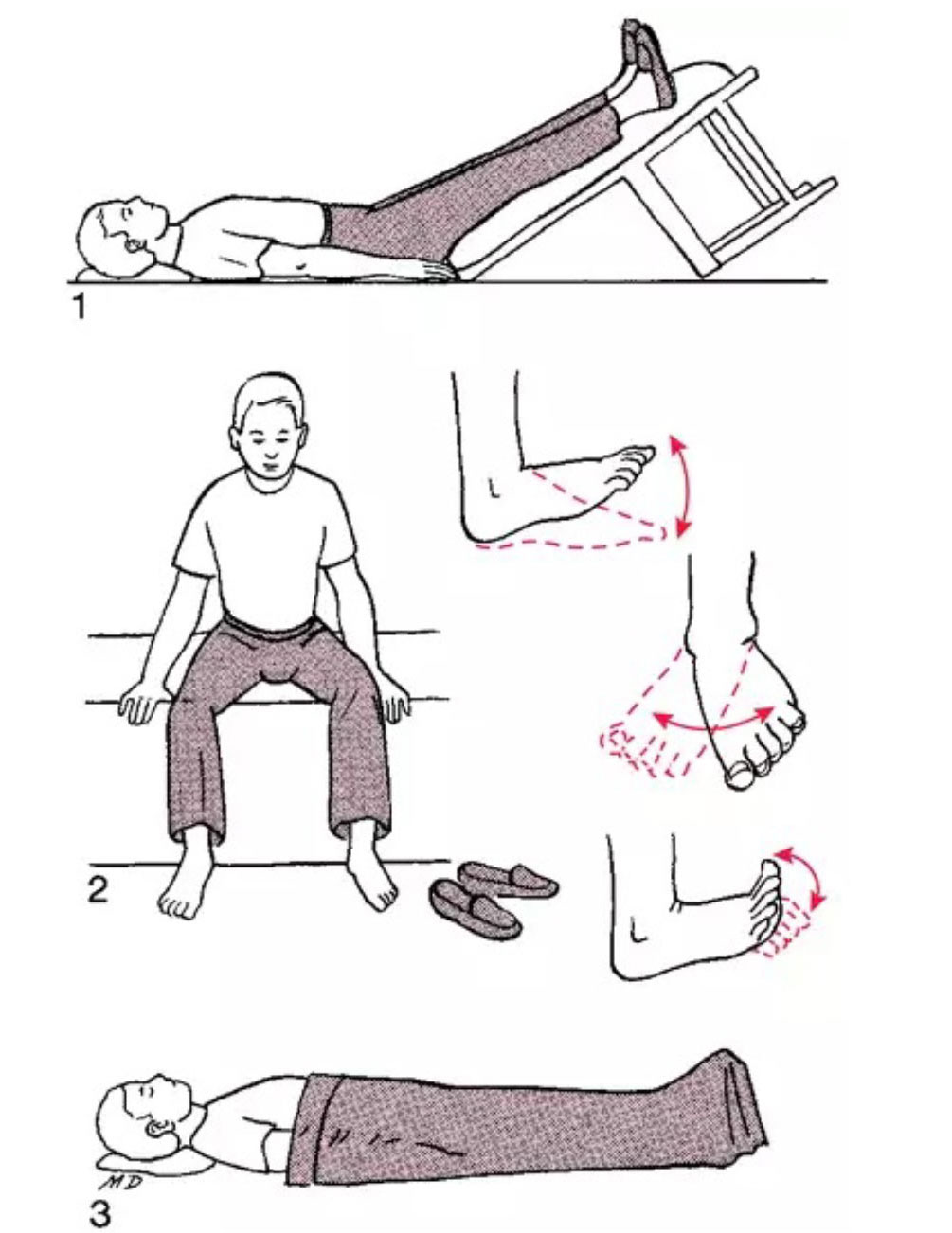
1. In the first step, the lower extremities were elevated to a 45-90 degree angle and supported in the same position for 5 minutes until the skin became pale.
2. In the second step, the patients were made to sit in a relaxed position with their feet and legs rested below the level of the remaining parts of their body and performed individual foot flexion/extension and then pronation/supination for 5 minutes until redness appeared.
3. The third step was horizontal positioning, and the patient was asked to lie down quietly for 5 minutes with both their legs rested on the bed .
Image from Black and Matassarin-Jacobs, 1997.
By Ahmad Mahdi Ahmad, Akram Abdel-Aziz, Walaa Anwar Mohamed Khalifa, and Alaa Abulfotouh Mohammed
People with diabetes suffer from serious micro and macrovascular complications of the disease with negative effects on blood flow and lower extremity sensation. Drug therapy alone might be insufficient to prevent or treat these health problems, and patients may need complementary therapy. Exercise therapy is an essential part of the treatment plan for diabetes mellitus and can complement drug treatment. Buerger-Allen exercises have recently become an evidence-based form of exercise to improve peripheral blood flow in people with diabetes. This short report briefly reports the clinical benefits of Buerger-Allen exercises.
Patients with diabetes mellitus, particularly those with poor glycemic control, often have impaired blood flow in the lower extremities and an increased risk of foot ulcers, gangrene, or amputations. Buerger-Allen exercises can improve peripheral blood flow in patients with diabetes mellitus.1 The Buerger-Allen exercises was first described by Leo Buerger in 1926 and later modified by Arthur Allen in 1930.2
Buerger-Allen exercises are active postural exercises in which gravity alternately deflates and fills blood vessels to increase blood flow to the lower limbs.3 The Buerger-Allen exercises includes several stages as follows: (a) The patient lies supine with the leg raised 45 degrees and 60 degrees using a pillow and performs ankle motion for 3 minutes or until the feet become pale; (b) Then, the patient sits on the edge of the bed with his/her feet dangling over and performs dorsiflexion and plantar flexion and moves legs in and out for 3 minutes; (c) Finally, the patient lies supine, covered with a blanket, for 3 minutes.4 The entire cycle can be repeated 3 to 6 times per session and each session can be repeated 3 times per day.4 Impaired blood flow in the lower extremities can be identified by measuring the ankle-brachial index (ABI), a standard non-invasive method of assessing blood flow to the lower extremities, which is the ratio of the higher of the two systolic blood pressures of either dorsalis pedis artery or posterior tibial artery, and the higher of the two systolic blood pressure values of the upper extremities.5 A circulatory disorder can be identified with an ABI value below 0.90 and a severe circulatory disorder can be identified with an ABI value below 0.4.5 However, in patients with diabetes and those on dialysis, the ABI may be an invalid method due to the presence of arterial calcification, and in such case, the toe-arm index should be used instead.
Discussion
The clinical benefits of Buerger-Allen exercises can be listed as follows:
(a) a reduction in the risk of neuropathy in people with diabetes;6
(b) a reduction in symptoms of peripheral neuropathy in patients with diabetes;7
(c) an increased ABI in people with diabetes;8
(d) a reduction in capillary filling time in the lower extremities of people with diabetes;9
(e) improvements in peripheral pulse, temperature and skin color in patients with type 2 diabetes;9
(f) an increase in peripheral blood flow in patients with diabetic foot ulceration as evidenced by increased skin perfusion pressure;10
(g) an improvement in wound status in people with diabetic foot ulcers;11 and
(h) elevated peripheral oxyhemoglobin, required for proper healing in patients with diabetic foot ulcers.12
The mechanism of Buerger-Allen exercises involves the use of gravity to alternately empty and fill the columns of blood through the blood vessels of the lower extremity.2 Benefits of Buerger-Allen exercises can include ease of use and learnability, safety, no cost, suitability for home care programs, less physical stress, and time efficiency.
Conclusion
Buerger-Allen exercises have numerous advantages and benefits and may be of clinical importance for people with diabetes who have impaired blood flow to the lower extremities and/or peripheral neuropathy. Clinicians and other health care professionals who deal with people with diabetes may consider implementing Buerger-Allen exercises into the treatment plan for diabetes mellitus.
Ahmad Mahdi Ahmad is with the Department of Physical Therapy for Cardiovascular and Respiratory Disorders at the Cairo University in Giza, Egypt.
Akram Abdel-Aziz is with the Department of Physical Therapy for Cardiovascular and Respiratory Disorders at the Cairo University in Giza, Egypt.
Walaa Anwar Mohamed Khalifa is with the Endocrinology Unit of the Internal Medicine Department at Assuit University in Upper Egypt.

Alaa Abulfotouh Mohammed is with the Department of Physiotherapy in the Assiut General Hospital in Upper Egypt.
This is an edited reprint of an article with the same title by the same authors. It originally appeared in the Archives of Medical and Clinical Research in January 2022: DOI: http://dx.doi.org/10.51941/AMCR.2022.2104. Style editing has occurred. Use is per CC Attribution 4.0 International License.
- Thakur A, Sharma R, Sharma SK, Thakur K, Jelly P. Effect of buerger allen exercise on foot perfusion among patient with diabetes mellitus: A systematic review & meta-analysis. Diabetes & Metabolic Syndrome. Diabetes Metab Syndr 2022; 16: 102393.
- Chang C, Chang C, Chen, M. Effect of Buerger’s Exercises on Improving Peripheral Circulation: A Systematic Review. Open J Nurs 2015; 5: 120-128.
- John J and Rathiga A. Effectiveness of Buerger-Allen exercise to improve the lower extremity perfusion among patients with type 2 diabetes mellitus. Int J Curr Res Acad Rev 2015; 3:252-63.
- Trisnawati I, Sudiana IK, Supriyanto S. Effect of Leg Exercise on the Lower Limb Circulation of Patients with Diabetes Mellitus: A Systematic Review. Jurnal Ners 2020 7; 15: 497-507.
- Rac-Albu M, Iliuta L, Guberna SM, Sinescu C. The role of ankle-brachial index for predicting peripheral arterial disease. Maedica (Buchar) 2014; 9:295e302.
- Widia C and Hidayat R. Literature Review: Foot Exercise Prevents the Risk of Neuropathy on Diabetes Mellitus Patient: Foot Exercise Prevents the Risk of Neuropathy on Type 2 Diabetes Mellitus Patient. Jurnal Keperawatan Komprehensif (Comprehensive Nursing Journal) 2021; 7.
- Radhika J, Poomalai G, Nalini S, Revathi R. Effectiveness of Buerger-Allen Exercise on Lower Extremity Perfusion and Peripheral Neuropathy Symptoms among Patients with Diabetes Mellitus. Iran J Nurs Midwifery Res 2020; 25:291-295.
- Zahran W, Hassanen A, Nabih M, Kyrillos F. Effect of Buerger Allen exercise on lower limb perfusion among patients with type 2 diabetes mellitus. Mansoura Nursing Journal 2018; 5: 101-111.
- El Sayed RAE, Abd Elsalam SN, Elmetwaly RM. Effect of Buerger- Allen Exercise on Lower Extremities Perfusion among Patients with Type 2 Diabetes Mellitus. Egyptian Journal of Health Care 2021; 12: 555-572.
- Chang CC, Chen MY, Shen JH, Lin Y Bin, Hsu WW, Lin BS. A quantitative realtime assessment of Buerger exercise on dorsal foot peripheral skin circulation in patients with diabetes foot. Medicine (Baltim) 2016; 95:46(e5334).
- Lin BS, Chang CC, Su CL, Li JR, Chen ML, Chen MY, Huang YK. The assessment of Buerger’s exercise on dorsal foot skin circulation in patients with vasculopathic diabetic foot ulcer by using wireless near-infrared spectroscope: a cohort prospective study. Laser Med Sci 2018; 33: 977e82.
- Chen ML, Lin BS, Su CW, Lin YB, Chen MY, Shen JH, Chang CC. The application of wireless near infrared spectroscopy on detecting peripheral circulation in patients with diabetes foot ulcer when doing Buerger’s exercise. Laser Surg Med 2017; 49:652e7.