







By Yuta Koshino, Tomoya Takabayashi, Hiroshi Akuzawa, Takeshi Mizota, Shun Numasawa, Takumi Kobayashi, Shintarou Kudo, Yoshiki Hikita, Naoki Akiyoshi, and Mutsuaki Edama
It is necessary to identify measurement methods that can detect greater ankle dorsiflexion range of motion limitation in patients with foot and ankle injuries.

Figure 1: Four measurements of DROM. (A) NWB with knee extended; (B) NWB with knee flexed 90 degrees; (C) WB angle measurement; and (D) WB distance measurement.
In clinical practice, ankle dorsiflexion range of motion (DROM) is commonly assessed in patients with foot and ankle injuries (eg, fractures, ligament, and tendon injuries). To date, DROM has been assessed using a variety of methods, including knee extension, knee flexion, weight bearing (WB), and non-weight bearing (NWB) positions. For example, DROM limitation during knee extension can be attributed primarily to the gastrocnemius muscle. If the limiting factor is something other than the gastrocnemius muscle, measurements in knee extended position may not adequately detect the limitation to DROM. In addition, DROM limitations may be more evident in the WB than in the NWB position, because DROM is significantly greater in the WB than in the NWB position. In the WB position compared to the NWB position, greater ankle moment and a greater contribution of foot motion are thought to lead to greater DROM. However, for patients with foot and ankle injuries, it remains unclear which assessment methods are more likely to detect dorsiflexion limitation. If DROM is not assessed with appropriate measurement methods, it could lead to underestimating or overlooking DROM limitations, which in turn will lead to inappropriate treatment programs.
Toward this end, this study aimed to: (1) identify assessment methods that can detect greater ankle DROM limitation in the injured limb; (2) determine whether differences in WB measurements exist even in the absence of DROM limitations in the injured limb according to NWB measurements; and (3) examine associations between DROM in the WB and NWB positions and compare those between a patient group with foot and ankle injuries and a healthy group.
Methods
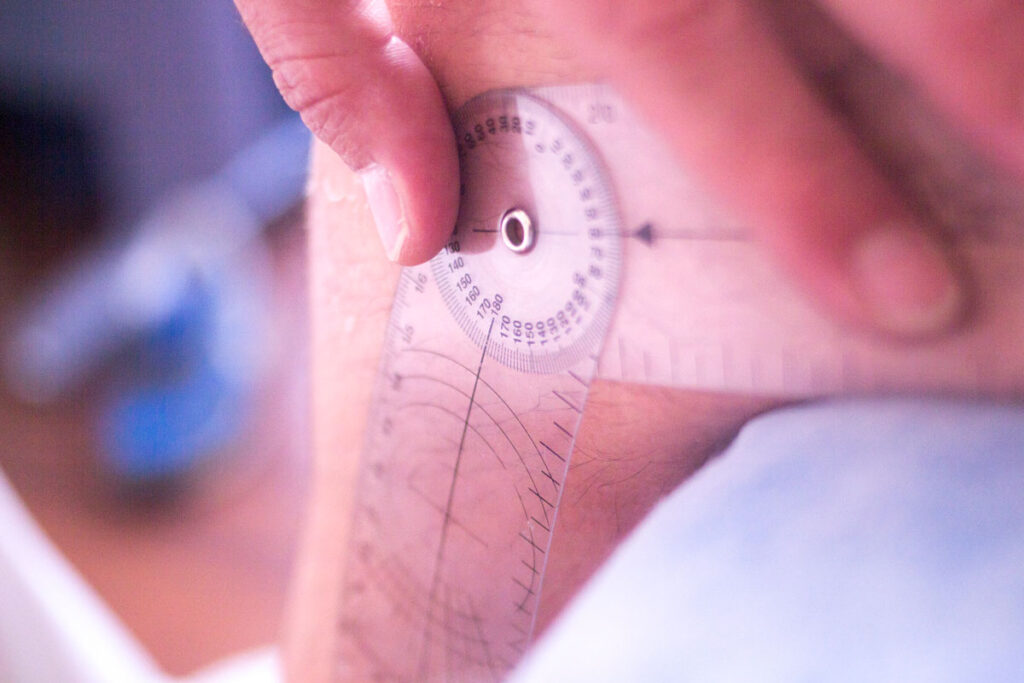
Eighty-two patients with foot and ankle injuries (eg, fractures, ligament, and tendon injuries) and 49 healthy individuals participated in this study. Height, weight, and sex ratio did not differ significantly among the groups, while age was significantly higher patient group (mean, 45.5 years) than in the healthy group (mean, 26.3 years). NWB DROM was measured under 2 different conditions: prone with knee extended and prone with knee flexed 90 degrees. WB DROM was measured as the tibia inclination angle (weight bearing angle) and distance between the big toe and wall (WB distance) at maximum dorsiflexion—the lunge test. (Figure 1.) The effects of side (injured, uninjured) and measurement method on DROM in the patient groups were assessed using 2-way repeated-measures ANOVA and t-tests. Pearson correlations between measurements were assessed. In addition, the study authors analyzed whether patients without NWB DROM limitation (≤ 3 degrees) showed limitations in WB DROM using t-tests with Bonferroni correction.
Results
For the patient group, significant main effects of measurement method (P < 0.001), side (P < 0.001), and interaction (P < 0.001) were found for dorsiflexion angle. For the between-side differences, post hoc analysis revealed that dorsiflexion angles differed significantly between injured and uninjured sides in NWB with knee extension, NWB with knee flexion, and WB angle (P < 0.001). For differences between measurement methods, dorsiflexion angles were significantly greater for NWB with knee extension, NWB with knee flexion, and WB angle, in ascending order (P < 0.001). For WB distance, distances between the injured and uninjured sides also differed significantly (P < 0.001). The effect size of differences in DROM measurements between injured and uninjured sides in each measurement method was largest for WB angle (d = 0.95).
In the patient group, 48 patients showed no DROM limitations in NWB with knee extension. These patients showed significant differences in DROM measurements between the injured and uninjured sides for all NWB with knee flexion, WB angle, and WB distance (P < 0.001). Effect sizes of the difference were large for WB angle and WB distance (d = 1.06 and 1.02). In NWB with knee flexion, 37 patients showed no dorsiflexion limitation. These patients showed significant differences in DROM measurements between injured and uninjured sides in WB angle and WB distance, and the effect sizes of these differences were large (P < 0.001, d = 0.98 and 0.97.)
In the patient group, NWB with knee extension showed no correlation with WB angle (R = 0.17, P = 0.123) and a significant but weak correlation with WB distance (R = 0.26). NWB with knee flexion correlated moderately with both WB angle and WB distance in the patient group (R = 0.45 and 0.49). The Healthy group showed moderate to strong correlations (R = 0.51–0.69). In the comparison of correlation coefficients, the correlation of dorsiflexion angles in NWB with knee extension and WB angle was significantly smaller in the patient group than in the healthy group (P = 0.013.)
Discussion
 The main findings of this study were: (1) differences in DROM between injured and uninjured sides were significant for all measures, and the effect size was greater in the WB position in the patient group; (2) even in patients with no difference in DROM between injured and uninjured sides in the NWB position, the difference was significant and large in the WB position; and (3) correlations between measurements in the NWB and WB positions tended to be weak in the patient group compared to the healthy group.
The results of each measurement method suggest that a large difference in DROM between the legs can be detected in NWB with knee flexion, WB angle, and WB distance in the patient group. In the patient group, the difference between legs was increased by knee flexion in the NWB position, suggesting that factors other than the gastrocnemius muscle may be more involved in DROM limitations. In addition, in the WB position, greater torque is applied to the ankle, and the effects of other joint motions (eg, subtalar and midtarsal joints) and muscle activity due to loading may contribute to greater limitations on DROM. Measurement in the WB position would be recommended because DROM limitations may be overlooked when measurements are obtained only in the NWB position.
Even among patients with no DROM limitations in the NWB position, limitations were observed in the WB position. This finding suggests that assessing DROM only in the NWB position is inadequate and that assessment of DROM in the WB position is necessary. This finding also suggests that DROM limitations may have improved in the NWB position, but not yet in the WB position. Intervention programs following foot and ankle injuries would need to be designed while keeping in mind the possibility of residual DROM limitations in the WB position.
The correlation between measurements in the NWB and WB positions tended to be weak in the patient group, unlike in the healthy group. The correlation coefficient between NWB with knee extension and WB position was particularly weak, and that in the patient group was significantly smaller than that in the healthy group. Correlations for the healthy group were moderate to strong (R = 0.60–0.67), suggesting that DROM in the NWB and WB positions assesses different phenomena. The study authors’ findings suggest that foot and ankle injuries further confound the association between DROM in the NWB and WB positions. This may be because injuries result in different factors limiting dorsiflexion than those seen in healthy individuals. The results suggest that DROM assessment differs between NWB and WB positions, particularly in those with foot and ankle injury.
Regarding clinical relevance, DROM should be measured in NWB and WB positions in patients with foot and ankle injuries, because these measurements do not correlate and may assess different DROM limiting factors. It should also be noted that measuring only at the NWB position is not sufficient. This is because even if the DROM is not restricted in the NWB position, it may be restricted in the WB position. In addition, clinicians may need to intervene to account for the possibility of more residual DROM limitations in the WB position in patients with foot and ankle injuries.
Conclusions
DROM limitations due to foot and ankle injuries may be overlooked if measurements are only taken in the NWB position and should also be measured in the WB position. Furthermore, DROM measurements in NWB and WB positions may assess different characteristics, particularly in the patient group.
Yuta Koshino, PhD, PT, faculty of Health Sciences, Hokkaido University, Sapporo, Japan.
Tomoya Takabayashi, PhD, faculty of Rehabilitation/Department of Physical, Therapy Institute for Human Movement and Medical Sciences, Niigata University of Health and Welfare, Niigata, Japan.
Hiroshi Akuzawa, PhD, PT, Institute for Human Movement and Medical Sciences, Niigata University of Health and Welfare, Niigata, Japan.
Takeshi Mizota, Department of Rehabilitation, Soejima Orthopedic Hospital, Takeo, Saga, Japan
Shun Numasawa, Department of Rehabilitation, Takarazuka University of Medical and Health Care, Takarazuka, Japan.

Takumi Kobayashi, faculty of Health Science, Hokkaido Chitose College of Rehabilitation, Chitose, Japan.
Shintarou Kudo, Inclusive Medical Sciences Research Institute, Morinomiya University of Medical Sciences, Osaka, Japan; Graduate School of Health Sciences; and AR-Ex Medical Research Center, Tokyo, Japan. Yoshiki Hikita, Aruck Lab, Osaka, Japan.
Naoki Akiyoshi, Department of Rehabilitation, J Medical Oyumino, Chiba, Japan.
Mutsuaki Edama, professor, Institute for Human Movement and Medical Sciences, Niigata University of Health and Welfare, Niigata, Japan.
This article has been excerpted from “Differences and relationships between weightbearing and non-weightbearing dorsiflexion range of motion in foot and ankle injuries.” J Orthop Surg Res 19, 115 (2024). https://doi.org/10.1186/s13018-024-04599-x. Editing has occurred, including the renumbering or removal of tables, and references have been removed for brevity. Use is per CC Attribution 4.0 International License.