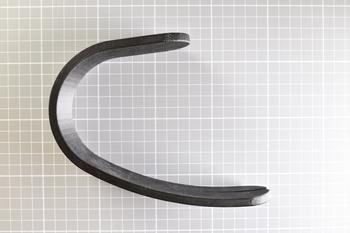
A 3D-printed running blade prototype, created using the technique Sanders and his colleagues are developing.
George Mason University, Fairfax, Virginia, researcher Quentin Sanders is part of a collaborative research team working to make high-performance prosthetic limbs more affordable, accessible, and better tailored to the needs of active children. Sanders, along with Jonathon Schofield, an associate professor at the University of California, Davis, and Garrett Melenka, an associate professor at York University, Toronto, Canada, received a 3-year, $500K grant from the National Science Foundation to support the project.
The research team has several goals, starting with identifying what children truly need from an activity-enabling prosthesis. The researchers are examining how motivation to be active, physical growth, and different types of movement influence prosthetic performance in everyday settings. They are also analyzing how children move while using their current running blades, studying activities such as running, jumping, and changing direction to better understand the biomechanics and physical demands involved. Finally, the team will take a close look at how today’s running blades perform under real-world demands.
Sanders and his collaborators are using an advanced additive manufacturing approach known as continuous-fiber 3D printing, in which carbon fibers are embedded within the printed plastic to reinforce the prosthetic structure. This method enables the creation of strong, lightweight devices that can be tailored to a child’s size, growth, and activity needs. The technique is already used to produce strong, lightweight components in the aerospace and automotive industries, but it has seen limited adoption in prosthetic design. This project represents one of the first efforts to apply it systematically to activity-enabling prostheses for children.