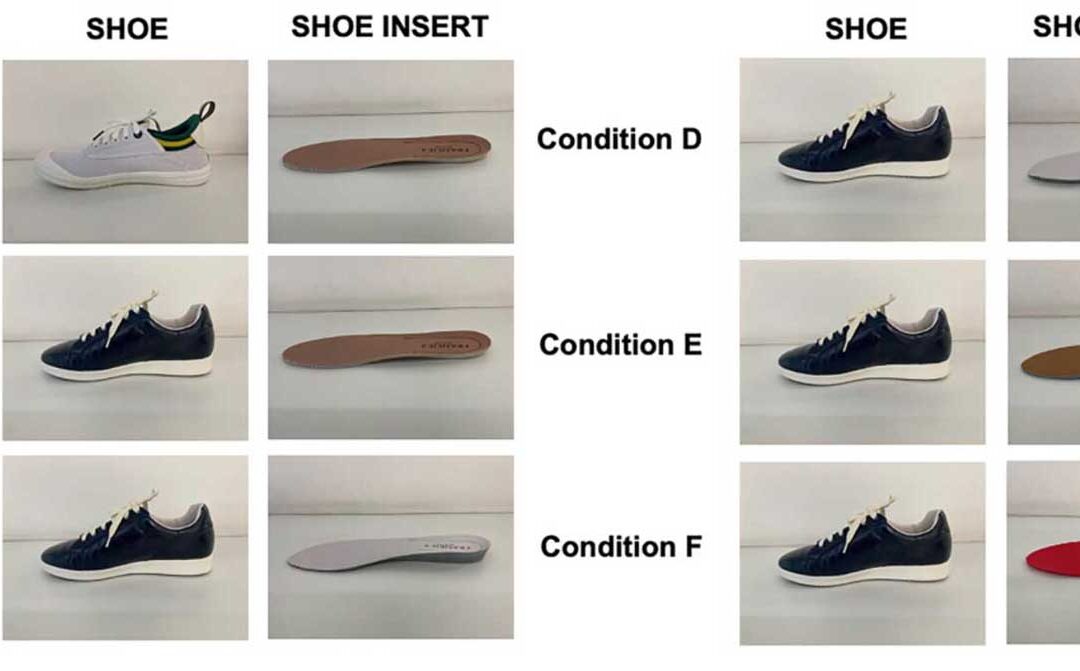








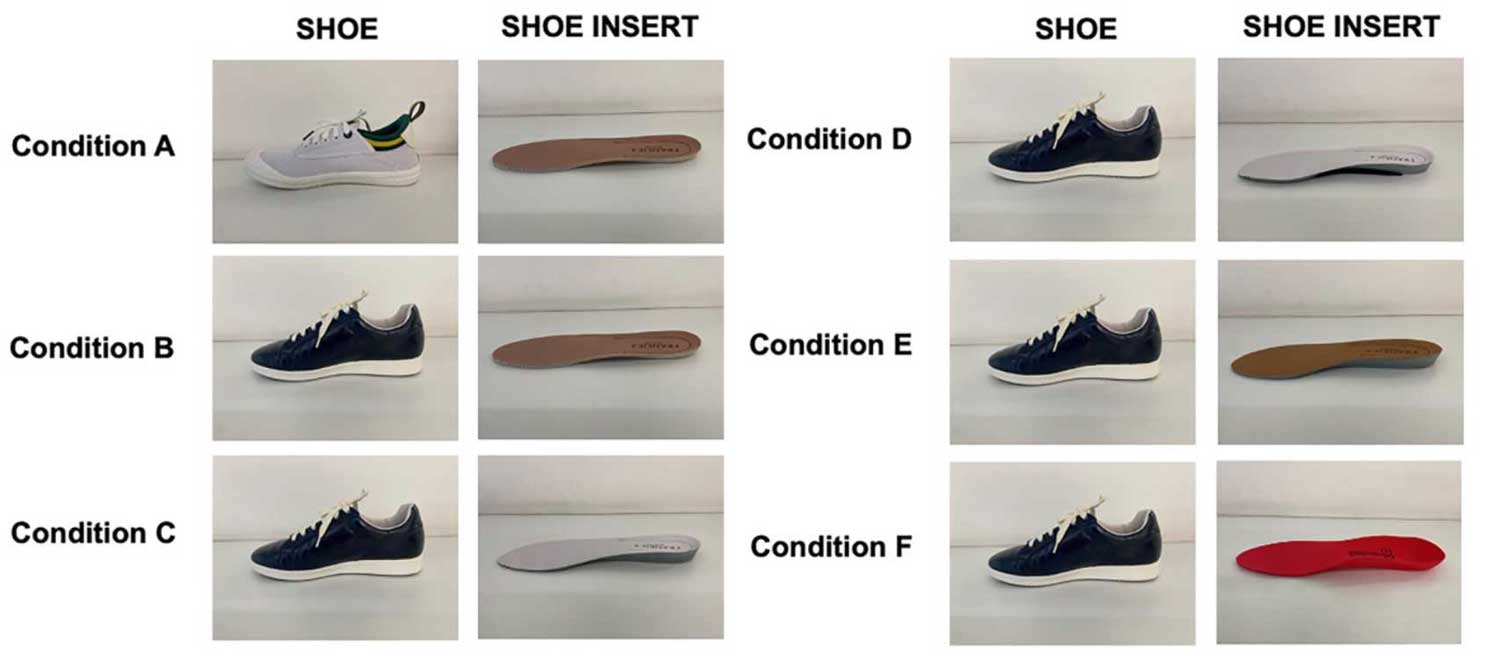
Figure. Shoe and insert conditions. The test shoe was a lace-up sneaker with leather upper, 14-mm heel-toe pitch and dual-density molded polyurethane outsole (Jackie sneaker, FRANKIE4, Australia). The control shoe was an athletic lace-up sneaker with canvas upper, 4-mm heel-toe pitch and rubber outsole (Dunlop Volley, Pacific Dunlop Ltd., Melbourne, Australia). Condition A: Control shoe (Dunlop Volley) with a flat low-density ethylene vinyl acetate foam insert (FRANKIE4 Flat + Lite Footbed). Condition B: Test shoe (Jackie sneaker, FRANKIE4) with a flat low-density ethylene vinyl acetate foam insert (FRANKIE4 Flat + Lite Footbed). Condition C: Test shoe (Jackie sneaker, FRANKIE4) with a molded contoured dua-density insert (FRANKIE4 Sole Hero Footbed). Condition D: Test shoe (Jackie sneaker, FRANKIE4) with a molded contoured dua-density insert (FRANKIE4 Sole Hero Footbed) with a molded contoured thermoplastic rubber piece at midfoot (FRANKIE4 Arch Peace). Condition E: Test shoe (Jackie sneaker, FRANKIE4) with a molded contoured bio-derived polyurethane (PU) dual-density insert (FRANKIE4 Sole Hero Bio PU Footbed). Condition F: Test shoe (Jackie sneaker, FRANKIE4) with a molded contoured polyethylene foam insert (Formthotics).
Footwear is often recommended in the management of plantar heel pain (PHP), theoretically to reduce tissue stress during standing and walking. However, limited data exist to guide footwear design and recommendations. The aim of this study was to investigate the effect of both shoe and shoe insert designs on in-shoe plantar pressures, vertical ground reaction force and underfoot comfort in individuals with PHP.
Plantar pressures, impact forces and comfort during walking were recorded in 29 women with PHP (mean age 47 ± 12 years) in 6 randomized shoe and insert conditions. A test shoe (polyurethane outsole, 14–mm heel–toe pitch) was compared to a control shoe (rubber outsole, 4–mm heel–toe pitch), and within the test shoe, five different insoles that varied by material, density and arch contouring were also compared.
The test shoe reduced heel peak pressure (15%, P< 0.01) and reduced the loading rate but not the peak magnitude of the vertical ground reaction force (average loading rate reduction: 7%, P < 0.01; maximum loading rate: 29%, P < 0.01) and was more comfortable (47%–67%, P < 0.01) compared to the control shoe. Within the test shoe, dual-density inserts with arch contouring showed lower heel peak pressure compared to a lightweight flat insert (11%–12%, P < 0.03). The insert with the firmest material and higher arch contouring showed higher midfoot peak pressure (16%–21%, P < 0.01) compared to other inserts. Forefoot peak pressure did not differ between shoe or insert conditions (P > 0.05). There were no differences in impact forces or comfort between the different inserts within the test shoe (P > 0.05).
Findings suggest that shoe and insert properties are both important and provide data to guide footwear design and management recommendations for PHP.
Source: Franettovich Smith MM, van den Hoorn W, van den Hoek A, Kerr G, Hurn SE. Immediate effects of footwear design on in-shoe plantar pressures, impact forces and comfort in women with plantar heel pain. J Foot Ankle Res. 2025;18: e70055. DOI: 10.1002/jfa2.70055. https://doi.org/10.1002/jfa2.70055.