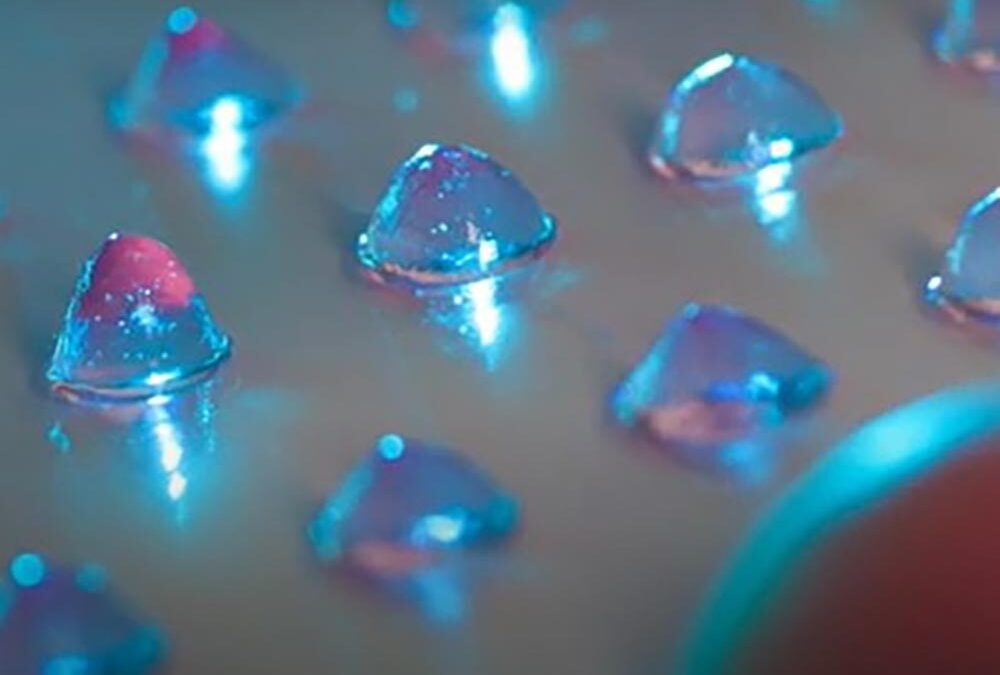








Image courtesy of Jeffrey C. Chase/UD.
The U.S. Food and Drug Administration has approved 2 new wound management products that include patented hydrogels invented by University of Delaware (UD) material scientist Darrin Pochan, PhD, and Joel Schneider, PhD, a former UD faculty member now at the National Cancer Institute. The unique hydrogel materials are made of peptides—the building blocks of proteins—that self-assemble to form a 3D matrix and are compatible with living cells. The consistency of jelly, the unique materials are useful for a variety of applications.
Gel4Med, a Harvard University-based biomaterials engineering company, licensed 4 patents related to the technology via UD’s Office of Economic Innovation and Partnerships (OEIP) in 2018. The company incorporated the UD-developed hydrogels into 2 products, G4Derm and G4Derm Plus, that have been intentionally designed to speed healing by combatting bacterial and fungal infection while simultaneously promoting tissue regrowth.
Gel4Med is currently piloting the products in healthcare settings in the United States. According to Gel4Med CEO Manav Mehta, the needs in the clinic are vast and advances in biomaterials are needed. Antibiotic resistance is a huge problem. Wound closure also is a major issue. Traditionally, pharmaceutical companies and wound care companies approach these problems independently.
“But a wound is a 2-sided problem,” Mehta said. “You have an infection problem, which is managing the bioburden, but also a wound-closure problem.”
Current antimicrobials on the market are generally designed to sterilize everything they encounter. Placed on an open wound, this means that while killing bacteria, an antimicrobial also may exert a toxic effect on healthy cells that are participating in wound closure. This is where G4Derm and G4Derm Plus are different—and where UD’s technology makes it mark.
The UD-patented biomaterials included in the products are inherently antimicrobial and flow in such a way that allows the product to reach wounds with crevasses and uneven topography, often missed by traditional sheet form products. The product has the ability to remain in place over long time-periods, too, before gradually being absorbed by the body, creating a natural scaffold on which tissue can regenerate and grow. Another feature that set the UD-developed biomaterials apart is that the hydrogel extrudes as a liquid and immediately regains its 3D structure at the molecular level after application.
Mehta pointed to Pochan and Schneider’s approach and intellect around peptide design as critical to Gel4Med’s ability to advance such an industry-disrupting solution. “It’s not just an innovation problem that they solved from a broad-spectrum antimicrobial perspective, but also other aspects from a commercialization standpoint, such as the ability to produce the hydrogels economically at-scale and the ability to build a simplified supply chain due to this innovative materials science approach,” he said.
Peptides and proteins typically degrade and break down under high heat, but the UD-developed peptides fold appropriately and are thermostable, allowing them to resist degradation at very high temperatures, an advantage over other materials in the marketplace. This allows them to be sterilized using steam as a final step in manufacturing, which enables a potentially safer and more environmentally friendly manufacturing approach, as well as the ability to use the product in various settings of care from operating rooms to the bedside.