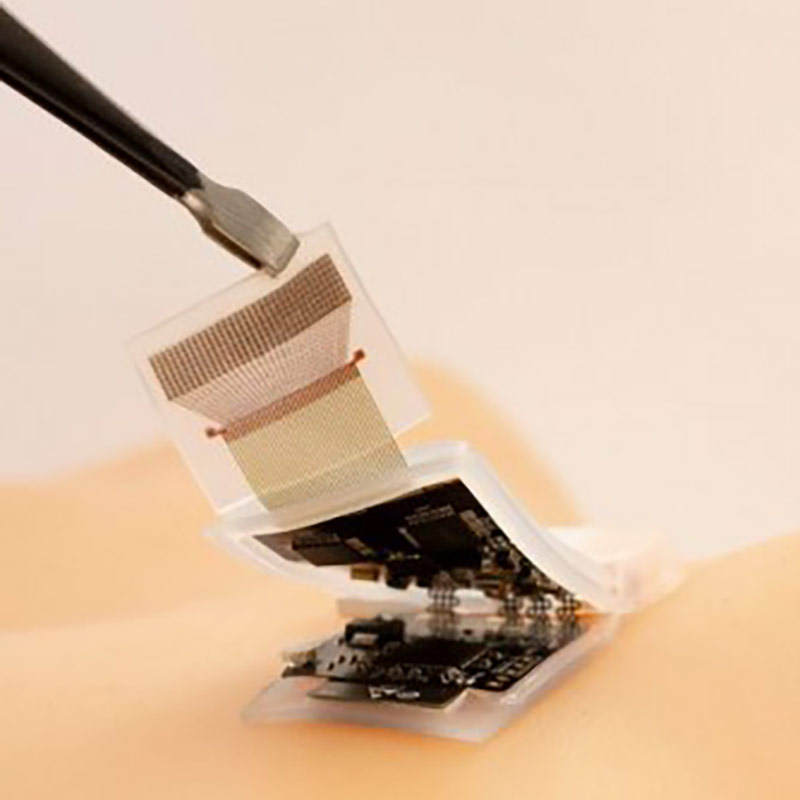
A view of the ultrasound probe and the interior of the circuit. Image courtesy of Xu lab at UC San Diego.
Wearable ultrasound patches have the potential to revolutionize health care, facilitating the remote monitoring of critical physiological functions in the comfort of a patient’s home. But most patches in development have a major limitation: they require cables to power the device and transmit the ultrasound data, physically tethering the wearer to a control system. That is, until now.
A fully wireless ultrasound patch that can continuously track critical vital signals such as heart rate and blood pressure was pioneered by Sheng Xu, PhD, an associate professor and Jacobs Faculty Scholar at the University of California San Diego (UC San Diego). The patch, which can capture detailed medical information and wirelessly transmit the data to a smart device (such as a laptop or smartphone), could represent a major step forward in at-home health care technology.
The ultrasound system is composed of a probe, a circuit, and a battery. The probe is attached to a flexible circuit, which activates the ultrasound transducers, collects the ultrasound echoes, amplifies and filters these echoes, and transmits the digitized signal to a terminal device. The entire system is powered by a commercial rechargeable lithium polymer battery.
While the device was mainly evaluated on its ability to monitor cardiovascular functions, the researchers also demonstrated that the patch can be applied to the abdomen for diaphragm monitoring or to limbs for peripheral artery monitoring. “The system holds the potential to perform measurements at multiple spots in the body, and we can easily tailor the probe design to fit diverse tissue monitoring requirements,” said Xu.