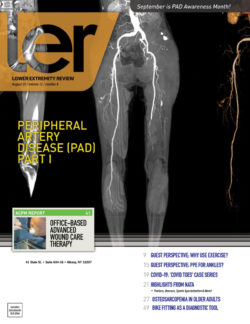
Click on image to download the issue in PDF format
Cover Story

This 2-part series examines the current state of peripheral artery disease. This article focuses on disease burden, risk factors, and clinical presentation. Part 2, which will appear next month, will examine current recommendations for diagnosis and treatment.
By Aisha Cobbs, PhD

With existing knowledge, much of the cardiovascular risk burden of peripheral artery disease (PAD) is preventable. PAD is a common atherosclerotic syndrome that is estimated to affect 12.5 million Americans and 237 million people worldwide.1 One in five Americans over the age of 65 has PAD.2 Based on national treatment patterns, more than half of ...
Guest Perspectives

It’s been a tough few weeks for exercise in healthcare, both on social media and in the literature. A recent systematic review1 has shown it provides little to no benefit for acute low back pain. Then a popular blogger called it ‘snake oil’ and a ‘dirty word.’2 And finally, a discussion on twitter questioned my ...

Workplace safety, the right to be safe in your workplace and while going about the activities of your work, was certainly a thing before the COVID-19 pandemic struck. However, the pandemic laid bare some of the realities of the workplace that so many of us never even thought about. I’m talking, of course, about Personal ...
Feature Articles
Bone loss (osteopenia/osteoporosis) and loss of muscle mass and function (sarcopenia) are two of the most prevalent chronic conditions among aging adults. However, the mention of osteosarcopenia might garner a few puzzled looks. This relatively new term describes a geriatric syndrome in which osteopenia/osteoporosis and sarcopenia overlap in the same individual.
By Aisha Cobbs, PhD
As diabetic foot ulcers plague more patients, wound care management—including a host of new technologies—are driving an increase in office visits. Diabetes mellitus is the leading cause for nontraumatic amputation. Since 1980, the number of people with diabetes around the world has nearly quadrupled, from 108 million to nearly 422 million in 2014—and it continues ...
Like a good medical exam, a medical bike fit starts before the patient ever gets on the bike. Talking with cycling patients before any assessments can facilitate the diagnostic process. Bike fitting is a service that has been offered in bike shops and studios for decades. Bike fitting is also a medical service offered by ...
From the COVID-19 Frontlines

As the COVID-19 pandemic continues to rage, so-called “COVID toes” continue to be reported around the world. These dermatologic manifestations were catalogued in a recent international registry-based case series, adding to the emerging evidence that pernio-like lesions may be a cutaneous manifestation of COVID-19.
Highlights from NATA
National Athletic Trainers’ Association Virtual Clinical Symposia & AT Expo July 13-17, 2020

Baton twirling, which has been around in some form since military groups first twirled torches and rifles, is evolving into a highly competitive sport, drawing ever larger numbers of youth athletes. Today’s twirling is a unique performance-based sport that emphasizes strength, athleticism, and artistry. It requires fine coordination of fingers, hands, arms, feet, and legs, ...

Dancing can be a beautiful work of art, a great form of exercise, or a fun leisure activity. But increasingly, it is also the cause of injuries requiring an emergency room visit. Such visits rose by 22.5% from 2014 to 2018, according to new research presented at the 2020 NATA Virtual Clinical Symposia & AT ...

Movement control, the ability to control one’s own movements, is required for the development of motor skills and motor skills (also known as “physical literacy”) are critical for normative development. Movement skills help children improve their strength, posture, balance, and sleep, and play in role in developing confidence. Age-appropriate movement control may play a factor ...

Early sports specialization appears to take an even greater toll on young females than previously thought. Research presented at the recent 2020 NATA Virtual Clinical Symposia & AT Expo suggests that prior sports specialization is associated with an increased risk of a lower extremity stress fracture in female U.S. Service Academy cadets, but not males ...
Industry News & Updates