Download the Complete issue as a PDF (6.2 mb)
Cover Story

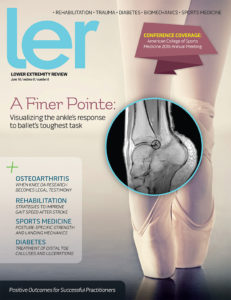
The use of detailed orthopedic imaging to examine dancers’ ankles while in the en pointe position offers insight into the biomechanical demands associated with a position that, although highly unnatural, is nevertheless essential to a ballerina’s performance.
By Jeffrey A. Russell, PhD, AT, FIADMS
Editor Message

Listening to what patients have to say is an important part of healthcare. But,
as research continues to demonstrate, it’s no substitute for objective measurements.
By Jordana Bieze Foster
LER Foot Health
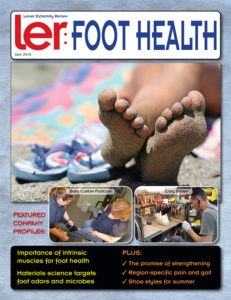 Small muscles, huge potential
In recent years there’s been a lot of study and discussion—some of it quite contentious—of the relative merits of running barefoot, in minimalist shoes, or with various foot-strike patterns. But it seems to me that these debates are distracting foot specialists from a more important aspect of this research: the clinical implications of intrinsic foot muscle weakness.
Departments

With the rise of a new crop of young stars and the anticipation of its Olympic debut this year, golf continues to be immensely popular for players and spectators alike. Golfing is a highly coordinated sport that, by its nature, is associated with risk of…
By Patricia Pande, MClScPT, CSCS, CPed

In worker’s compensation cases, including those involving knee osteoarthritis, an expert witness often will be asked to use his or her knowledge of biomechanics to provide an opinion supporting or refuting a causal relationship between work conditions and an overuse injury.
By Steven T. McCaw, PhD

Multiple techniques can help improve gait speed after stroke, from therapeutic exercise to task-specific training to orthotic devices. Despite a growing body of research in this area, however, it is still not clear which intervention is most appropriate for which patients.
By Hank Black

Recent research suggests that training designed to maximize strength at deeper knee flexion angles during landing may be warranted, especially in female athletes, to help reduce the risk of anterior cruciate ligament injury without inadvertently compromising jump height.
By Boyi Dai, PhD; Jacob S. Layer; and Taylour J. Hinshaw

When calluses or ulcers develop on the distal aspect of the lesser toes, offloading pressure from the distal end of the digit is essential for healing to occur. Research suggests that toe crest pads offer an inexpensive but effective means of offloading and healing these distal wounds.
By Monica Melo, DNP, RN, ACNS-BC, CWOCN, CFCN
News
In the Moment: Sports Medicine
The adverse biomechanical effects of concussion can persist for up to two years, but short-term visual deficits may help identify athletes who are most at risk for gait-related effects, according to multiple studies presented in…
By Jordana Bieze Foster
Preseason hip abductor strength is associated with risk of lateral noncontact ankle sprain in soccer players, according to research presented in early June at the annual ACSM meeting in Boston.
By Jordana Bieze Foster
Gluteal muscle fatigue is associated with altered upper extremity kinematics in collegiate softball players, according to findings from the University of Auburn in Alabama that add to the body of research supporting the importance of the lower body in throwing athletes.
By Jordana Bieze Foster
In the Moment: Rehabilitation

Preoperative hip mechanics during gait can enhance clinical scores for identifying patients who are less likely to have an adequate clinical response after total hip arthroplasty (THA), according to…
By Katie Bell
Preliminary findings presented in early June at the 2016 American College of Sports Medicine (ACSM) meeting in Boston suggest there may be a subgroup of athletes who are most likely to respond positively to knee bracing after anterior cruciate ligament (ACL) reconstruction.
By Jordana Bieze Foster
Among habitually shod runners with a recent history of injury, those with the greatest magnitudes of loading asymmetry are those who are most likely to become more symmetrical after switching to barefoot running, according to…
By Jordana Bieze Foster
Market Mechanics
By Emily Delzell
Products
Therafirm is releasing an addition to its new brand, Ease by Therafirm. Sheer Ease styles include open- and closed-toe knee highs, thigh highs, and pantyhose in three compression levels—mild (15-20 mm Hg), moderate…
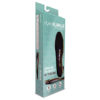
Apex introduces a prefabricated version of its custom DynaFlange orthotic support. This over-the-counter device features a rearfoot flange, which flexes at three points during heel strike to minimize the deforming effects of impact. DynaFlange orthotic supports are designed to…
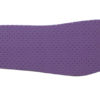
ComfortFit Labs has expanded its topcover choices to seven with its purple perforated Memory Foam Top Cover. The 1/8″ topcover forms to the contour of the foot based on heat. With perforations for improved air flow, it is designed to be both comfortable and durable…
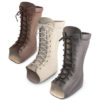
For 2016, Acor has updated its custom AFO Gauntlets, which are handmade in the company’s Cleveland, OH, facility. Also known as a “Leather Lacer,” the company’s most popular AFO (ankle foot orthosis) gauntlet is the G9210. This particular design comes with…
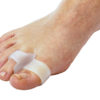
Foot specialists since 1885, PediFix now offers a new version of its popular Visco-Gel ToeBuddy for dividing crooked toes, including overlapping, hammer, claw, and mallet toes…
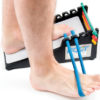
Allied OSI Labs now offers the Foot Gym Pro, an all-in-one tool for performing eight different foot and ankle strengthening and rehabilitation exercises including toe curl, toe extension, dorsiflexion, plantar fascia…
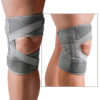
Swede-O introduces the Patella Tracker, a thermal support designed to help reduce swelling and associated pain while providing gentle counter “traction” to help prevent the patella from shifting out of position…
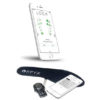
Orpyx LogR is a technology solution designed for accurate, efficient, and real-time foot and plantar pressure measurement and analysis. Featuring comfortable sensor-embedded shoe inserts, a simple but powerful iOS application, and cloud-based software…