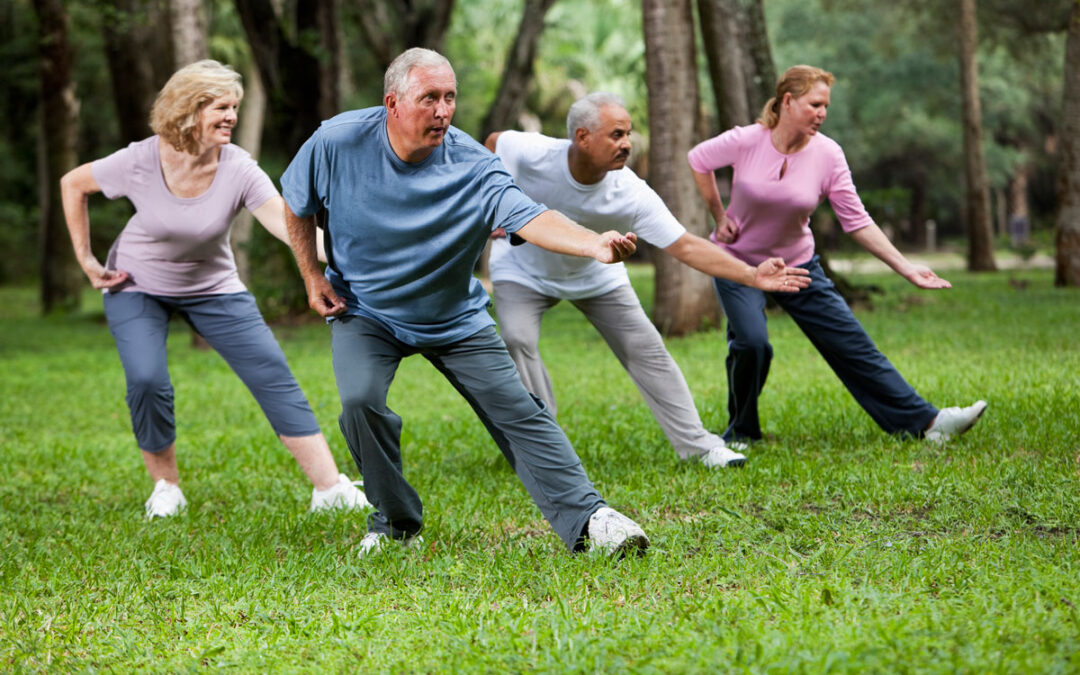








 The inaugural meeting of the Tai Chi & Qigong as Whole Person Health Conference was held in Boston, MA, in September 2023. It was hosted by the Osher Center for Integrative Medicine and jointly sponsored by the Harvard Medical School and Brigham and Women’s Hospital. Nearly 300 experts, professors, researchers, and professionals from 12 countries participated in this international gathering dedicated to the science of Tai Chi and Qigong. Select findings relevant to LER readers are listed below.
- Long-term Tai Chi (TC) training is associated with higher levels of physical function in older adults, suggesting a potential preventive healthy aging effect. One example: in a study comparing 60 TC experts vs 27 TC naïves, values for single leg stance time with eyes closed (SLST-EC) were 15.1±2.2s vs 6.6±2.1s (p<0.001). Ma Y, et al. Can Tai Chi Make Older Adults ‘Functionally Younger? OA01.02.
- Tai Chi plus usual care may improve health outcomes in patients with chronic heart failure. In particular, when compared to other exercise plus usual care, this meta-analysis found that tai chi plus usual care showed a significant benefit in the 6-min walk test (6MWT; 29.25 m, p< 0.0001). Cai Y, et al. Effects of Tai Chi Plus Usual Care for Chronic Heart Failure: A Systematic Review and Meta-Analysis of Randomized Controlled Trials. OA02.04.
- Peripheral neuropathy (PN) increases patients’ risk of falling as it impairs balance and sensory function. In a scoping review of 54 studies, 8 consistently demonstrated that TC improved participant balance as measured with the 1-leg standing test, Activities-Specific Balance Confidence scale, and Functional Reach Test. Participants also demonstrated increased sensory function as measured with the sway balance test, plantar sensory threshold, and nerve conduction. Yang M, et al. Effects of Tai Chi Plus Usual Care for Chronic Heart Failure: A Systematic Review and Meta-Analysis of Randomized Controlled Trials. OA02.04.
- Nearly 50% of veterans experience chronic pain, particularly those who suffer with Gulf War Illness (GWI). In this study, 70 vets participated in 1-hr TC classes twice/wk for 12 wks. GW Vets in the TC program exhibited significant increases in the average number of hours spent on stretching from baseline to the post-treatment (p < .001), 3 months (p = .002), and 9 months (p = .02). Feedback interviews showed that Vets appreciated TC, enjoyed the stretching components, and reported feeling increased flexibility and mobility. Busser C, et al. Tai Chi Intervention for Stretching and Flexibility in Gulf War Veterans. P02.16.
- Turo is a hybrid TC/qigong dancing program developed to relieve motor dysfunction symptoms in Parkinson’s Disease (PD) patients. This qualitative study included 7 patients who agreed to the 1-hour program, twice/week for 8 weeks. Measure Yourself Medical Outcome Profiles (MYMOP) results showed a significant increase in Well-being, Main symptoms 1 and 2, and Activeness. MYMOPs are individualized health outcome questionnaires created by participants to address their individual concerns. Lee H-J, et al. The Experience of the Turo (Qi dance) Program for Patients with Parkinson’s Disease: A Qualitative Study. P02.17.
- Three clinical practice guidelines for knee osteoarthritis (KOA) now include recommendations for Tai Chi as appropriate therapy. TC addresses the root causes of KOA by improving the biomechanical forces on the knee and decreasing inflammation, thus allowing normal healing and repair processes to resume. Huston P. How Tai Chi May Influence Cell Behaviour in Osteoarthritis of the Knee. P01.01.
- A 12-week aquatic Tai Chi exercise could significantly improve college students’ subjective and objective sleep quality. Wan X, et al. Aquatic Tai Chi’s Effect on Sleep Quality Improvement in College Students. P05.03.
Source: Journal of Integrative and Complementary Medicine. 2023;29(S2). Available at https://www.liebertpub.com/doi/10.1089/jicm.2023.29125.abstracts.