







 By Jay Blumberg, PT, DPT
Growing up playing sports, I would hear coaches call some kids “injury prone.” Now that I have my doctorate in physical therapy and work as a youth sports physical therapist, I have a different perspective on what it means to be “injury prone.” It is not just a coincidence, nor are the forces of the universe conspiring to end a child’s potential professional sports career before it has a chance to start. Kids who are more susceptible to injury share similar physical characteristics, which I often see in the clinic. Usually, these injuries are the result of a lack of coordination and strength, but there is often an underlying reason for that. These youth athletes are hypermobile.
So what is hypermobility and how do you combat it?
Contrary to popular belief, being hypermobile does not mean that one is “double jointed.” Hypermobility refers to laxity, or looseness, in the joints, allowing them to bend farther than average and, in many instances, farther than is safe for the structures of the joint. It is not unusual for most people to have laxity in some joints, but when kids have global joint hypermobility (consistent throughout the entire body), they are at much greater risk for injury.
Hypermobility is common in children: approximately 1 in every 3 is hypermobile. For the kids that step into my clinic with an injury, I would say that number is 2 out of 3. Why? Hypermobility has a genetic component, so it often runs in families.
Having increased movement in the joints isn’t always a bad thing. In fact, it is beneficial in many sports, as long as you have the strength to control that extra motion. Most – if not all – high-level gymnasts are hypermobile. These athletes use their hypermobility to their advantage, putting their bodies into incredible physical positions. The key here is adequate strength. When you are hypermobile, but don’t have the strength to control the motion, the hypermobility becomes an instability in that joint, which leads to increased chance of injury.
The other one-third of my “injury prone” patients may not be hypermobile, but they still display poor motor control/coordination, decreased single limb stability, and/or muscle weakness. (And, to be fair, some may just have bad luck.) These other physical causes revolve around a lack of stability.
Being unstable, whether due to hypermobility or not, increases the risk for injury, especially injuries that include falling and things moving out of place, such as sprains, dislocations, and fractures. Impairments I see in most kids who are hypermobile include poor balance and stability, compensatory movements, generalized muscle weakness, and having a difficult time purposely engaging specific muscle groups. These impairments are typically the root cause of the injury that brought them into the clinic in the first place. I have seen far too many injuries in the clinic that stem from young patients having weak cores or not being able to engage these muscles properly.
Injuries and pain related to core weakness include:
- Balance- and stability-related injuries such as ankle sprains, knee injuries, and falls/fractures
- Low back pain and hamstring injuries
• Both of these involve attachments to the pelvis, so if the core is not stabilizing the pelvis, these areas are required to work overtime and compensate for that decreased stability - Poor posture and postural-related impairments
• This includes scapular and deep neck flexor weakness, along with pec and upper trap tightness. Having elevated shoulders is a compensation which could even cause headaches.
Creating Better Youth Athletes
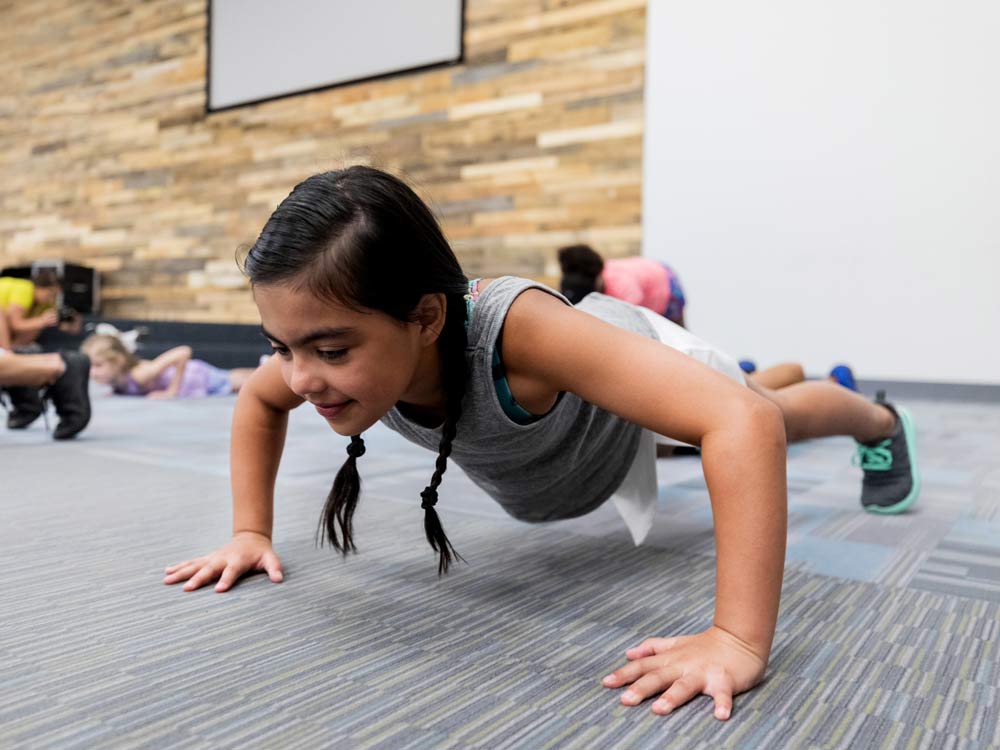
Traditionally, strength training for kids has been synonymous with “play,” and the idea is that as long as they are moving and exercising (in any capacity), kids will naturally build adequate strength. This, combined with their sport-specific training and physical education in school, has been the standard for youth exercise and fitness. Many parents will pay for youth sports training programs as well, which tend to focus on speed, agility, jumping, hand-eye coordination, and sport-specific drills. Physical Education in school primarily has students running, stretching, and playing sports with less training structure. These are all great things, but we are doing a big disservice to our young athletes if we aren’t focusing on, or at least introducing, strength training early on. It is never too early to establish good fitness habits.
Core strengthening, in particular, is something we need to prioritize so that youth athletes can achieve the strength and stability required to prevent many sports-related injuries. An athlete’s core is critical to healthy athleticism. The major muscles of the core include the rectus abdominis (whose tendinous intersections form the infamous “six pack”), transverse abdomins, diaphragm, multifidus, internal and external obliques, erector spinae, quadratus lumborum, psoas major and the glutes. These stabilizing muscle groups are very important for moving properly and protecting hypermobile joints.
According to Luo et al.,1 “Core training optimizes the transfer and overall control of motion and force to the terminal segment within athletic actions. Meanwhile, core training could increase stability and stiffness in the spine to reduce unrequired ‘energy leaks’ and torso movement during the exertion of external loads. This mechanism could help athletes achieve better skill performance. Therefore, this review suggests that core training should be considered integrated into athletes’ daily training routines.”
Focusing on core strength and motor control for my “injury prone” athletes is a key strategy to improve their overall athletic performance. Seeing firsthand the under-utilization of core strengthening in kids and teens was one of the reasons I recently published a children’s book titled: Corey and Abby Go to the Gym: A Fun and Motivating Fitness Adventure Book for Kids. The book contains a core workout that I regularly do with my patients between the ages of 6 and 17. And it’s not just a good workout for kids; it’s a fun and challenging workout for the entire family. Most books in the Amazon categories of “Exercise & Fitness for Children” and “Children’s Fitness Books” are about yoga and meditation. It’s time we stop seeing “strength training” as only appropriate for adults. Today, youth athletes are playing sports at higher skill levels. Let’s give them the best shot to not only succeed but stay injury free. Let’s establish good fitness habits as early as possible, showing kids that exercise and fitness is fun, working hard is fun, getting a strong core is fun, and not being “injury prone” is definitely fun.
Jay Blumberg is a doctor of physical therapy and has been working for the past 9 years as a youth sports physical therapist at Rady Children’s Hospital in San Diego, California. He has given numerous talks to various youth soccer and baseball clubs, created injury prevention programs for both professional and youth sports teams, and regularly hosts sports medicine talks at local high schools. He is the creator and author of Corey and Abby Go to the Gym, which can be found on Amazon at https://a.co/d/eN59ios and at his website coreyandabby.com
1. Luo S, Soh KG, Soh KL, Sun H, Nasiruddin NJM, Du C, Zhai X. Effect of Core Training on Skill Performance Among Athletes: A Systematic Review. Front Physiol. 2022;13:915259. doi: 10.3389/fphys.2022.915259.