







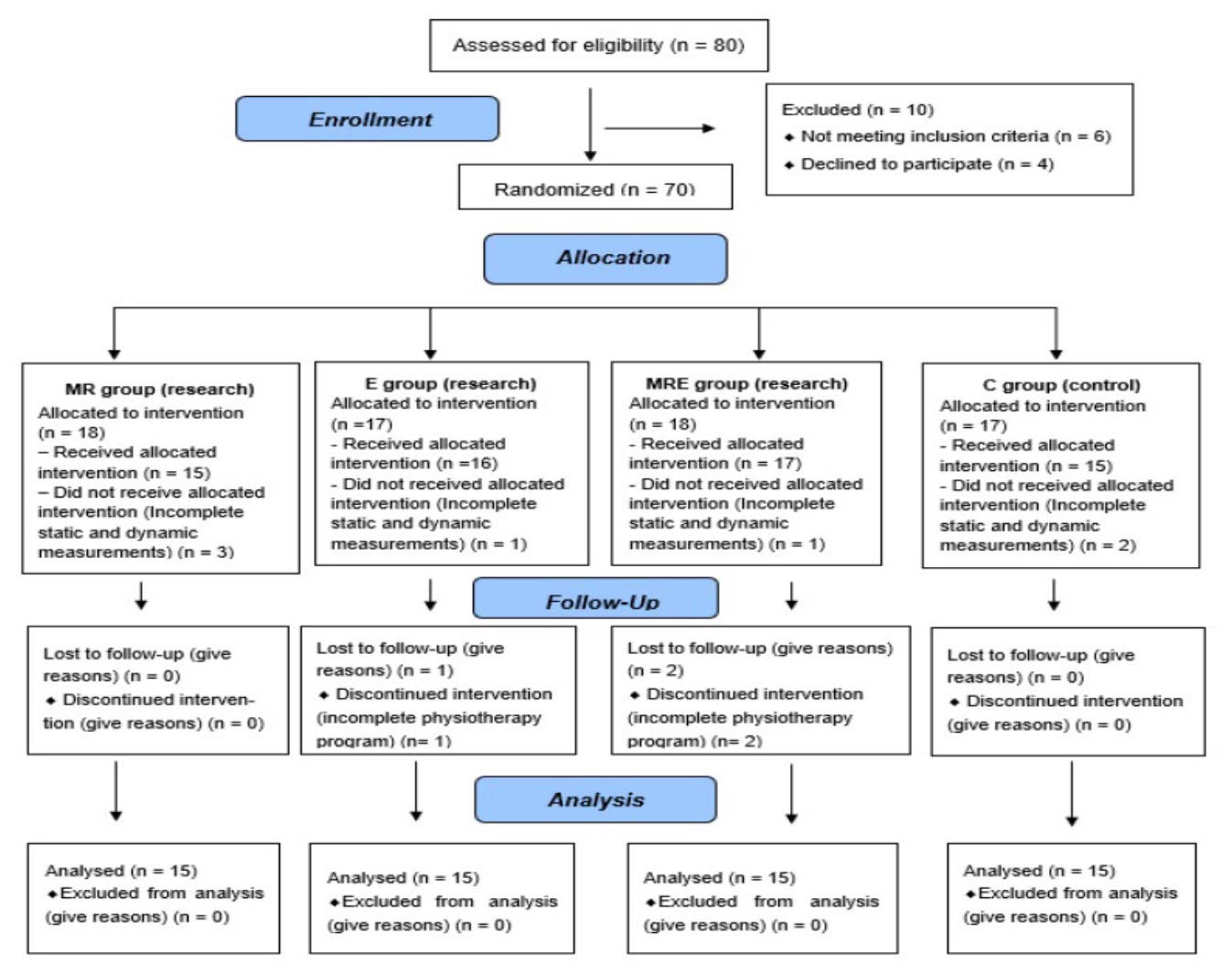
 Symptomatic flat foot is quite a common pathology in adults. Myofascial release is 1 of the physiotherapeutic methods that are currently used in the treatment of musculoskeletal diseases. This study aimed to assess the impact of myofascial release on the range of motion and functional efficiency of the flat foot in adults. The study involved 60 people with flat feet allocated to 4 groups and therapy lasting 4 weeks: group MRE (Myofascial Release and Exercises): myofascial techniques and an exercise program; group MR (Myofascial Release): only myofascial techniques; group E (Exercises): only an exercise program; and the control group C (Control): no intervention. The range of all tested movements significantly improved after therapy in groups MRE (left foot: dorsiflexion P = 0.017; plantar flexion P = 0.006; inversion P = 0.003; and eversion P = 0.001; right foot: dorsiflexion P = 0.008; plantar flexion P = 0.003; inversion P = 0.008; and eversion P = 0.004) and MR (left foot: dorsiflexion P = 0.001; plantar flexion P = 0.001; inversion P = 0.001; and eversion P = 0.001; right foot: dorsiflexion P = 0.001; plantar flexion P = 0.002; inversion P = 0.001; and eversion P = 0.029). The results were significantly better after therapy in groups MRE (P = 0.010), MR (P = 0.001) and E (P = 0.015). In the people studied, the combination of myofascial techniques and exercises (MRE) was the most effective for improving the tested ranges of motion of the ankle joint.
Source: Kaczor S, Żmudzińska U, Kulis A. The influence of myofascial techniques on the range of motion and flat foot efficiency in adults with symptomatic flat foot: a controlled randomised trial. Healthcare (Basel). 2025 19;13(16):2046. doi: 10.3390/healthcare13162046.