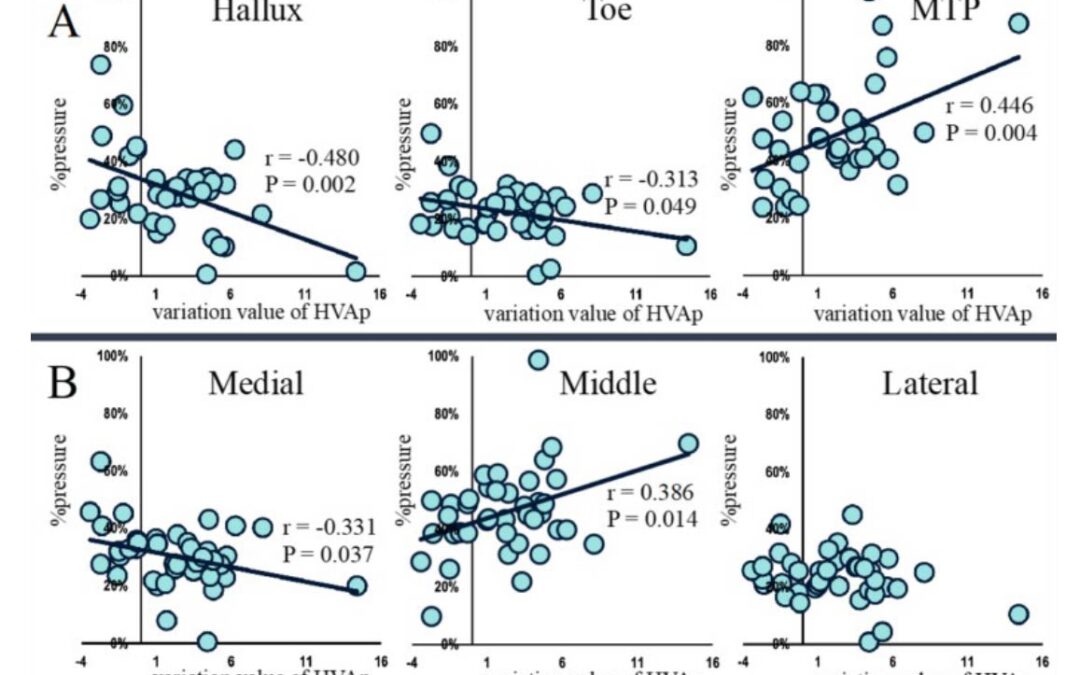








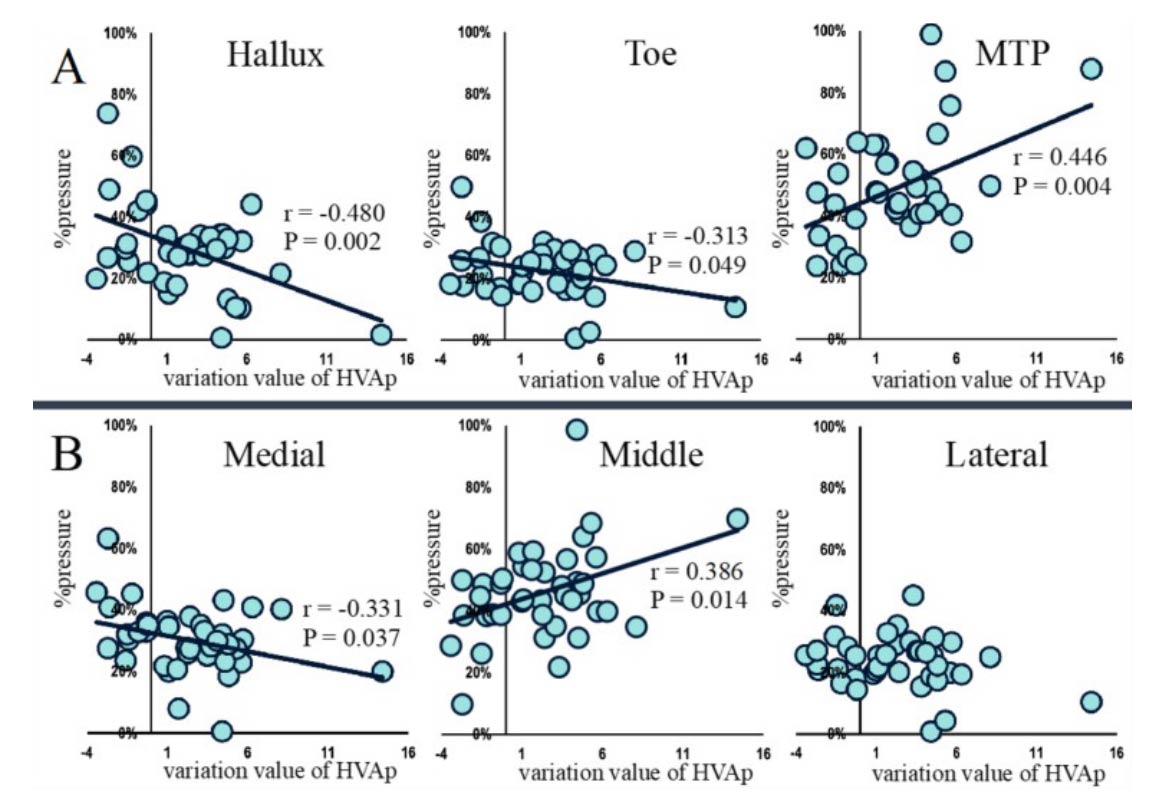
Figure: Significant correlations were observed between the variation value and %pressure in the hallux, toe, and MTP joint areas (A)and between the variation value and %pressure in the medial, middle, and lateral areas (B). MTP, Metatarsophalangeal, %pressure, Plantar pressure percentage.
No previous studies have linked the progression of hallux valgus (HV) with plantar pressure distribution, based on available information. This study aimed to determine the progression of HV angle in elite adolescent dancers and evaluate the risk factors associated with foot plantar pressure during demi-pointe movement.
For this cohort study, 40 adolescent dancesport dancers (age: 14.5 ± 1.3 years; height: 168.3 ± 8.3 cm; weight: 52.4 ± 8.1 kg) were recruited from a dancesport specialty school in Japan. All participants reported no foot or lower limb injuries or symptoms in the past year and were not undergoing any rehabilitation or medication treatment. The HV angle was measured by photography (HVAp). The HVAp survey included baseline and follow-up assessments after 1 year. Foot plantar pressures (kPa) were obtained using the F-Scan measurement system (Tekscan, Tokyo, Japan), and the data were divided into 2 categories based on the foot location (type 1: hallux, toe, and metatarsophalangeal [MTP] joint area and type 2: medial, middle, and lateral areas). Data were analyzed using the Pearson’s chi-square test and multiple logistic regression.
The HVAp measurement demonstrated excellent reliability. A significant increase of 2.1° ± 3.5° in the HV angle of elite adolescent dancers was found at the 1–year follow-up assessment relative to that at baseline. There were significant correlations between the HVAp variation values and the hallux (r = –0.480, P = 0.002), toe (r = –0.313, P = 0.049), and MTP joint area (r = 0.446, P = 0.004) plantar pressure percentages in the type 1 category and medial area (r = –0.331, P = 0.037) and middle area (r = 0.386, P = 0.014) pressure percentages in the type 2 category. Based on the multivariate logistic regression analysis, the HVAp variation values were associated with foot plantar pressure in the hallux (odds ratio [OR]: –0.12, 95% confidence interval [CI]: –0.191 to –0.048, P = 0.002) and middle areas (OR: 0.09, 95% CI: 0.019 –0.161, and P = 0.014) from the 2 categories, respectively.
This study demonstrated significant progression of the HV angle in elite adolescent dancers over 1 year, which was significantly associated with increased foot plantar pressure in the middle area and decreased plantar pressure in the hallux area. These findings highlight the importance of monitoring and addressing foot plantar pressure in adolescent dancers.
Source: Liu Z, Chen S, Okunuki T, et al. Progression and risk factors of hallux valgus angle in elite adolescent dancers: a cohort study. BMC Musculoskelet Disord. 2024;25(1):983. doi: 10.1186/s12891-024-08005-9.