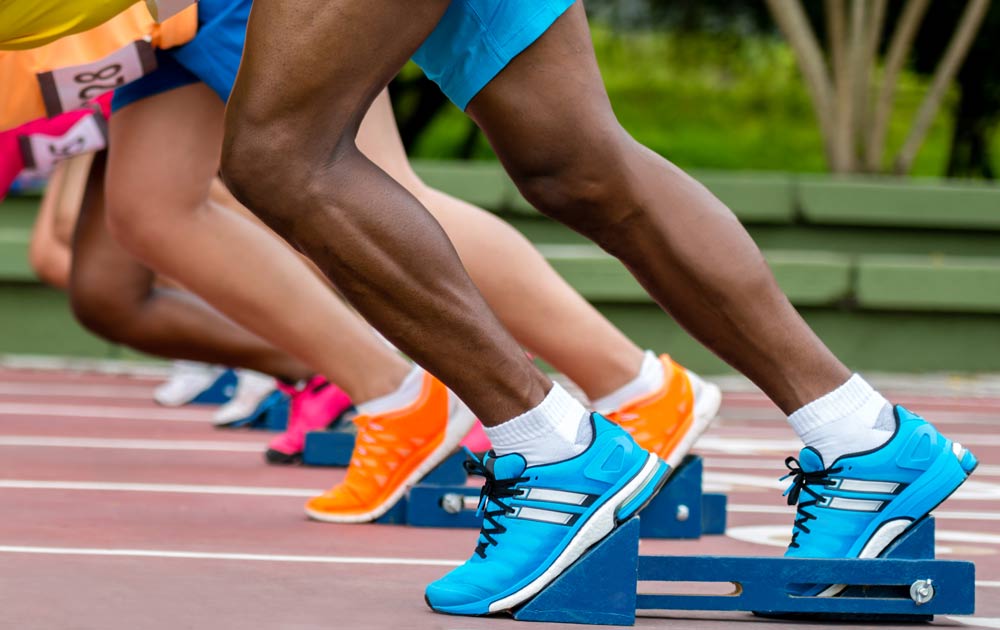
 The 100m race is the highlight of many track and field events; indeed, in the Olympic Games, it defines the fastest man and woman in the world. In this event, the block start performance and subsequent first 2 steps can be of critical importance since they directly influence the runner’s overall time. In a systematic review of 36 peer-reviewed articles reporting biomechanical analysis of the block start and/or first 2 steps in 100m events, researchers from Portugal identified several biomechanical determinants for successful sprint starts:
- In the “set” position, an anthropometry-driven block setting facilitating the hip extension and a rear leg contribution should be encouraged.
- Faster sprinters tend to move their center of mass (CM) closer to the starting line and closer to the ground.
- Horizontal CM velocity at the block take-off and along the first 2 steps increases significantly when the rear knee angle is set to 90° instead of 135° or 115°. A 90° rear knee angle allows for a better push-off of the rear leg than larger angles, showing such condition may be a strategy that allows some elite sprinters to maximize their strength capacity.
- At the push-off, a rapid extension of both hips and greater force production seems to be important.
- After block exiting, shorter flight times and greater propulsive forces are the main features of the best sprinters.
This systematic review emphasizes important findings and recommendations that may be relevant for researchers and coaches.
The authors call for future research to focus on upper limb behavior and on the analysis of the training drills used to improve starting performance.
Source: Valamatos MJ, Abrantes JM, Carnide F, Valamatos M-J, Monteiro CP. Biomechanical performance factors in the track and field sprint start: a systematic review. Int J Environ Res Public Health. 2022; 19(7):4074. https://doi.org/10.3390/ijerph19074074