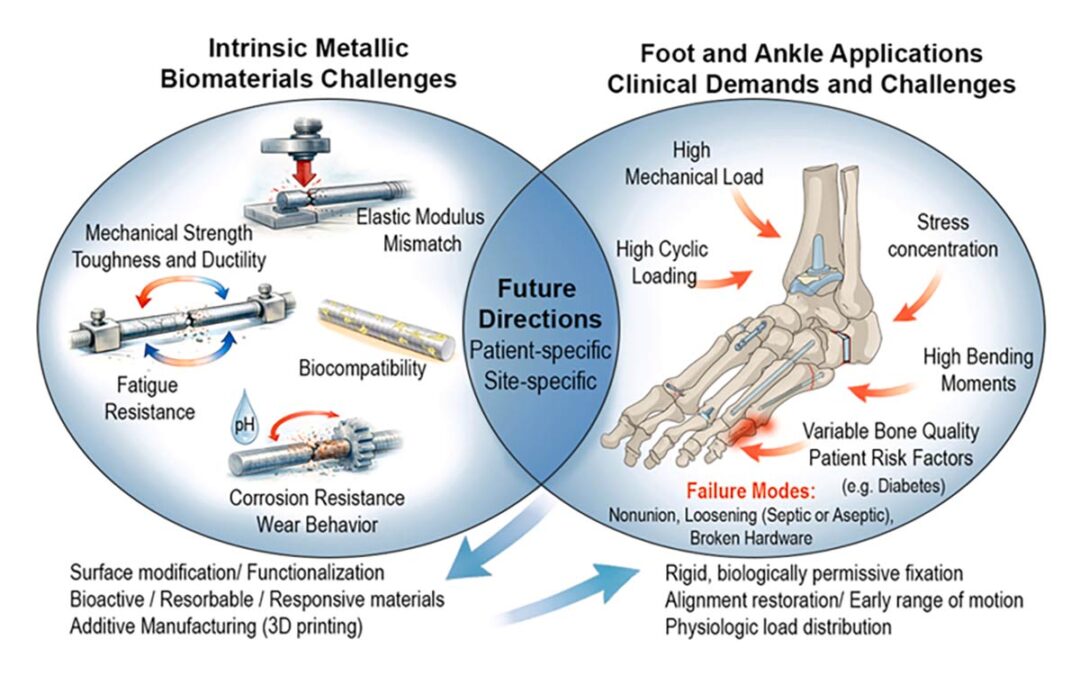








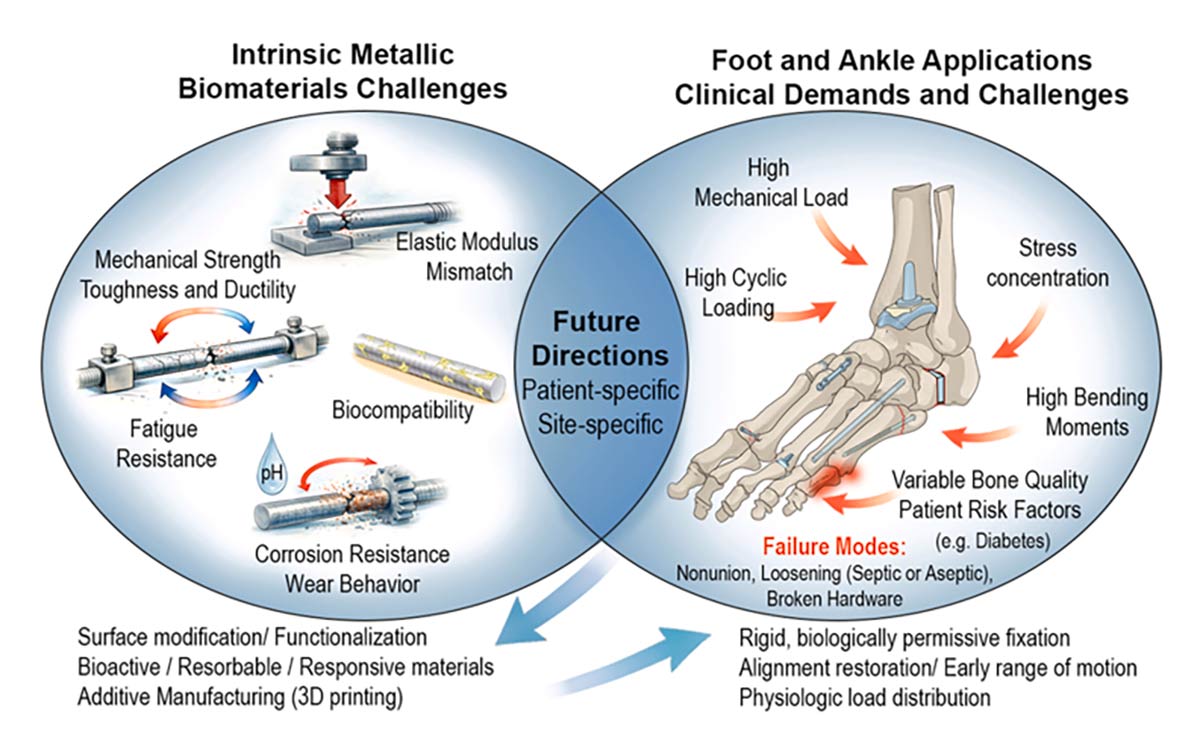
 Metallic biomaterials enable successful reconstruction of skeletal tissues by supporting repair, load-bearing function, and anatomical alignment in foot and ankle surgery. The unique anatomic and biomechanics in this region, and challenging pathologies such as flatfoot and Charcot neuroarthropathy, present challenges. Intervention requires targeted biomaterial solutions. Metallic biomaterials currently represent the most predominant and clinically validated fixation systems in foot and ankle surgical reconstructions. This review summarizes and discusses their applications, outcomes, limitations, unmet needs, and future directions based on literature from 2020–2024. 3D-printed titanium implants for patient-specific reconstructions, surface-engineered alloys with infection mitigation properties for at-risk patient populations, and the exploration of bioresorbable/biointegrative magnesium, as well as non-metallic alternative materials (eg polymerics) were examined. Persistent unmet needs identified include hardware challenges in osteoporotic bone and neuropathic patients, ion leeching, cyclic fatigue, economic burden, imaging artifact interference, and lack of long-term data or clinical trials on innovative implant designs and manufacturing approaches. Lastly, scanning electron microscopy (SEM) imaging of titanium, nitinol, and stainless steel is provided to offer an analysis on biomaterial-specific microstructural features that play a role in influencing tissue integration, corrosion behavior, and mechanical performance in reconstructive surgeries. This review provides guidance for selecting metallic biomaterials for biomechanical and pathological demands of foot and ankle surgery, supporting evidence-based selection of hardware, improved fixation strategies, and reduced complication rates. It adds insights informing the development and of next-generation devices based on patient- and site-specific requirements, such as 3D-printed constructs and surface-engineered implants, designed to enhance fusion, reconstruction, and limb salvage.
Source: Elvin P, Sanchez A, Reyes AA, et al. Foot and ankle biomaterials: a comprehensive review of current applications, challenges, and future directions. J Orthop Translat. 2026 24;57:101051. doi: 10.1016/j.jot.2026.101051