







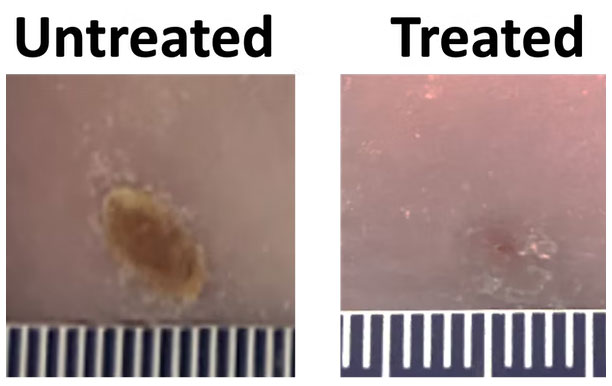
 Chronic wounds in people with diabetes are the leading cause of nontraumatic lower limb amputation because existing treatments cannot overcome the obstacles to healing, such as chronic inflammation, abnormal skin cell functions and delayed growth of new blood vessels. Jianjun Guan, PhD, professor of mechanical engineering and materials science in the McKelvey School of Engineering at Washington University in St. Louis, is developing a new wound dressing to overcome those obstacles and lead to faster wound healing.
To overcome the obstacles, Guan and his team will control the transforming growth factor beta 1 (TGFß1)/p38 pathway using a new wound dressing, which is composed of a water-based hydrogel and a peptide-based TGFß receptor inhibitor. The dressing, which is liquid when applied to the wound and solid at body temperature, would gradually release the inhibitor to block the TGFß1/p38 pathway to decrease tissue inflammation and improve migration of healthy skin cells to the wound, which would lead to growth of new blood vessels. Additionally, the hydrogel in the wound dressing would scavenge reactive oxygen species in the wounds, further decreasing inflammation.
In early experiments, Guan and his team found no difference in healing when the wound dressing was applied to wounds on normal mice. However, when applied to wounds on diabetic mice, they saw a big improvement. After applying a single dose of the wound dressing into wounds in young diabetic mice, the wounds completely closed at day 14. Wounds that were treated only with the hydrogel or were untreated were reduced to roughly half of their original size.