







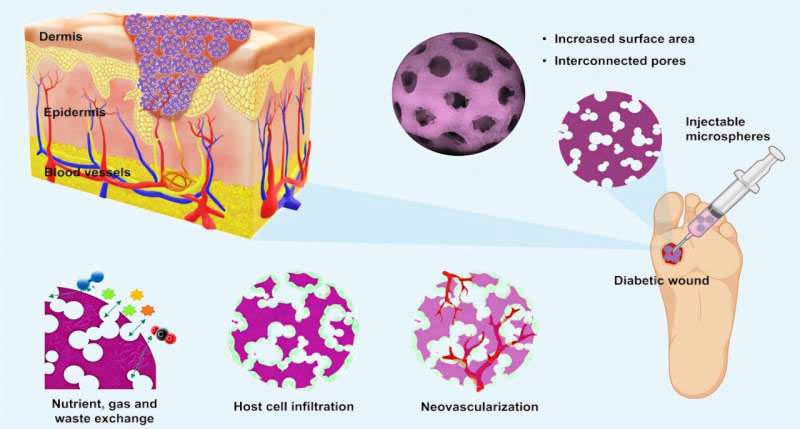
Graphical abstract of the new treatment courtesy of TIBI and UNMC.
Researchers at the Terasaki Institute for Biomedical Innovation (TIBI) have developed a revolutionary injectable granular filler that could transform the way diabetic wounds are treated, potentially improving patient outcomes. The research team from TIBI and the University of Nebraska Medical Center (UNMC) developed a novel method combining electrospinning and electrospraying technologies to create porous, granular nanofibrous microspheres (NMs). These microspheres, made from biocompatible materials including poly(lactic-co-glycolic acid) (PLGA) and gelatin, can be easily injected into wound sites, making the treatment minimally invasive. .
This highly advanced approach from current treatments may potentially improve healing outcomes in a short period of time, said principal investigator Johnson John, PhD, an assistant professor at TIBI.
The study presented several significant advances in the wound-healing process. For example, the newly developed dermal fillers with tunable porous microstructures demonstrated remarkable cell migration and granulation tissue formation, and neovascularization. Moreover, the dermal fillers showed enhanced strength, and maintained their shape during the minimally invasive injection process.
Perhaps most notably, the research demonstrates promise in promoting 3 crucial aspects of wound healing: host cell infiltration, formation of new blood vessels, and skin regeneration. These findings suggest that the treatment could significantly improve healing outcomes for diabetic wounds.