







 By Mathias B. Forrester, BS
Background: Skydiving is a popular activity; however, there is a risk of serious injury. Skydiving injuries most often involve the lower extremities and lumbar spine. The objective of this study was to characterize lower extremity injuries while skydiving.
Methods: Cases were lower extremity injuries among skydiving incident reports collected by the United States Parachute Association (USPA). The distribution of cases by injury characteristics, circumstances of the injury, and demographics was determined.
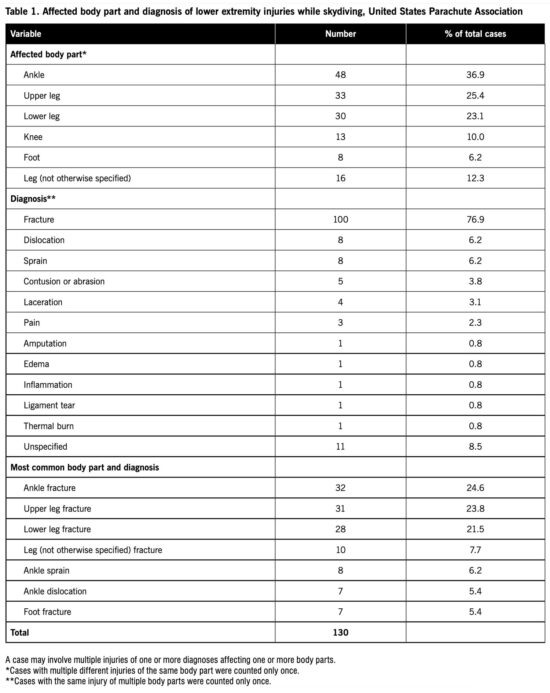
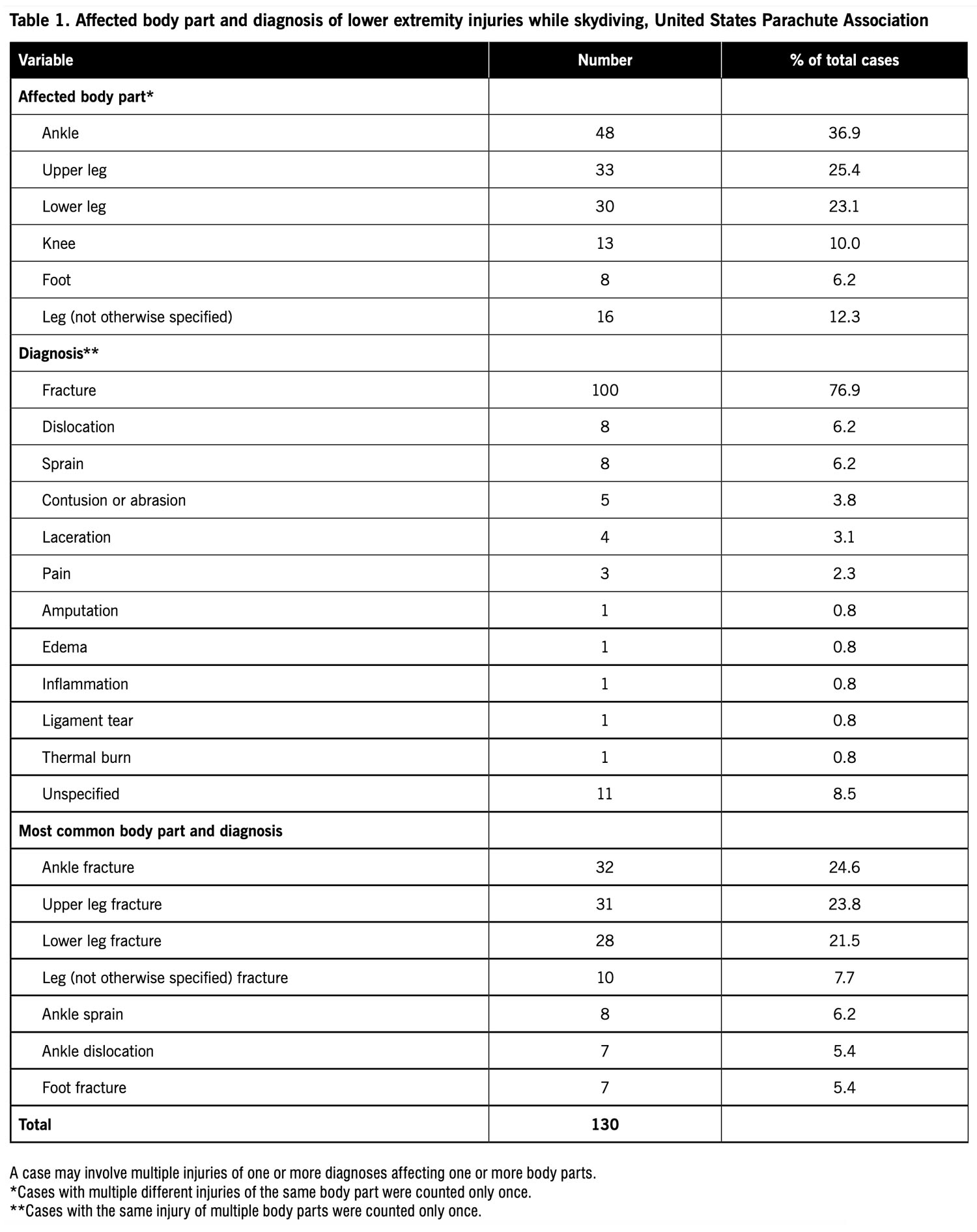
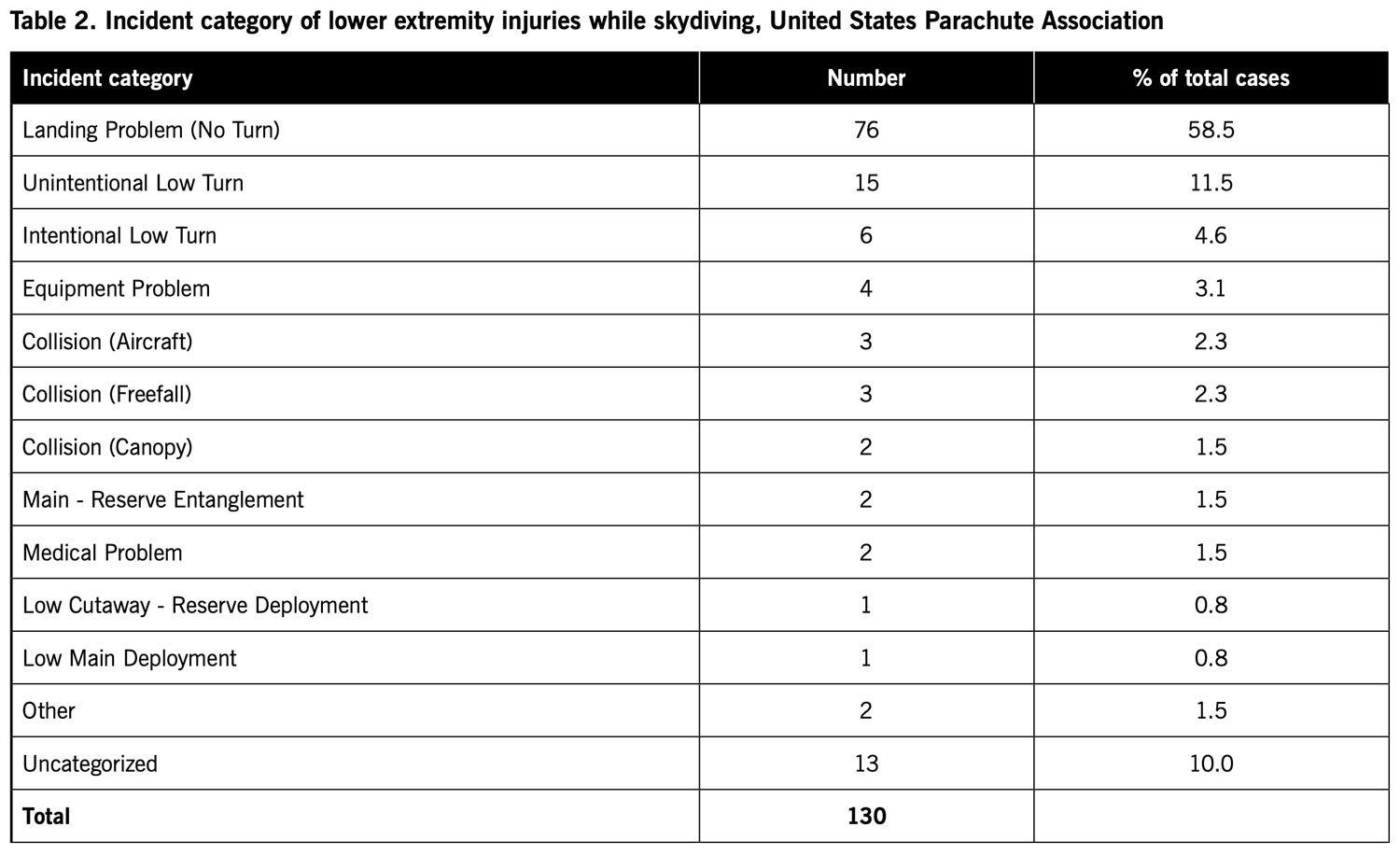
Results: Of 130 cases with one or more lower extremity injuries, the affected body part was 37% ankle, 25% upper leg, 23% lower leg, 10% knee, 6% foot, and 12% leg (not otherwise specified). The most frequently reported injuries were 77% fracture, 6% dislocation, and 6% sprain. The most common incident categories were 58% Landing Problem (No Turn), 12% Unintentional Low Turn, and 5% Intentional Low Turn. The age distribution of the injured persons with known age was 32% 20-29 years, 27% 30-39 years, 24% 40-49 years, 12% 50-59 years, and 5% 60 years or older. Of the injured persons with a known sex, 71% were male, and 29% were female.
Conclusion: Lower extremity injuries while skydiving reported to the USPA most often involved the ankle followed by the upper leg and lower leg, and the most common injury was a fracture. Most of the injuries occurred while landing. The majority of injured persons were aged 20-39 years, and most were male.
Skydiving, jumping from an aircraft and free-falling before landing by parachute, is a popular activity in the United States. In 2022, approximately 42,000 United States Parachute Association (USPA) members made about 3.9 million jumps at more than 208 USPA-affiliated skydiving centers in the United States – an average of 92 jumps per member.1
Studies have reported skydiving injury rates between 0.03% to 0.17% during a jump. The differences in rates depend, in part, on whether minor injuries, which often do not require medical treatment, are included.2-5 In a 2021 survey of USPA members, 6% reported experiencing an injury that required treatment at a medical facility, with the rate ranging 5–7% during 2016–2020.6 The most common skydiving injuries are fractures, strains and sprains, contusions, abrasions and lacerations, ligament tears, and dislocations.3,5 Skydiving injuries most often involve the lower extremities and lumbar spine.2,3,5,7,8
The objective of this study was to characterize skydiving injuries specifically involving the lower extremity.
 Methods
The USPA collects reports on skydiving incidents. According to the USPA website, incidents that should be reported include any event that requires medical attention or raises a safety concern, noteworthy malfunctions, unsafe procedures, unusual or ethically unacceptable skydives, or other extraordinary occurrences concerning skydiving operations. Further reporting criteria include, but are not limited to, fatalities, injuries requiring medical attention more than local first aid, any injuries of a solo or tandem student, reserve deployments, automatic activation device (AAD) activations, off-field landing or obstacle landings, emergency exits from an aircraft, freefall or canopy collisions, premature deployments in aircraft or freefall, harness or canopy damage during a jump, unplanned dropping of equipment during a jump, and anything filed on an insurance claim. Anyone can voluntarily submit an anonymous report online, and the submission is handled confidentially. All reports are studied, printed in Parachutist, published online, and then destroyed, although the USPA keeps a brief summary on record.9
USPA incident report summaries are available on their website (https://www.uspa.org/searchincidentreports?pagesize=50). The following information is provided for each incident: Published Report Date, Category, Age, Gender, Time in Sport, Total Number of Jumps, Skydives Within the Last 12 Months, Fatality, Cause of Death, multiple fields providing details about the equipment used, Description (a brief description of the incident), and Conclusions. All variables are not available for all reports. The reports do not include identifying information. The information is publicly available, so institutional review board (IRB) approval is not required.
On August 1, 2023, there were 504 incident reports available on the USPA website with a report date of July 2008–April 2023 (n=494) or no report date (n=10). All incident reports were individually examined to identify those reports that mention the occurrence of lower extremity injuries while skydiving. The incident reports do not include a data field for injuries, so the Description and Conclusion fields were reviewed to identify any lower extremity injuries. Those reports with lower extremity injuries were included in the study. For each study case, the part of the lower extremity injured and the type of injury were documented.
The distribution of lower extremity injuries while skydiving was determined for body part, diagnosis, whether a fatality was known to have occurred, injured person’s age and sex, and category of the incident. A person may have experienced lower extremity injuries involving more than one body part and/or more than one type of injury. For the body part analysis, multiple injuries to the same body part were grouped together. Similarly, for the diagnosis analysis, the multiple body parts involving the same injury were grouped together. For example, if a person experienced a lower leg fracture and a lower leg laceration, it would be counted once in the body part analysis (lower leg) but twice in the diagnosis analysis (fracture and laceration). If a person experienced a lower leg fracture and a foot fracture, it would be counted twice in the body part analysis (lower leg and foot) but once in the diagnosis analysis (fracture).
Results
Of the 504 reports, 130 (25.8%) indicated a lower extremity injury occurred while skydiving. Table 1 provides the distribution of lower extremity injuries while skydiving by affected body part and diagnosis. The most frequently affected body parts were the ankle, reported in over one-third of the cases, followed by the upper leg and lower leg. The most common reported diagnosis was a fracture, reported in over three-fourths of the cases. All other diagnoses were reported in a small number of cases. When the affected body part and diagnosis were examined together, the most common injuries were ankle fracture, upper leg fracture, and lower leg fracture. A fatality was reported in 13 (10.0%) of the cases.
Table 2 presents the distribution of lower extremity injuries while skydiving by incident category. The most common incident category was Landing Problem (No Turn), reported in almost 60% of the cases. All other incident categories were reported in a much smaller proportion of the cases.
The injured person’s age was known in 92 of the cases. The age distribution of the persons with known age was 29 (31.5%) 20-29 years, 25 (27.2%) 30-39 years, 22 (23.9%) 40-49 years, 11 (12.0%) 50-59 years, and 5 (5.4%) 60 years or older. The mean injured person’s age was 38 years (range 21–72 years). The injured person’s sex was reported in 127 of the cases. Ninety (70.9%) of the injured persons with a reported sex were male, and 37 (29.1%) were female.
Discussion
This study characterized lower extremity injuries while skydiving. Skydiving is a popular activity. However, injuries may occur while participating in the activity, and most injuries involve the lower extremities and lumbar spine.2,3,5,7,8 Detailed analysis of lower extremity injuries while skydiving may provide useful information to manage and prevent such injuries in the future.
Of the 504 USPA incident reports examined, 26% involved lower extremity injuries while skydiving. Previous studies reported that 47%–64% of skydiving injuries involved the lower extremity.3,5,7,8 The lower proportion of lower extremity injuries observed in the present study may be due, in part, to the USPA incident report inclusion criteria. The USPA includes reports of a variety of incidents, some of which do not require the presence of an injury.9
The most frequently affected body part was the ankle, followed by the upper leg and lower leg. In a previous study of Swedish skydiving over a five-year period (1999–2003), the most frequently affected lower extremity body part was the lower leg followed by the foot, ankle, upper leg, and knee.3 Differences between the two studies may be due to differences in the study populations and inclusion criteria.

The most commonly reported diagnosis was a fracture, reported in over three-fourths of the cases. The next most common diagnoses, although reported in only a much lower fraction of the cases, were dislocation, sprain, contusion or abrasion, and laceration. In the Swedish skydiving study, the most commonly reported injury of the lower extremity was fracture, followed by strain or sprain, contusion, and abrasion or laceration.3 The USPA incident reporting criteria specifically mention that injuries requiring medical attention more than local first aid are to be reported.9 Fractures are likely to require medical attention more than local first aid. Other injuries such as sprains, contusions and abrasions, and lacerations may be less likely to require medical attention more than local first aid – and thus less likely to have an incident report submitted or be mentioned in an incident report that is submitted.
 Ten percent of the persons with lower extremity injuries died. In many of these instances, the fatality was probably due to injuries other than those to the lower extremity. The number of lower extremity injuries involving a fatality is likely to be higher than 10% because many of the incident reports of fatalities did not provide details of the person’s injuries.
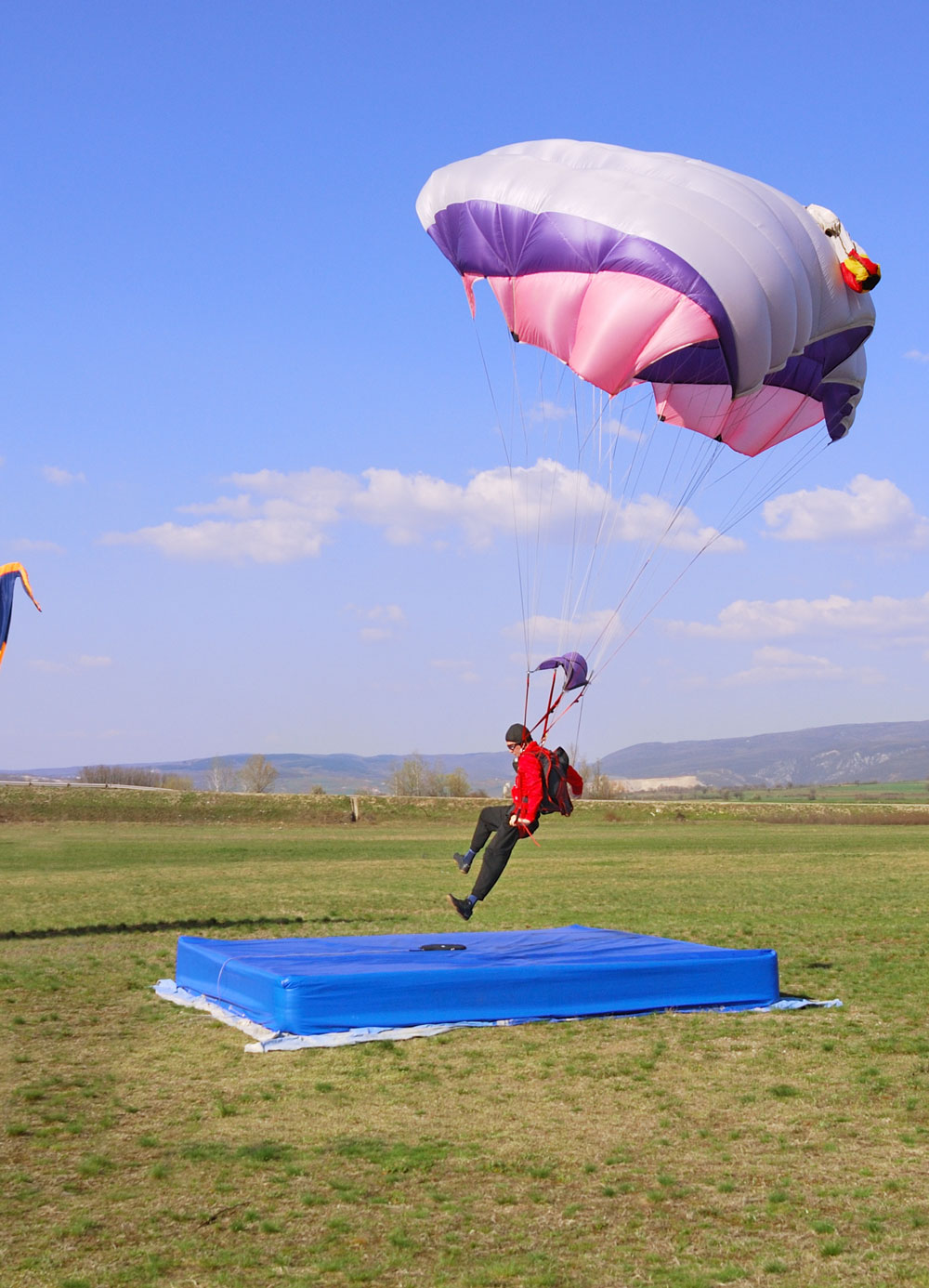
In almost 60% of the incidents involving lower extremity injuries, the incident category was Landing Problem (No Turn). Skydiving injuries can occur during three different phases of a jump. In the exit phase, exiting the airplane can result in lacerations and contusions. In the opening phase, after deploying the parachute, the skydiver experiences average decelerations of 3–5 times the Earth’s gravity. In the landing phase, landing on the ground is affected by speed, flying technique, type of parachute, weather, and geographical conditions.2 Previous studies reported that injuries most often occurred during the landing phase.2,3,5,7
Of the injured persons with a reported age, the mean age was 38 years, with almost 60% aged 20–39 years. Of the injured persons with a reported sex, 71% were male. In a Danish study of 110,000 sports jumps, the mean age of injured persons was 29 years,5 lower than in the present study. The difference in mean age between the two studies could be due to differences in study design and/or study population. Moreover, the previous study was published over 35 years ago, and the demographics of skydivers may have changed since then. In the 2021 survey of USPA members, 52% were aged 20–39 years.6 Prior studies also reported a preponderance of injured persons being male.3,5,8 In the 2021 survey of USPA members, 86% of the members were male.6 The demographic patterns of the injured persons in the present study may reflect the general demographics of skydivers. Alternately, persons in certain age groups or of a particular sex may be more likely to be injured while skydiving and/or more likely to have an incident report submitted to the USPA.
This study is subject to limitations. Reporting of skydiving injuries to the USPA is voluntary, and the incident reports do not collect injury information in a consistent manner, i.e., using specific data fields. In addition, there may be bias in the reporting of particular types of injuries; the USPA reporting criteria includes injuries requiring medical attention more than local first aid.9 Incident reports might not have been submitted for injuries considered less serious or not requiring more extensive medical attention or less serious injuries might not have been documented in reports that were submitted. Relatively few variables are included in the incident reports; information such as the date and location of the incident are not available, so temporal and geographic analysis cannot be performed.
In conclusion, lower extremity injuries while skydiving reported to the USPA most often involved the ankle followed by the upper leg and lower leg, and the most common injury was a fracture. Most of the injuries occurred while landing. The majority of injured persons were aged 20–39 years, and most were male.
Mathias B. Forrester, BS, is an independent researcher in Austin, Texas. Now retired, he previously performed public health research for various university and government programs for 38 years.
- United State Parachute Association. How safe is skydiving. Available at https://www.uspa.org/Discover/FAQs/Safety. Accessed August 9, 2023.
- Barthel C, Halvachizadeh S, Gamble JG, Pape HC, Rauer T. Recreational skydiving – really that dangerous? A systematic review. Int J Environ Res Public Health 2023;20(2):1254.
- Westman A, Björnstig U. Injuries in Swedish skydiving. Br J Sport Med 2007;41(6);356-364.
- Barrows TH, Mills TJ, Kassing SD. The epidemiology of skydiving injuries: World freefall convention, 2000-2001. J Emerg Med 2005;28(1):63-68.
- Ellitsgaard N. Parachuting injuries: A study of 110,000 sports jumps. Br J Sport Med 1987;21(1):13-17.
- United State Parachute Association. 2021 USPA member survey data. Available at https://www.uspa.org/who-are-we. Accessed August 9, 2023.
- Fer C, Guiavarch M, Edouard P. Epidemiology of skydiving-related deaths and injuries: A 10-years prospective study of 6.2 million jumps between 2010 and 2019 in France. J Sci Med Sport 2021;24(5):448-453.
- Christey GR. Serious parasport injuries in Auckland, New Zealand. Emerg Med Australas 2005;17(2):163-166.
- United State Parachute Association. Search & browse incident reports. Available at https://www.uspa.org/searchincidentreports?pagesize=50. Accessed August 9, 2023.