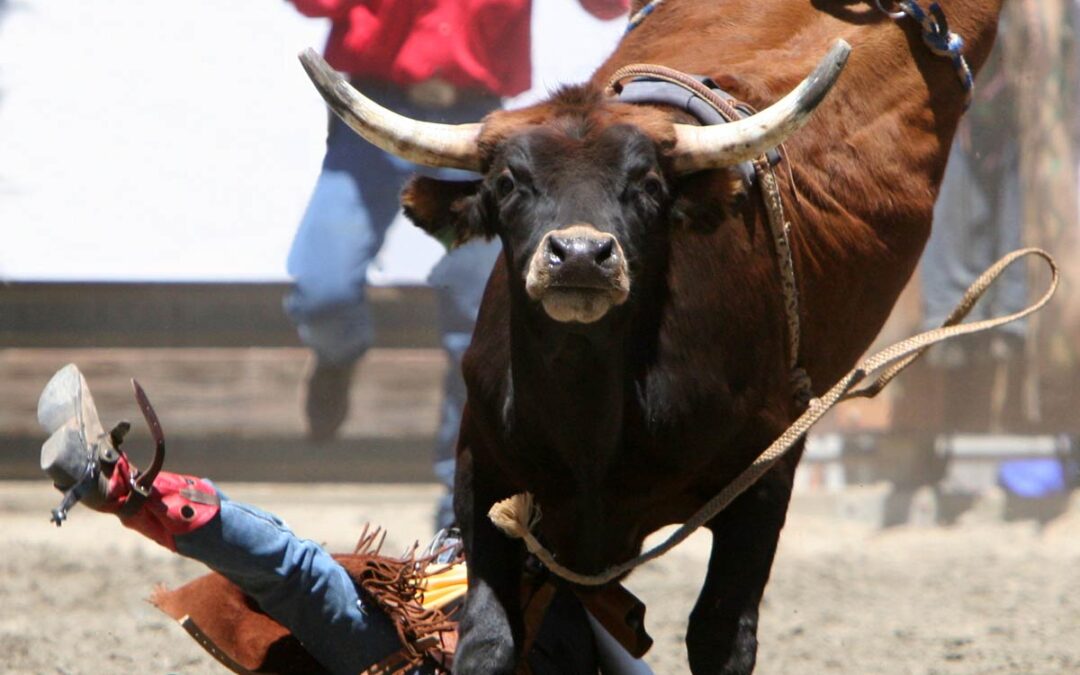








 Move over pickleball! Professional bull riding is a growing sport across the United States and the world. Viewership of the events—topping 30 million at a time—increases weekly. The Professional Bull Riders (PBR, the leading association of riders) signed a 10-year broadcast deal in 2018 with CBS and another in 2023 with Spanish-language Univision.
Bull riding competitions typically include a bucking bull weighing 1,200-2,000 pounds. These animals are specially bred for their ability to leap, plunge, and spin when a rider is on its back. Their average daily diet includes 10-15 pounds of specially blended high-protein grain plus 15 pounds of high-quality hay per day.
Bucking bulls are treated as athletes, much like racing horses. While they start bucking as early as age 2, they are considered in their prime at age 5-6, with some able to compete even beyond age 10. How often a bull is bucked at any given competition depends on the length of the event and how well the bull performed in his first out of the event. The longer the bull had to work to buck off a rider, the longer the rest they receive.
In a case-control study, 78 bucking bulls were compared against 236 nonbucking controls for medical disorders. While the frequency of medical disorders did not differ between the 2 groups, musculoskeletal disorders were identified in 70.5% of bucking bulls compared to 46% of controls. 55% of the bucking bulls were examined because of lameness with the thoracic limb affected in 44%. Compared to nonbucking bulls, bucking bulls were 13.37 and 3.31 times as likely to have a musculoskeletal disorder of the vertebral region and pelvic limb, respectively.
Intense breeding has led to more aggressive and dangerous animals witnessed by the decline in the number of riders staying on the bull for the 8-second count: 75% in early 1990s down to 35% in 2014.
Professional Bull Riders’ Safety Equipment
Helmet: Beginning with the 2013 season, any contestant born on or after Oct. 15, 1994 is required to wear a protective helmet. The Professional Bull Riders (PBR) group leaves the choice of headwear up to any of its riders born before this date. Over 50% of PBR riders choose to wear a helmet and/or mask to help protect them from threatening head blows and injuries to the face and jaw. The helmet is similar to those worn in hockey with some adaptations.
Protective Vest: The vest, invented by PBR Livestock Director and former bull rider Cody Lambert, is worn by the PBR athletes for protection. It serves 2 primary purposes: it absorbs shock and dissipates the blow to the body, while protecting the torso from threatening punctures caused by direct contact with the bull’s hooves and horns.
Glove: Riders wear a glove only on their riding hand (the hand that grips the bull rope). This leather glove protects the hand and fingers and makes it easier to hold on to the bull rope.
Rosin: Rosin is used to help the glove adhere to the bull rope. It is a sticky substance that provides a little extra grip.
Chaps: Chaps are custom-made and often display the logo of a rider’s sponsors, as well as various decorative elements. Chaps may be flashy, but they are part of the armor that adds a layer of protection for the rider against a bull’s horns and hooves.
Bull Rope: The bull rope is a flat rope braided from nylon or grass that goes around the bull’s girth area behind his front legs. The rope has a handle, constructed partially of leather that is braided into it and serves as the rider’s only anchor for the duration of the ride.
Boots: The boots worn while riding have a special spur ridge on the heel which helps keeps spurs from riding up and resting on the Achilles tendon. Some riders wear the traditional pull-on boot and then add extra wrapping at the ankle, while others prefer those that lace up to fit the foot snugly.
Spurs: Spurs help the rider stay in position on a bull. The rowels are dull so they don’t injure or cut the skin of the bull. The spurring action displays the level of complete control of the rider during the ride.
Sources:
- Appleton A. Too much bull: an industry obsessed with breeding bigger, nastier bulls is putting children in harm’s way.
- PBR FAQs. Pbr.com-101. Available at https://pbr.com/pbr-101. Accessed May 1, 2024.
- Smith JS, Angelos JA. Disorders of performance-age bucking bulls. 2017;250(11): https://doi.org/10.2460/javma.250.11.1302