








 By Mathias B. Forrester, BS
Background: Ninety-seven percent of people in the United States (US) own a cell phone. Consequently, millions of people are at risk of cell phone-related injury, including when using or carrying a cell phone while walking. This study described cell phone-related lower extremity injuries while walking that were treated at US hospital emergency departments (EDs).
Methods: An analysis was performed of cell phone-related lower extremity injuries while walking reported to the National Electronic Injury Surveillance System during 2000-2023. National injury estimates were calculated for selected variables.
Results: An estimated 13,264 cell phone-related lower extremity injuries while walking were treated at US hospital EDs during 2000-2023, representing 35.5% of the estimated 37,344 such injuries affecting all body parts. The estimated number of lower extremity injuries increased from 34 during 2000-2003 to 4,477 during 2016-2019 and then declined slightly to 4,381 during 2020-2023. The activity during which the lower extremity injury occurred was 64.4% texting on or looking at the cell phone, 16.6% talking on the cell phone, and 19.1% other or unknown activity. The mechanism of the injury was 63.1% fall, 8.3% hit or hit by another object, 6.4% hit or hit by a vehicle, and 22.2% other or unknown. The location of the incident was 27.5% other public property, 16.9% home, 16.3% street or highway, 2.5% school, 1.5% place of recreation or sports, 0.6% industrial place, and 34.8% not recorded.
Conclusions: Although the estimated number of cell phone-related lower extremity injuries while walking that were treated at US hospital EDs appears to have stabilized in recent years, it remains a problem. Such injuries most often occurred while the patient was texting on or looking at the cell phone, and the majority involved a fall. While the highest proportion of the injuries occurred at other public property, the next most common location was the home. The results of this study may be useful for creating educational activities that can reduce the occurrence of these injuries.
According to a January 2024 Pew Research Center fact sheet, 97% of people in the United States (US) own a cell phone of some kind.1
Injuries may occur while using a cell phone, and these injuries may occur under a variety of circumstances. One of the more recognized circumstances is walking while using or carrying a cell phone.2-4 (See also “Smartphone Usage Negatively Impacts Standing Postural Balance, page 17, and “Does Texting While Walking Affect Gait’s Plantar Pressure Parameters?”, page 17.)
Studies have reported that 20-25% of people engage with technology-related distractions while walking.5-8 Distracted walking can negatively affect walking safety through such factors as reduced situation awareness, unsafe walking behaviors, slower speed, greater deviation from walking in a straight line, and increased near collisions with other pedestrians.5,8-12
The objective of this study was to describe cell phone-related lower extremity injuries while walking. A previous study found that 25% of ambulatory cell phone injuries treated at US emergency departments (EDs) involved the lower extremity.
 Methods
Data for this study were downloaded from the National Electronic Injury Surveillance System (NEISS) website at https://www.cpsc.gov/cgibin/NEISSQuery/home.aspx. The NEISS database has previously been described in Lower Extremity Review.13 In brief, operated by the US Consumer Product Safety Commission (CPSC), NEISS collects data on consumer product- and activity-related injuries from the EDs of approximately 100 hospitals as a probabilistic sample of the more than 5,000 US hospitals with EDs. National estimates are calculated from database records according to the sample weight assigned to each case based on the inverse probability of the hospital being selected for the NEISS sample.14,15 Since data are publicly available and de-identified, the study is exempt from institutional review board approval. Previous studies used NEISS data to examine cell phone-related injuries. However, these studies either did not focus on injuries while walking16,17 or did not focus on lower extremity injuries.2-4
Cases were cell phone-related injuries while walking reported to the NEISS during 2000-2023. The NEISS database includes three numeric fields for coding the product or activity involved in the injury (Product_1, Product_2, Product_3). (Product_3 was added to the NEISS database in 2018 but does not appear to have been used until 2019.)15 The NEISS database has product code 550 (telephones or telephone accessories); however, this code is not only used for cell phones but also for landline phones, intercoms, and other such devices. Thus, the product code alone cannot be used to identify cell phone-related injuries. For this analysis, first, all records with code 550 in any of the three product code fields or “phone” in the Narrative text field (a text field that briefly summarizes the circumstances of the injury) were identified. Next the Narrative fields were individually reviewed to determine whether the injury appeared to be related to using or carrying a cell phone while walking. A record was included even if it did not explicitly state that the phone was a cell phone but the context suggested that the phone was a cell phone. For example, if the Narrative field stated that the person was talking on a phone on the street and fell down a manhole, it was assumed that the person was not talking on a landline phone. At the same time, the activity at the time of the injury and the mechanism of the injury were noted. The activity at the time of the injury was grouped into texting on or looking at the cell phone, talking on the cell phone, and other or unknown (eg, carrying a cell phone, “using” a cell phone, “on” a cell phone). The mechanism of the injury was grouped into a fall (including trip or slip), hit or hit by a cell phone, hit or hit by a vehicle, hit or hit by another object, and other or unknown (including a person “rolled” a body part but a fall was not explicitly mentioned).
The variables examined were the affected body part, activity at the time of the injury, mechanism of the injury, year and month of treatment, patient age and gender, location of the incident, injury type (diagnosis), and patient disposition. The NEISS database contains 2 numeric fields for coding the affected body part (Body_Part and Body_Part_2) and 2 numeric fields for coding the type of injury or diagnosis (Diagnosis and Diagnosis_2). The Body_Part_2 and Diagnosis_2 fields were added in 2018, although they do not appear to have been used until 2019.15 For consistency over the entire study period, the Body_Part and Diagnosis fields alone were examined for the analysis.
Analyses were performed using Microsoft 365 Access and Excel (Microsoft Corporation, Redmond, Washington, US). For the selected variables, the distribution of the national injury estimates was determined for cell phone-related injuries while walking affecting any body part and the subset of lower extremity injuries (based on the Body_Part field). Comparisons were made between the 2 groups for the studied variables by calculating the lower extremity rate (lower extremity injury estimate/total injury estimate x 100, presented as a percentage). National injury estimates were calculated by summing the values in the Weight numeric field in the publicly available NEISS database. The CPSC considers an estimate unstable and potentially unreliable when the estimate is <1,200.14
 Results
There were an estimated 13,264 cell phone-related lower extremity injuries while walking treated at US hospital EDs during 2000-2023; this represents 35.5% of the estimated 37,344 such injuries affecting all body parts. The affected lower extremity body part was 6,376 (48.1%) ankle, 3,107 (23.4%) knee, 1,897 (14.3%) foot, 1,413 (10.7%) lower leg, 435 (3.3%) toe, and 35 (0.3%) upper leg.
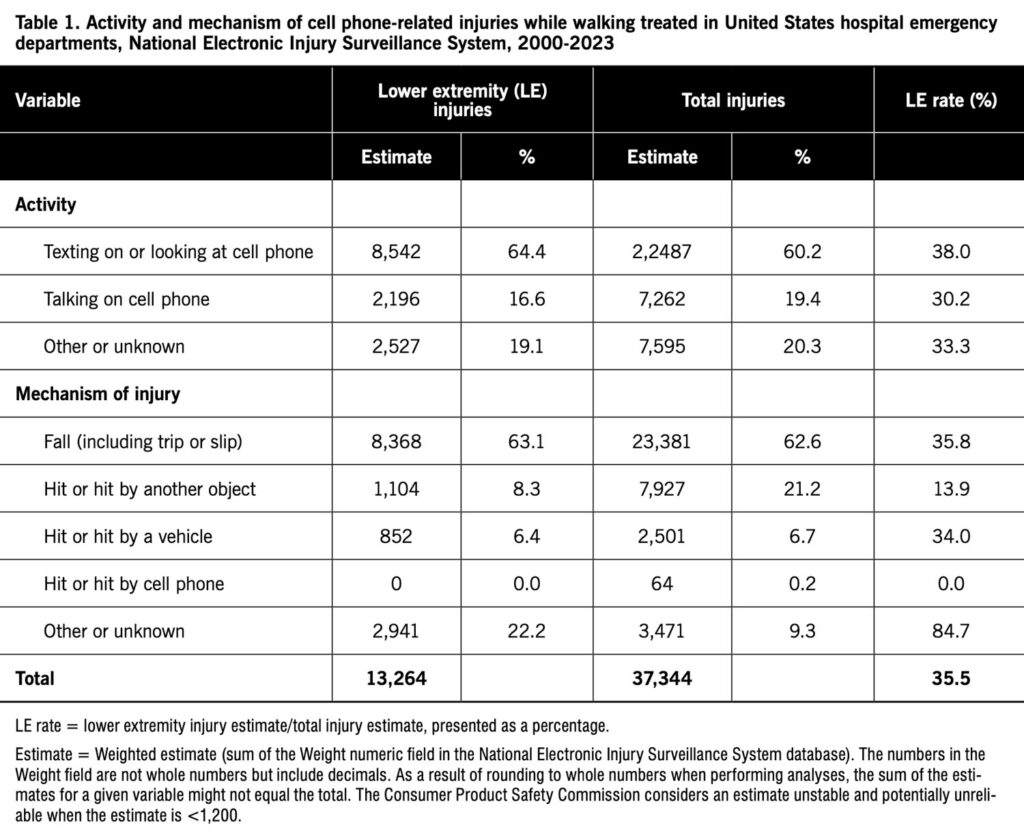
Table 1 shows the distribution of cell phone-related injuries while walking by the activity and mechanism of injury. Most of the injuries occurred while the patient was texting on or looking at a cell phone, and a lower proportion occurred while the patient was talking on a cell phone. Moreover, the lower extremity rate was higher for injuries that occurred while texting on or looking at a cell phone than while talking on a cell phone. The majority of injuries involved a fall, and the next most common mechanisms were hitting or being hit by another object followed by hitting or being hit by a vehicle. The lower extremity rate was higher for injuries that occurred from falls and hitting or being hit by a vehicle than for hitting or being hit by another object. For the estimated 852 lower extremity injuries that occurred by hitting or being hit by a vehicle, the type of vehicle was 739 (86.8%) automobile, truck, or motor vehicle (not otherwise stated); 57 (6.7%) motorcycle, moped, or dirt bike, and 55 (6.5%) train.
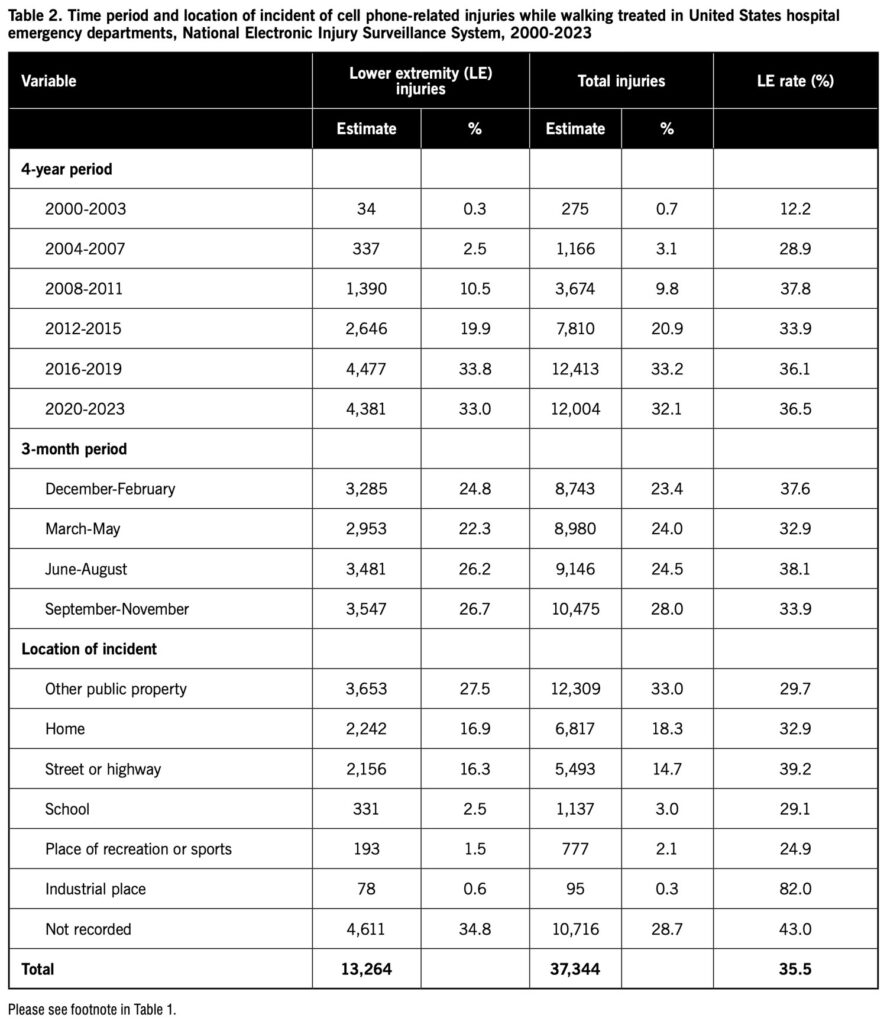
Table 2 presents the distribution of cell phone-related injuries while walking by the time period and the location of the incident. The estimated number of injuries increased during each 4-year period from 2000-2003 to 2016-2019 and then declined slightly during 2020-2023. Moreover, the lower extremity rate increased during 2000-2003 to 2008-2011 and then remained relatively stable for the rest of the study period. The estimated number of injuries did not vary greatly by season. Of those injuries with a documented location of incident, the highest proportion occurred at other public property. The next most reported location was home followed by street or highway; a small proportion of the injuries occurred at school. The lower extremity rate was lower for other public property and school than for home or street or highway.
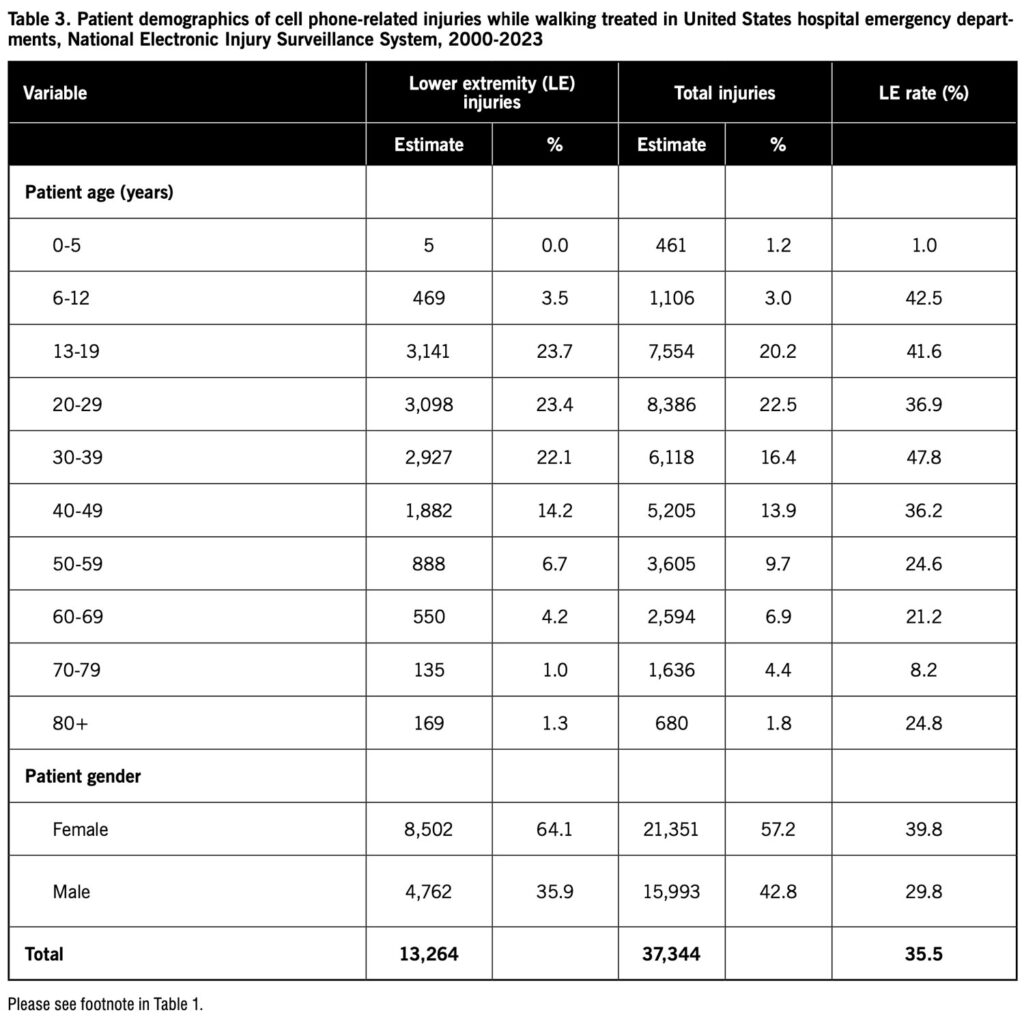
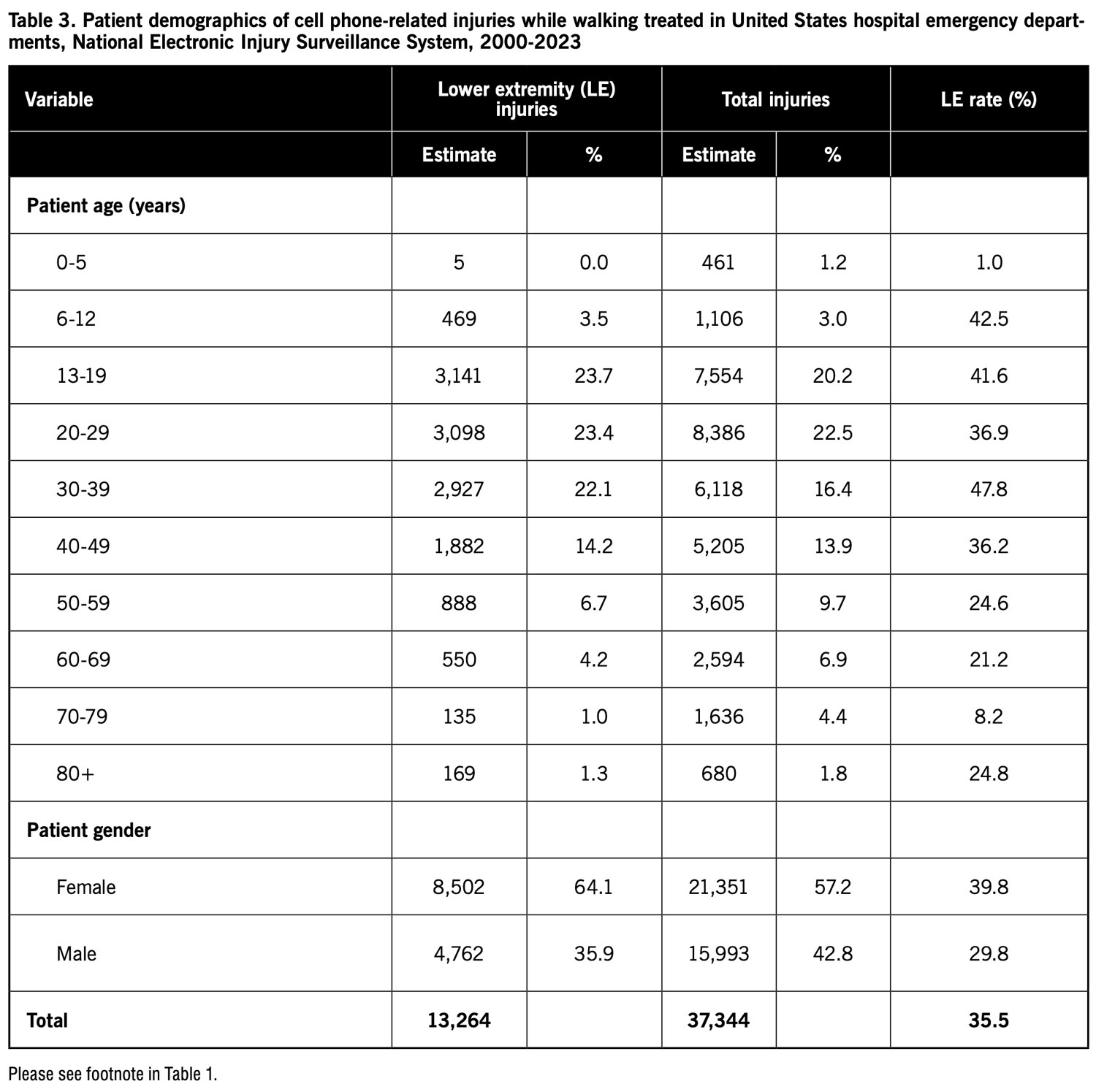
When the patient demographics of cell phone-related injuries while walking were examined (Table 3), relatively few of the patients were aged 0-12 years. Patients aged 13-39 years accounted for 69.1% of the estimated lower extremity injuries and 59.1% of the estimated total injuries. The lower extremity rate was higher for patients aged 6-49 years than for patients aged 50 years and older. Most of the patients were female, and the lower extremity rate was higher for females than for males.
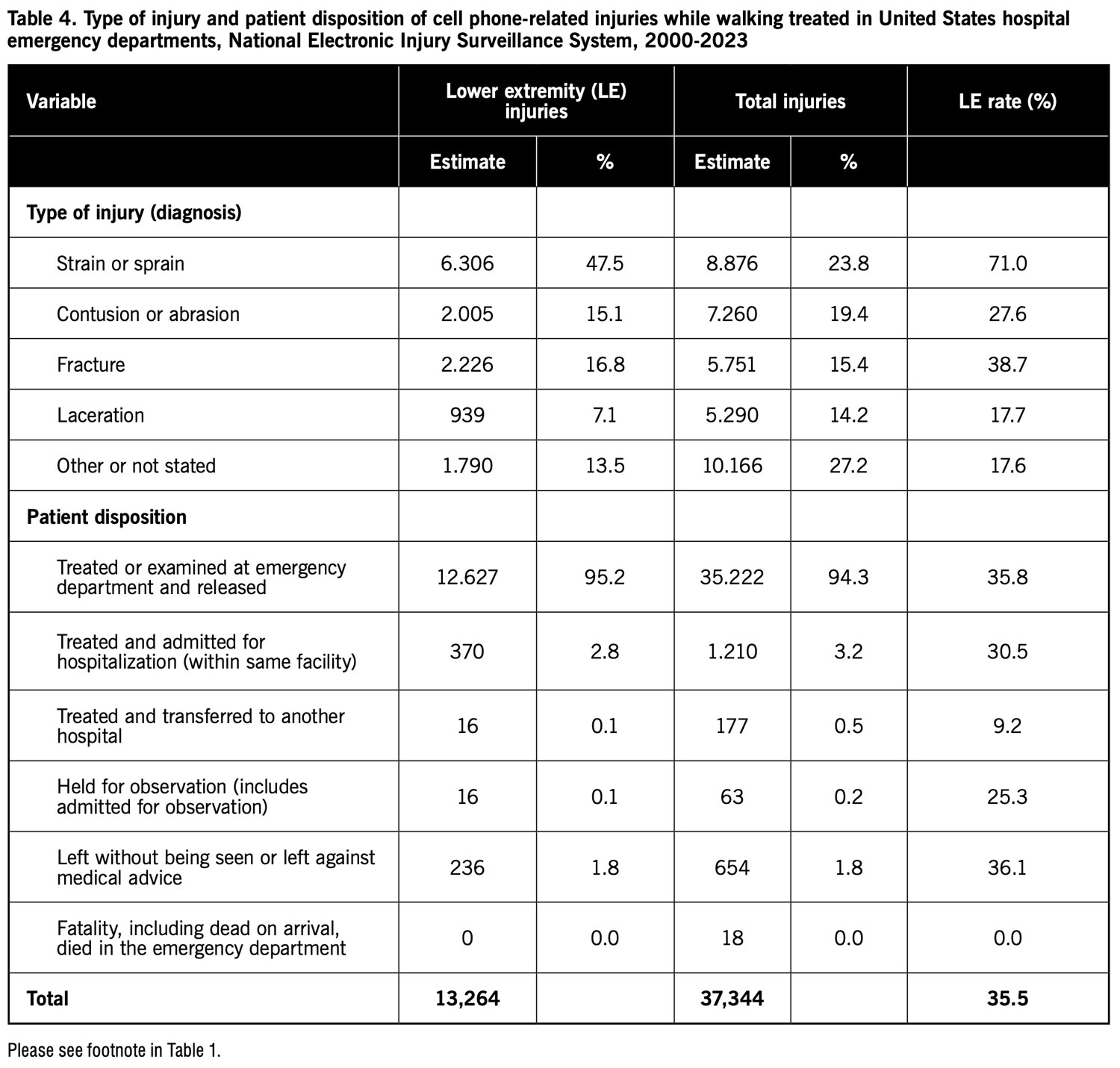
Table 4 provides the distribution of cell phone-related injuries while walking by the type of injury (diagnosis) and patient disposition. For cell phone-related lower extremity injuries while walking, the most common type of injury was strain or sprain followed by fracture, contusion or abrasion, and laceration. For cell phone-related injuries while walking affecting all body parts, the most common type of injury was strain or sprain followed by contusion or abrasion, fracture, and laceration. The lower extremity rate was highest for strain or sprain and lowest for laceration. Most of the patients were treated or examined in the ED and released. There was 1 fatality case, resulting in a national estimate of 18 fatalities.

 Discussion
Ninety-seven percent of people in the US own a cell phone.1 Consequently, millions of people are at risk of cell phone-related injury, including when using or carrying a cell phone while walking.2-4 Although a portion of these injuries may affect the lower extremity, literature on cell phone-related lower extremity injuries while walking is limited.
This study found that most of both lower extremity injuries and total injuries occurred while the patient was texting on or looking at a cellphone while a smaller proportion occurred while the patient was talking on a cell phone. Texting might be more distracting since the person usually has to look at the cell phone while texting. In contrast, a person usually can more easily observe their surroundings while talking on a cell phone. Another possible explanation for the lower proportion of injuries that occurred while the patient was talking on a cell phone could be that such cases might have been more likely to have been excluded from the study, particularly if the injury occurred at home. If the record Narrative stated that a person was talking on a phone while walking at home but did not state that phone was a cell phone, the record would not have been included in the analysis because the person could have been using a cordless landline phone. This would not have been the situation if the Narrative stated that a person was texting on or looking at a phone while walking at home but did not state that it was a cell phone because the phone would likely be a cell phone.
For both lower extremity injuries and total injuries, most of the injuries involved a fall followed by hitting or being hit by another object and hitting or being hit by a vehicle. However, the lower extremity rate was higher for injuries that occurred from falls and hitting or being hit by a vehicle than from hitting or being hit by another object. This suggests that the mechanisms differ in which body parts will likely experience injury, a factor which may need to be taken into consideration when creating prevention activities. Furthermore, the observation that the mechanisms differ in risk of lower extremity injuries might account for the difference in lower extremity rates observed among the subgroups of other examined factors. For example, the observation that the lower extremity rate was higher for injuries that occurred while texting on or looking at a cell phone than while talking on a cell phone could partially be due to differences in the mechanisms of injury between these two activities.
The estimated number of cell phone-related injuries while walking increased during 2000-2019 for both lower extremity injuries and total injuries. Other studies using NEISS data also observed an increase in the estimated number of cell phone-related injuries while walking.2-4 This increase is likely due to an increase in the number of people owning cell phones.1 Alternately, it may be that the hospital staff providing records to NEISS increasingly documented in the Narrative field that the injury was related to cell phone use or possession while walking. Interestingly, the estimated number of cell phone-related injuries while walking declined slightly during 2020-2023. This may be due to the number of cell phone owners increasing only slightly during this time period. The January 2024 Pew Research Center fact sheet indicates that the proportion of people in the US with cell phones increased from 62% in 2002 to 96% in 2019 but only further increased to 97% in 2023.1 Alternately, in recent years, people may have become more aware of the hazards of using a cell phone while walking and become less likely to do so.
For both lower extremity injuries and total injuries, the highest proportion of cell phone-related injuries while walking occurred at other public property followed by home and street or highway. This indicates that such injuries don’t occur primarily on the street but other places as well, even at home. That the lower extremity rate varied by the location of the incident suggests that the mechanism of the injuries may vary by location. That a small portion of the injuries occurred at school is important for several reasons. First, injuries that occur at school are likely to involve children, who may be at increased risk of certain injuries. Second, currently, there are efforts to reduce or eliminate cell phone use by students in school.18 If the use of cell phones in school is reduced, then cell phone-related injuries in school also should decline.
 For both lower extremity injuries and total injuries, the majority of patients were aged 13-39 years, and most patients were female. These results were similar to those reported by previous studies using NEISS data,2-4 although one of the studies reported a higher proportion of the patients were male.3 It may be that adolescents and younger adults and females are more likely to use or carry cell phones while walking. Alternately, people of this age and gender may be at increased risk of injury while using a cell phone while walking. In either event, prevention and education activities might need to target these demographic groups.
Cell phone-related injuries while walking affecting both the lower extremity and all body parts most often involved a sprain or strain with contusion or abrasion and fracture being the next most common injury and laceration being the least common type of injury. Most patients with these types of injury might be expected to require less extensive medical care. This study found that most patients were treated or examined at the hospital ED and released. However, 3.0% of the patients experiencing lower extremity injuries and 3.9% experiencing total injuries were admitted for hospitalization, held for observation, or transferred to another hospital, and there was 1 reported fatality. Thus, although relatively uncommon, using or carrying a cell phone while walking can lead to injury requiring more extensive management or even death.
There are limitations to this study. The NEISS database does not have any way to easily identify cell phone-related injuries. To identify cases, first, all records where the product code for telephones or telephone accessories was used in any of the product code fields or “phone” was used in the Narrative field were identified. Then the Narrative field for each record was reviewed to determine whether the phone was a cell phone because either “cell” or some equivalent term was used or the context indicated that the phone was a cell phone and the activity was walking while using or carrying the cell phone. Any records where the patient was using or carrying a cell phone while walking and did not meet these criteria would not have been included in the analysis. Thus, the estimated number of injuries is likely to be an underestimate. As indicated previously, this is particularly true for records where the Narrative stated that the patient was talking on a phone (but not explicitly stating a cell phone) while walking at home because the phone could have been a cordless landline phone. Furthermore, the selection of records for inclusion in the study was made by a single person. In addition, the study included only patients treated at hospital EDs. Examination of patients treated elsewhere, such as at home or by a primary care physician, would provide a more complete understanding of injuries that occur while walking with a cell phone.
In conclusion, although the estimated number of cell phone-related lower extremity injuries while walking that were treated at US hospital EDs appears to have stabilized in recent years, it remains a problem. Such injuries most often occurred while the patient was texting on or looking at the cell phone, and the majority involved a fall. While the highest proportion of the injuries occurred at other public property, the next most common location was the home. The majority of patients were aged 13-39 years—the so-called digital natives, and most patients were female. The most common type of injury was strain or sprain followed by fracture, contusion or abrasion, and laceration. The results of this study may be useful for creating educational activities that can reduce the occurrence of these injuries.
Mathias B. Forrester, BS, is an independent researcher in Austin, Texas. Now retired, he has performed public health research for various university and government programs for 38 years.
- Pew Research Center. Mobile fact sheet. January 31, 2024. Available at https://www.pewresearch.org/internet/fact-sheet/mobile/. Accessed September 16, 2024.
- Zheng H, Giang WCW. Risk perception and distraction engagement with smart devices in different types of walking environments. Accid Anal Prev. 2021;162:106405.
- Nasar JL, Troyer D. Pedestrian injuries due to mobile phone use in public places. Accid Anal Prev. 2013;57:91-95.
- Smith DC, Schreiber KM, Saltos A, Lichenstein SB, Lichenstein R. Ambulatory cell phone injuries in the United States: an emerging national concern. J Safety Res. 2013;47:19-23.
- Russo BJ, James E, Aguilar CY, Smaglik EJ. Pedestrian behavior at signalized intersection crosswalks: Observational study of factors associated with distracted walking, pedestrian violations, and walking speed. Trans Res Rec. 2018;2672(35):1-12.
- Barkley JE, Lepp A. Cellular telephone use during free-living walking significantly reduces average walking speed. BMC Res Notes. 2016;9:195.
- Basch CH, Ethan D, Rajan S, Basch CE. Technology-related distracted walking behaviours in Manhattan’s most dangerous intersections. J Community Health. 2015;40(4):789-792.
- Thompson LL, Rivara FP, Ayyagari RC, Ebel BE. Impact of social and technological distraction on pedestrian crossing behaviour: an observational study. Inj Prev. 2013;19(4):232-237.
- Luo Y, Grimaldi N, Zheng H, Giang WCW, Hu B. Distraction from smartphones changed pedestrians’ walking behaviors in open areas. Motor Control. 2022;27(2):275-292.
- Lamberg EM, Muratori LM. Cell phones change the way we walk. Gait Posture. 2012;35(4):688-690.
- Hyman IE, Boss SM, Wise BM, McKenzie KE, Caggiano JM. Did you see the unicycling clown? Inattentional blindness while walking and talking on a cell phone. Appl Cogn Psychol. 2010;24(2):597-607.
- Nasar J, Hecht P, Wener R. Mobile telephones, distracted attention, and pedestrian safety. Accid Anal Prev. 2008;40(1):69-75.
- Forrester MB. Pickleball-related injuries involving the lower extremity treated in emergency departments. Lower Extremity Review. 2021;13(5):24-30.
- United States Consumer Product Safety Commission. National Electronic Injury Surveillance System (NEISS). Available at https://www.cpsc.gov/Research–Statistics/NEISS-Injury-Data/Explanation-Of-NEISS-Estimates-Obtained-Through-The-CPSC-Website. Accessed March 20, 2023.
- United States Consumer Product Safety Commission. NEISS Coding Manual. January 2021. Available at https://www.cpsc.gov/s3fs-public/January-2021-NT-CPSC-only-NEISS-Coding-Manual.pdf?xa_nMM1kB4SGpuSMOwf0NHkkkIqNcn8F. Accessed March 20, 2023.
- McLaughlin WM, Cravez E, Caruana DL, Wilhelm C, Modrak M, Gardner EC. An epidemiological study of cell phone-related injuries of the hand and wrist reported in United States emergency departments from 2011 to 2020. J Hand Surg Glob Online. 2023;5(2):184-188.
- Guyon PW Jr, Corroon J, Ferran K, Hollenbach K, Nguyen M. Hold the phone! Cell phone-related injuries in children, teens, and young adults are on the rise. Glob Pediatr Health. 2020;7:2333794X20968459.
- Chernikoff S. States weigh school cell phone bans atop district policies. USA Today. June 9, 2024. Available at https://www.usatoday.com/story/news/education/2024/06/09/cell-phone-school-laws/73975232007/. Accessed September 25, 2024.