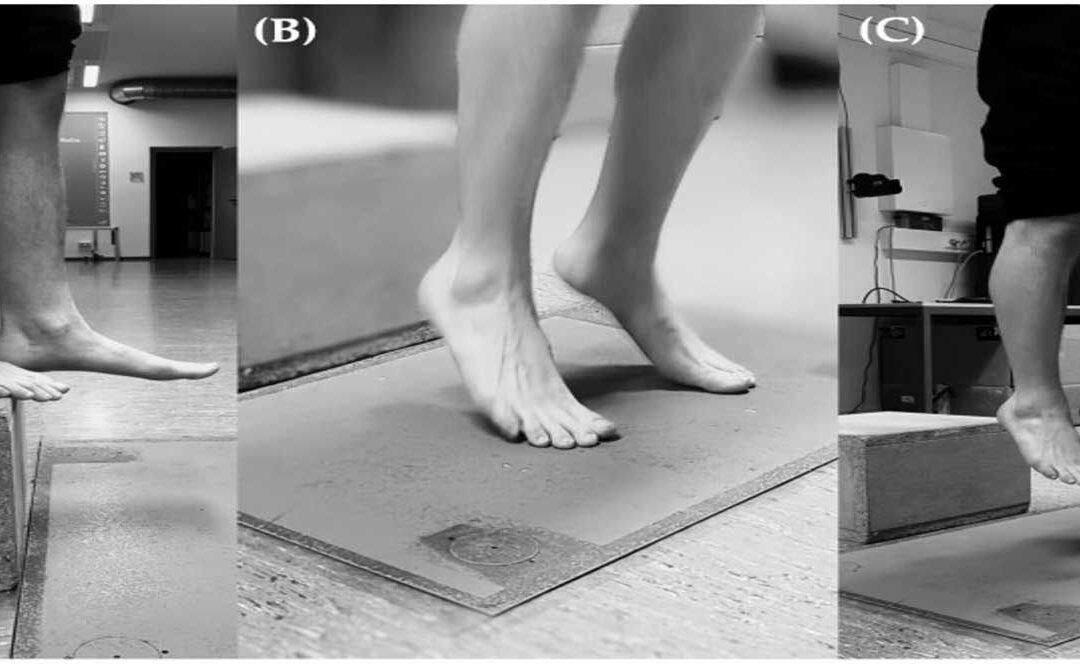








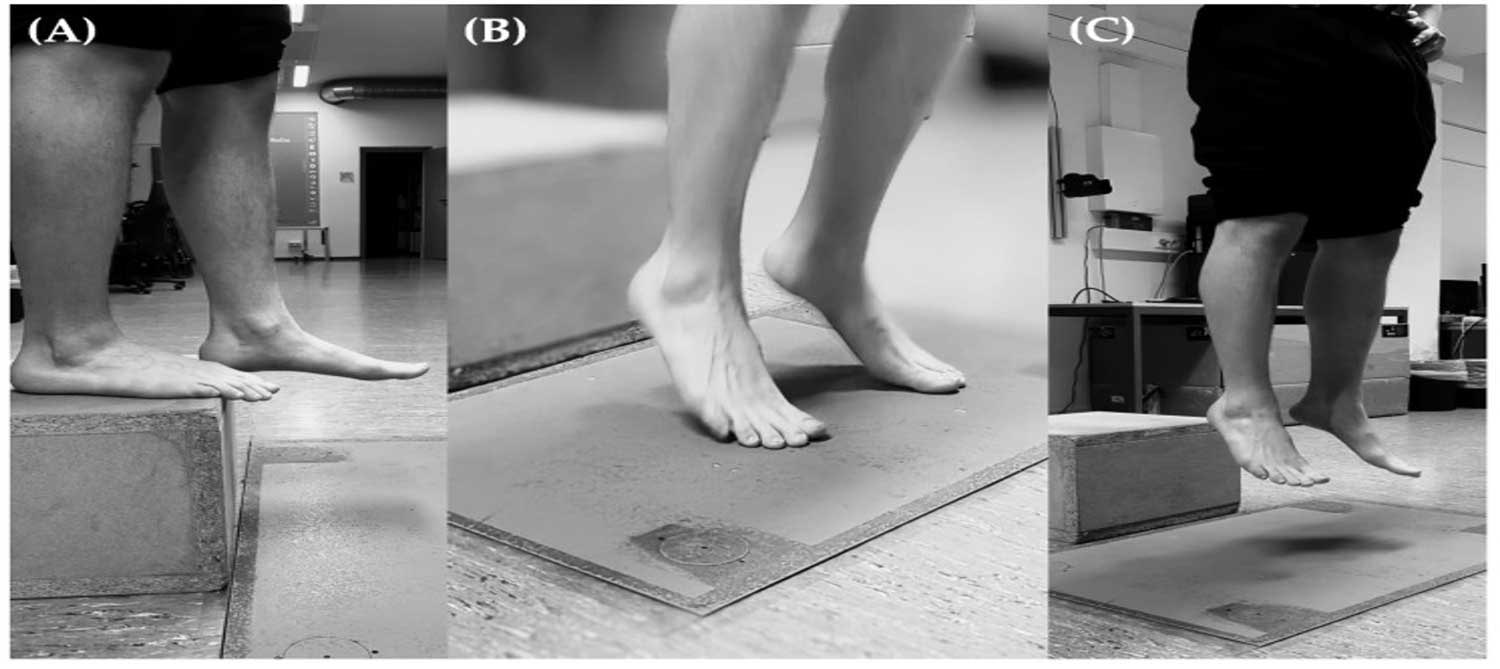
An exemplary illustration of a drop jump performed: (A) starting position at the edge of the box (fall height 30 cm), (B) toe contact with the ground (force plate), and (C) take-off/flight phase after initial ground contact.
Tendon properties influence athletic performance, and Achilles tendon (AT) stiffness correlates with an athlete’s jumping performance across sports. This study examined the relationship between AT stiffness and jumping performance in male athletes. Sixty-six males (24.9 ± 4.7 years; 22 basketball players (22.0 ± 4.1 years), and 44 soccer players (26.3 ± 4.4 years) participated. Reactive jumping performance (reactive strength index (RSI), jump height (JH), and ground contact time (GCT)) were assessed using drop jumps (fall height: 30 cm), and AT stiffness (supine position) was measured using the MyotonPro. Soccer players had a significantly higher AT stiffness (826.8 ± 90.5 N/m) than basketball players (754.1 ± 80.1 N/m, P = 0.002), but no differences were found in JH, RSI, or GCT (P > 0.05). JH and AT stiffness significantly correlated in basketball players (r = 0.448) but not in soccer players (r < 0.100). The multiple linear regression indicated that AT stiffness is significantly influenced by the sport type (soccer or basketball), while age, mass, and height remained non-significant. Despite higher AT stiffness in soccer players (which can be explained by different activity regimens), a moderate correlation between jumping performance and AT stiffness was evident only in basketball. Given the versatile demands of both sports, tendon characteristics appear to have an influence on jumping performance. For future studies, investigating tendon characteristics represents a valuable addition to training and therapy scheduling.
Source: Schmidt D, Verderber L, Germano A, Nitzsche N. Correlations between achilles tendon stiffness and jumping performance: a comparative study of soccer and basketball athletes. J Funct Morphol Kinesiol. 2025 28;10(2):112. doi: 10.3390/jfmk10020112.