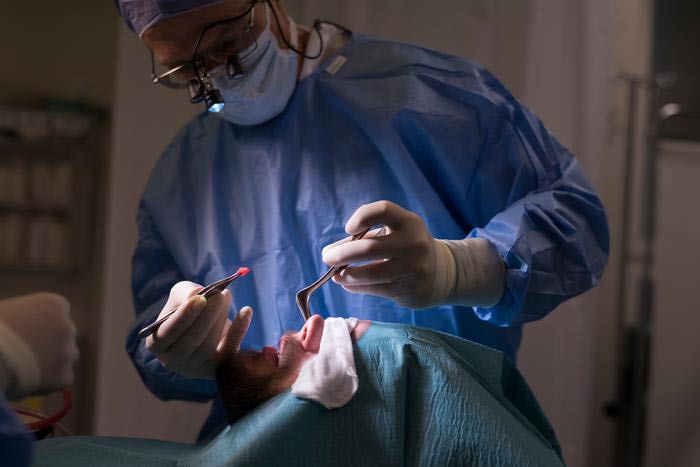
Human articular cartilage defects can be treated with cells taken from the nasal septum. Photo courtesy of University of Basel, Christian Flierl.
Researchers at Switzerland’s University of Basel and University Hospital Basel are developing cartilage implants using cells from the patient’s nasal septum and then allowing them to multiply in the laboratory on a scaffold made of soft fibers. Finally, the newly grown cartilage is cut into the required shape and implanted into the knee joint. Their work shows that giving these cartilage implants more time to mature significantly improved clinical efficacy, even in patients with complex cartilage injuries. This suggests that the method could also be suitable for the treatment of degenerated cartilage in osteoarthritis. Earlier studies have already shown promising results.
In a clinical trial involving 98 participants at clinics in 4 countries, the researchers compared 2 experimental approaches. One group received cartilage grafts that had matured in the lab for 2 days before implantation—similar to other cartilage replacement products. For the other group, the grafts were allowed to mature for 2 weeks, during which time the tissue acquires characteristics similar to native cartilage.
For 24 months after the procedure, the participants self-assessed their well-being and the functionality of the treated knee through questionnaires. While both groups showed a clear improvement, patients who received more mature engineered cartilage continued to improve even in the second year following the procedure, overtaking the group with less mature cartilage grafts. The more mature cartilage grafts also resulted in better tissue composition at the site of the implant, and even of the neighboring cartilage. The additional maturation time of the implant only requires a slight increase in effort and manufacturing costs, and gives much better results.