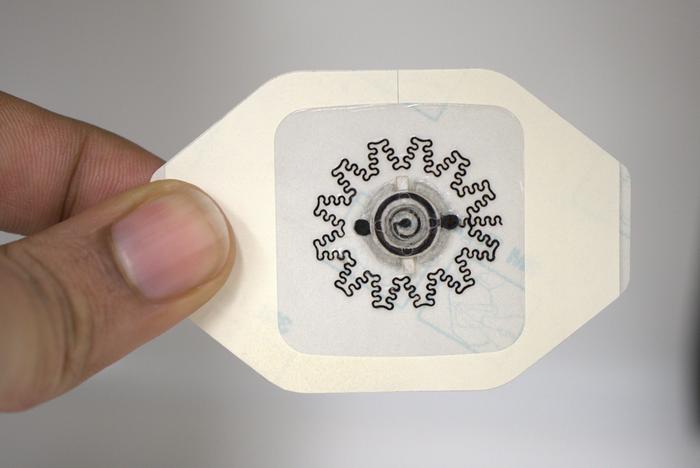
With additional testing, the researchers will get closer to clinical trials and—ultimately—practical usage. Image courtesy of Kaveti.
Researchers at North Carolina State University (NC State) and Columbia University have developed an inexpensive bandage that uses an electric field to promote healing in chronic wounds. In animal testing, wounds that were treated with these electric bandages healed 30% faster than wounds treated with conventional bandages.
Specifically, the research team developed water-powered, electronics-free dressings (WPEDs), which are disposable wound dressings that have electrodes on 1 side and a small, biocompatible battery on the other. The dressing is applied to a patient so that the electrodes come into contact with the wound. A drop of water is then applied to the battery, activating it. Once activated, the bandage produces an electric field for several hours.
“That electric field is critical, because it’s well established that electric fields accelerate healing in chronic wounds,” said Rajaram Kaveti, PHD, a researcher at NC State.
The electrodes are designed in a way that allows them to bend with the bandage and conform to the surface of the chronic wounds, which are often deep and irregularly shaped. With the ability to conform to the wound’s surface, the electric field is able to be directed from the periphery of the wound toward the wound’s center. To focus the electric field effectively, the electrodes need to be in contact with the patient at both the periphery and center of the wound itself. And since these wounds can be asymmetrical and deep, the electrodes need to conform to a wide variety of surface features.
In addition, the WPEDs can be applied quickly and easily. And once applied, patients can move around and take part in daily activities. This functionality means that patients can receive treatment at home and are more likely to comply with treatment.
“Next steps for us include additional work to fine-tune our ability to reduce fluctuations in the electric field and extend the duration of the field,” said Amay Bandodkar, PhD, an NC State assistant professor of electrical and computer engineering.