








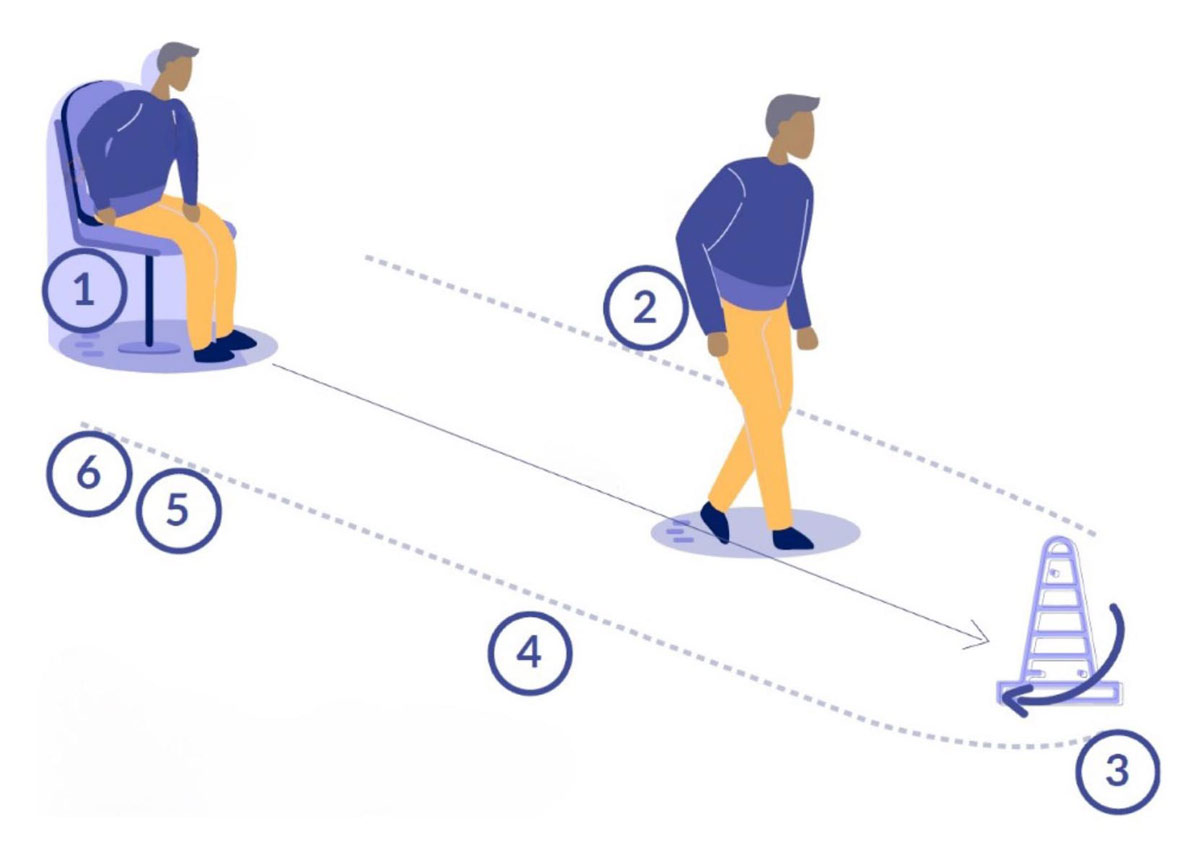
Timed Up and Go test with the different sub-phases after the most complete segmentation. (1) Standing. (2) Go Walking. (3) Three-meter turning. (4) Return Walking. (5) Pre-sitting turning. (6) Sitting. Image reprinted from Ortega-Bastidas P, Gómez B, Aqueveque P, Luarte-Martínez S, Cano-de-la-Cuerda R. Instrumented Timed Up and Go Test (iTUG)—More Than Assessing Time to Predict Falls: A Systematic Review. Sensors. 2023; 23(7):3426. https://doi.org/10.3390/s23073426. Use is per Creative Commons Attribution (CC BY) license.
…May Effectively Improve Walking, Balance, Overall Mobility
Backward Walking (BW), as compared with Forward Walking (FW), is known to better differentiate fallers from nonfallers in people with multiple sclerosis (MS). However, the effectiveness of BW training in improving walking and balance in the MS population is now well studied. Researchers from Wayne State University used interim data from an ongoing study to examine the issue.
24 people with MS participated in an 8-week study that randomly assigned them to either a FW training or BW training session; each session consisted of 1 time a week during in-person visits with a physical therapists and 2 times a week with at-home exercises. Sessions included FW and BW at comfortable and fast speeds as well as standing balance assessments.
The research team reported that small effects were identified for group differences in fast FW forward velocity (MD = 0.94, t = 0.96, df = 22, P = .35, d = 0.39) and BW comfortable velocity (MD = 2.87, t = 0.74, df = 22, P = .47, d = 0.3), with the BW group depicting larger improvements.
These findings, the authors concluded, highlight the promise of BW training in people with MS and they went on to suggest that BW training may provide an effective means of improving walking as well as balance and overall functional mobility in this population.
Source: Monaghan PG, VanNostrand M, Abbawi M, Fritz NE. (REH17) Backward Is the Way Forward: Preliminary Effectiveness of a Backward Walking Intervention in People With Multiple Sclerosis. Int J MS Care. 2024;26(S1):86.
…Can Improve Motor Function
Previous research has shown that backward walking (BW) velocity in addition to MRI measures may improve fall prediction for people with MS. Researchers from Wayne State University used a case series to examine the impact of an 8-week training program to improve BW. Outcome measures included several structural brain measures as well as associated changes in gait, postural control, and falls. Tasks included functional tests (backward- and forward-walking velocity; sway during an eyes-closed, feet-together [ECFT] balance task; postural latency of stepping in reactive balance) and 3T MRI before and after the 8-week intervention, which included treadmill and overground BW once per week and home exercises twice per week. Falls were monitored for 6 months after the intervention.
The pilot study included 8 participants with relapsing-remitting MS (2 men, 6 women; age range, 51-65 years; Patient Determined Disease Steps score range, 1-5). Participants were divided into quartiles by BW speed.
At the end of the 8-week intervention:
- 7 participants had documented changes in brain structure which was associated with forward walking (4/8) and BW velocity (6/8).
- All participants improved sway metrics in the ECFT task.
- 7 participants improved reactive stepping responses.
- 2 could not generate reactive steps backwards before training but were able to after.
- 4 participants improved their walking enough to move quartiles and reduce their fall risk.
Source: Abbawi M, Stanley JA, Yu B, Myers E, Fritz NE. (CS14) Backward-Walking Training Can Improve Motor Function and Brain Structure in Patients With MS: A Case Series. Int J MS Care. 2024;26(S1):24.
…May Improve Proprioception for Better Balance
The slowed somatosensory conduction associated with MS increases postural instability and reduces proprioception, yet prior research has shown people with MS have greater reliance on proprioception for balance. This paradox contributes to increased fall risk for this population. While prior research has focused on stationary balance and forward walking (FW), backward walking (BW) is more sensitive to predicting fall risk, most likely due to greater reliance on proprioception and lack of visual cues. These authors present an interim report on their study to examine the role proprioception plays in BW compared to FW.
To date, 35 participants (30 with relapsing-remitting disease, 3 with primary progressive disease, 2 with secondary progressive disease) had completed BW and FW trials at 2 speeds (comfortable and fast) on the GaitRite® walkway using vibration as a proxy measure for proprioception. Vibration thresholds were quantified at the great toe bilaterally using a 2-alternative forced-choice procedure.
Their findings show a significant correlation for vibration sensation and FW comfortable, FW fast, BW comfortable, and BW fast (all P <.01). They note that vibration sensation significantly predicted performance during all walking tasks with larger larger β coefficients seen during the BW tasks (comfortable β = 0.75; fast β = 0.74) as compared with FW (comfortable β = 0.67; fast β = 0.70).
They conclude that there is significant clinical relevance for conducting fall risk assessments and interventions that evaluate and enhance proprioception and advocate for BW as a more effective approach for assessing fall risk and as a more efficacious exercise intervention modality.
Source: VanNostrand M, Monaghan PG, Fritz NE. (REH13) Examination of Proprioceptive Reliance During Backward Walking in Individuals With Multiple Sclerosis. Int J MS Care. 2024;26(S1):85.
…May Help With Concerns About Falling and Fall Risk
More research from Wayne State university advocates for incorporating measures of concerns about falling (CAF) in fall risk assessments and prevention efforts as it has greater predictive value than prior fall history. In this single session study, 34 participants with relapsing-remitting MS did a comprehensive battery of motor and cognitive testing and then reported the number of weekly falls for the next 3 months. Prospective falls were highly correlated with Patient Determined Disease Steps (PDDS), CAF, and retrospective fall history, and moderately correlated with balance, forward and backward walking speed, retrospective fall history, and executive functioning. (all P ≤.01).
Source: Takla TN, Monaghan PM, Abbawi M, VanNostrand M, Fritz NE. (REH21) Predictors of Falls and Concern About Falling in People With Relapsing-Remitting Multiple Sclerosis. Int J MS Care. 2024;26(S1):85.
…May Be Effective in Improving Reactive Balance Strategies
The neurological impairments of multiple sclerosis (MS) can include decreased walking speed, reactive balance, and functional mobility, which all contribute to falls. In looking for ways to improve reactive balance strategies, researchers from Nazareth University in Rochester, New York, wanted to examine perturbation-based balance training (PBBT), which has been reported to be more effective than typical balance training in reducing slip-falls while improving reactive balance. Their current study included 7 participants (6 with relapsing-remitting MS, 1 with secondary progressive disease) with an Expanded Disability Status Scale score < 6. Tests included Timed Up and Go (TUG), Timed Up and Go Dual Task (TUGDT), 3-Meter Backward Walking (BW), and Mini Balance Evaluation Systems (MiniBEST) reactive portion. Scores were assessed 1 week before the intervention (pretest), 1 week after the intervention (posttest1), and at a 5-month follow-up (posttest2). The intervention was 1 session of PBBT using a slip trainer platform with a dynamic overhead harness for 4 2-minute trials.
The researchers found that 1 session of PBBT improved BW in people with MS, potentially decreasing fall risk. Further, they found that the clinical effect on TUGDT indicated a maintained improvement at the 5-month follow-up, which suggests PBBT may be influential in preventing a decline in predictive fall risk outcome scores despite the progressive nature of the disease.

They concluded that a single session of PBBT may be effective in improving fall risk outcome measures in MS in a clinic setting where time and resources are limited.
Source: Vore ME, Bonino S. (REH12) Effect of a Single Session of Perturbation Training on Individuals with Multiple Sclerosis. Int J MS Care. 2024;26(S1):85.