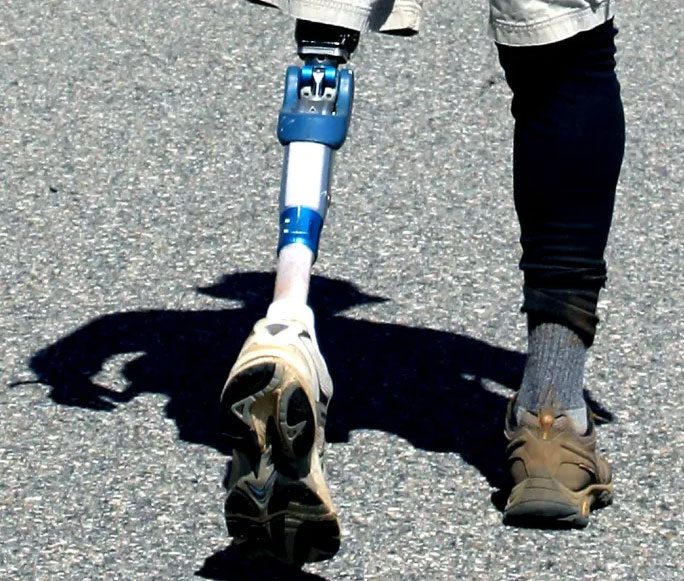
ETH researchers have developed a prosthetic leg that communicates with the brain via natural signals. Image courtesy of Keystone.
Swiss researchers have developed a special prosthesis that enables amputees to feel the ground better when walking. This is thanks to a new method that allows sensors in the sole of the prosthesis to communicate more naturally with the brain. “The prosthesis feels more like a part of the body,” Stanisa Raspopovic, PhD, from ETH Zurich told the Keystone-SDA news agency.
The 3 patients on whom the new signal transmission was tested were able to move faster and more safely. “Greater mobility is ultimately also good for health,” said Raspopovic. According to the researcher, the test subjects were also able to concentrate on other things while walking. For example, they made fewer mistakes when trying to spell words backward while climbing stairs.
Prostheses that are connected to the nervous system have been around for several years. However, according to Raspopovic, these lead to unpleasant sensations in patients, such as an annoying tingling sensation on the skin due to the signals being transmitted via constant electrical pulsations. This is where Raspopovic’s research team came in. The researchers relied on biomimetic stimulation—signals that were modelled on nature. “We have learnt the language of the nervous system, so to speak,” explained Raspopovic.
To this end, PhD student Natalija Katic developed a computer model called FootSim, stated a ETH Zurich press release. It is based on data that records the activity of special sensory cells in the sole of the foot. The computer model shows exactly how the sensory cells in the soles of the feet behave during walking or running.
To test how well the model simulates the signals from the sole of the foot, the researchers first implanted electrodes in the leg nerve and spinal cord of cats. When they applied pressure to the cat’s paw from below to generate the natural nerve activity during a cat’s step, the activity patterns recorded in the spinal cord actually resembled the patterns that occurred in the spinal cord after the researchers had stimulated the nerve in the leg with biomimetic signals. In contrast, the conventional rigid stimulation produced a significantly different pattern in the spinal cord of the cats. According to Raspopovic, this shows that biomimetic stimulation is superior to conventional stimulation.