







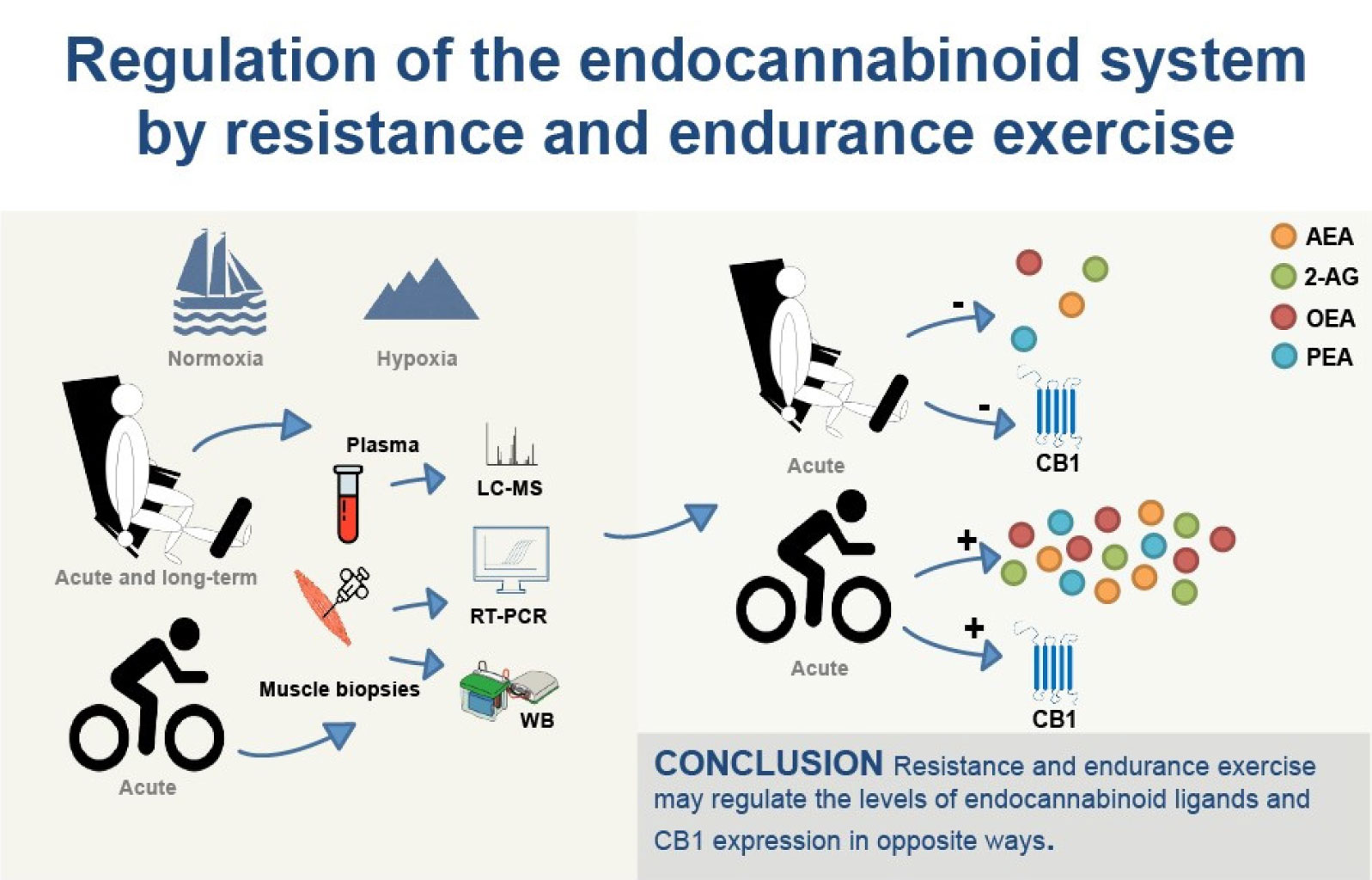
 In a first-of-its-kind study, researchers from the Institute of Neuroscience, Université Catholique de Louvain, Louvain-la-Neuve, Belgium, investigated the regulation of the endocannabinoid system using several exercise paradigms in human skeletal muscle. They also compared endocannabinoid regulation in healthy and prediabetic people in response to an acute endurance exercise. Blood and muscle samples were taken before and after resistance and endurance exercise in normoxia and hypoxia to measure plasma endocannabinoid levels as well as muscle protein expression of CB1, CB2, and downstream signaling. They found that:
- an acute resistance exercise session decreased plasma 2-AG and N-palmitoylethanolamine (PEA) levels in normoxia;
- 4-wk resistance training decreased plasma AEA, PEA, and N-oleoylethanolamine (OEA) levels in both normoxia andhypoxia;
- an acute moderate-intensity endurance exercise increased plasma OEA levels in the healthy and prediabetic groups in normoxia and hypoxia, whereas plasma 2-AG levels increased in the healthy group and AEA in the prediabetic group only in normoxia.
Overall, the expression of the cannabinoid receptors was only marginally regulated by acute exercise, hypoxia, and prediabetes, and downstream signaling did not follow the changes detected in the endocannabinoid ligands. According to the research team, these results suggest that resistance and endurance exercise regulate the levels of the endocannabinoid ligands and CB1 expression in opposite ways.
These findings, which were published in the Journal of Applied Physiology were noteworthy as the first to analyze both endocannabinoids ligands and receptors in response to endurance and resistance exercise. Additionally, no prior study had compared both exercise paradigms regarding endocannabinoid tone, which is of interest as endocannabinoids regulate energy metabolism, and these are different between endurance and resistance exercise. Furthermore, the team investigated whether the endocannabinoid tone was differently regulated in response to acute endurance exercise in prediabetic people – linking exercise, endocannabinoids and (pre)diabetic people had never been done before.
Source: van Doorslaer de Ten Ryen S, Dalle S, Terrasi R, Koppo K, Muccioli GG, Deldicque L. Regulation of the endocannabinoid system by endurance and resistance exercise in hypoxia in human skeletal muscle. J Appl Physiol (1985). 2023;134(3):569-580. doi: 10.1152/japplphysiol.00645.2022.