 By Cylie M. Williams, Stewart C. Morrison, Kade Paterson, Katherine Gobbi, Sam Burton, Matthew Hill, Emma Harber, and Helen Banwell
Footwear is a global business, with small and large companies co-existing, often purporting design differences or mechanical properties as their ‘edge’ within a competitive market. There is little consistency between commercial grade footwear brands for determinants of shoe sizing, and no universally accepted descriptors of common types or features of footwear. This can be problematic when specific footwear features are prescribed by health professionals as part of a therapeutic intervention.
Children’s footwear plays an important role in protecting and supporting the growing foot. This is of particular importance in the younger child, from new walkers until around 6 years of age, as they typically engage in increasingly complex bipedal activities during a time of increased tissue plasticity. The purchase of children’s footwear is a common source of angst for parents. This angst can be heightened when children present with disability or developmental concerns, where specific footwear features may assist in achieving, improving, or maintaining ambulation. The lack of consistency in descriptors of footwear types and features can stymie both health professionals and parents as it is typically dependent on the individual retail center to interpret prescribed or recommended inclusions.
The primary aim of this research was to develop a footwear taxonomy through international consensus about the types of footwear commonly worn by children under the age of 6. Secondary aims were to gain consensus of the common footwear features, when different types of footwear would be commonly worn, common terms for key footwear parts, and how movement at some of these footwear parts should be described.
Methods
Opinions were collected through a 3-round modified Delphi international online survey from parents, health professionals, researchers, and footwear industry professionals. There were 159 participants who consented to complete the first round. The first survey displayed generic pictures about different footwear types and asked participants to provide a grouping term, when the footwear would be worn (for what type of activity) and any grouping features. The second and third rounds presented consensus.
Results
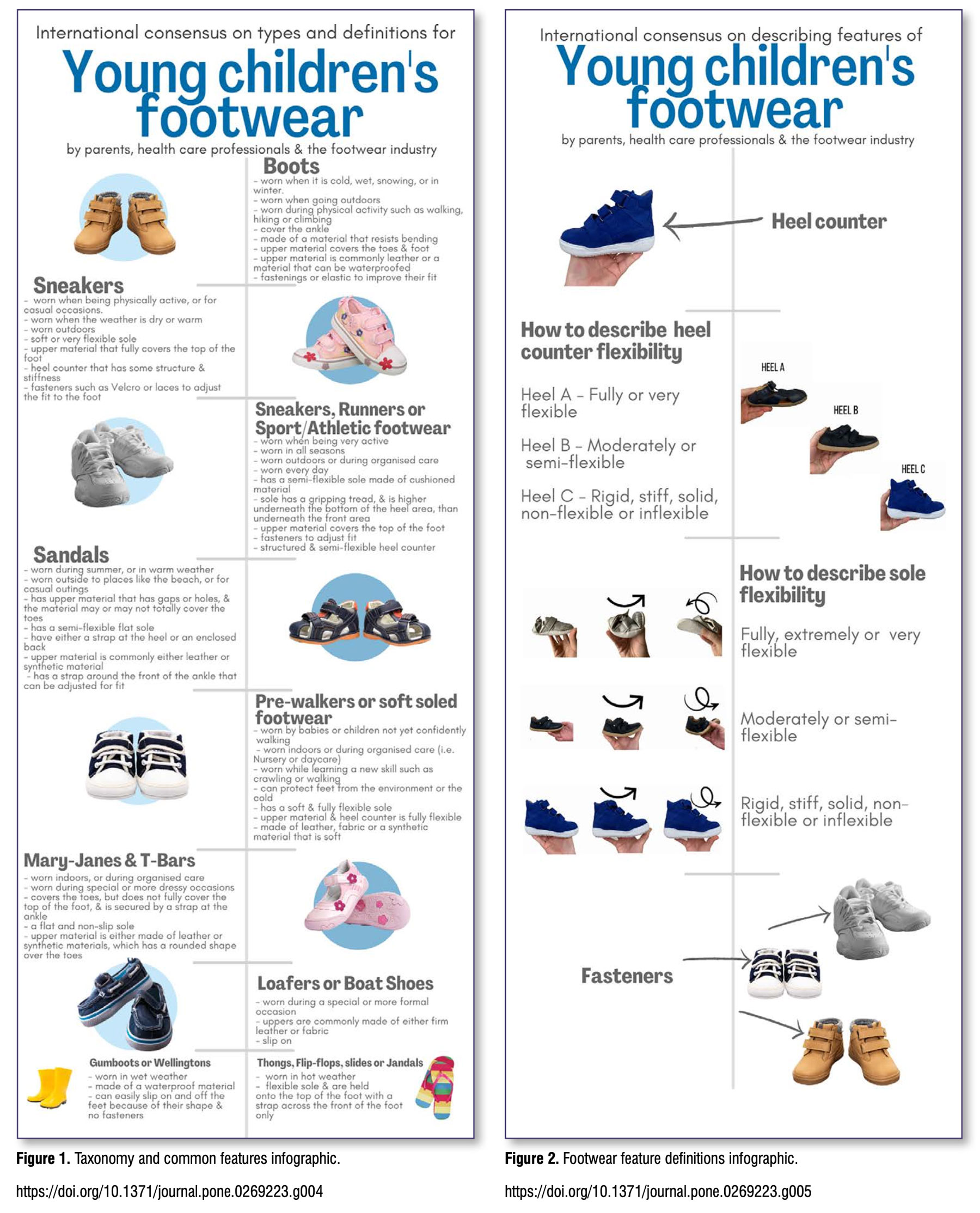
There were 121 participants who provided detailed feedback to open-ended questions. The final round resulted in consensus and agreement on the names of 14 different footwear types (Figure 1), when they are commonly worn and their common features. Participants also reached consensus and agreement on the terms heel counter to describe the back part of footwear (Figure 2) and fixtures as the collective term for features allowing footwear adjustability and fastening. They also agreed on terms to quantify the flexibility at footwear sole (bend or twist) or the heel counter.
Discussion
This study offers the first taxonomy for young children’s footwear developed by consensus in consultation with footwear industry professionals, health professionals, and parents. This work was undertaken to respond to persistent challenges with promoting clarity about footwear information, and transparency with footwear research. This taxonomy is a useful resource of contemporary terms and features of footwear, to guide terminology, research, and descriptors provided in clinical practice and footwear retail.
Footwear has long been considered a factor impacting on foot development alongside the attainment and improvement of motor skills. Footwear is an external factor that can influence children’s gait and differences in motor skill, meaning that greater consideration of footwear recommendations for toddlers and young children are required. In recent years, the focus on footwear dimensions and fit has been explored but there has also been a shift toward understanding the effects of footwear characteristics on biomechanical outcomes and identifying what features should typify shoes for infants and young children.
Parents often report concerns about footwear choices for their children and health professionals have an important role providing footwear education for consumers, but especially parents. These findings are a prerequisite to conversations in practice about footwear choices for children and will assist clinicians with evolving and implementing age-appropriate footwear advice and helping parents to navigate footwear recommendations.
Conclusion
This taxonomy represents consensus amongst parents, health professionals, and footwear designers and retailers, and is an important step in enabling consistency in footwear research. One shoe does not fit all purposes, and the recommendations from this work help to inform the next steps toward ensuring greater transparency and commonality with footwear recommendations for parent.
This article has been excerpted from “Young Children’s Footwear Taxonomy: An International Delphi Survey of Parents, Health and Footwear Industry Professionals,” from the same authors, which was published in PLoS ONE. 2022 Jun 9;17(6):e0269223. doi: 10.1371/journal.pone.0269223. Editing has occurred, including the renumbering of tables and figures, and references have been removed for brevity. Use is per CC Attribution 4.0 International License.