






 By Mathias B. Forrester, BS
Background: Milk crates can be found in many homes and are used for a variety of purposes. While milk crates may result in injuries, the literature on such injuries is limited. This study described milk crate-related lower extremity injuries treated at United States (US) emergency departments (EDs).
Methods: An analysis was performed of milk crate-related lower extremity injuries using data from the National Electronic Injury Surveillance System of the US Consumer Product Safety Commission during 2000-2021.
Results: An estimated 8,107 milk crate-related lower extremity injuries treated at US hospital EDs during 2000-2021 were identified. The most common circumstance leading to injury was 34.4% fell off milk crate, 23.0% struck milk crate (didn’t fall), and 12.9% tripped over milk crate. The most common types of injuries were contusion or abrasion (26.5%), strain or sprain (23.0%), fracture (13.3%), and laceration (10.1%). The affected body part was 27.5% lower leg, 22.8% ankle, 18.8% foot, 16.2% toe, 12.7% knee, and 3.0% upper leg. The patient was treated or examined at the ED and then released in 98.1% of cases.
Conclusions: The highest proportion of milk crate-related lower extremity injuries involved the patient falling off a milk crate followed by being struck by a milk crate and tripping over a milk crate. The most common type of lower extremity injury was contusion or abrasion. The lower leg was the most frequently affected part followed by the ankle. The majority of patients were treated or examined in the ED and released.
Milk crates are square or rectangular boxes usually made of plastic with holes on the sides and bottom. Their exterior is designed so the crates interlock, allowing them to be easily stacked. Although they may vary in size, milk crates in the United States (US) are usually 12-13 inches wide and 10.5-11 inches tall. Originally designed to more easily transport milk containers,1-3 milk crates can be found in many homes and are used for a variety of purposes, such as to store other items like files, vinyl records, and clothes; bicycle basket; TV stand; planter; shelving; and stepstool.4
 Although videos of people walking across a stack of milk crates date back to at least 2011, on August 1, 2021, a Facebook post initiated the Milk Crate Challenge.5 Promoted on social media outlets such as TikTok, Instagram, Facebook, and Twitter, the Milk Crate Challenge involves stacking milk crates upside-down into a pyramid-shaped set of stairs that reach up to 7 milk crates high, then attempting to walk or run up and down the structure without destroying the structure or falling. However, because of the milk crates’ design, the structure is not very stable, and many Milk Crate Challenge posts show people falling.1,5,6 Injuries such as fractures, dislocations, and spinal cord injuries have been reported with the Milk Crate Challenge, and doctors have warned against the activity.5,6 TikTok deleted Milk Crate Challenge videos because of the potential dangers involved in the activity.5
A review of PubMed failed to identify articles on injuries involving milk crates. The objective of this study was to characterize milk crate-related lower extremity injuries in general treated at US emergency departments (EDs). In addition, injuries related to the Milk Crate Challenge were identified and described.
Methods
The source of data for this retrospective epidemiologic study was the National Electronic Injury Surveillance System (NEISS) website (https://www.cpsc.gov/cgibin/NEISSQuery/home.aspx). Operated by the US Consumer Product Safety Commission (CPSC), the NEISS collects data on consumer product-related injuries from the EDs of a stratified random sample of 100 hospitals from the more than 5,000 hospitals in the US. The random sample is stratified by hospital size, geographic location, and hospital type (general and pediatric hospitals). Professional NEISS coders view the medical charts at participating hospitals and, for patients with injuries that meet NEISS inclusion criteria, collect and code information such as treatment date; patient age, sex, and race; injury diagnosis and body part injured; discharge disposition; consumer product(s) involved in the injury; location where the incident occurred; and a brief narrative describing the incident.7,8 Data are publicly available and de-identified; thus, the study is exempt from institutional review board approval.
Cases were milk crate-related lower extremity injuries reported to the NEISS database during 2000-2021. The publicly available NEISS database contains 3 numeric fields for coding the product involved in the injury (Product_1, Product_2, Product_3). However, there is no product code specific to milk crates. The NEISS database contains a text field (field name Narrative) that provides a brief summary of the circumstances of the injury. The NEISS database was searched for all records that included the letter groups “mil” and “crat” in the Narrative field. The Narrative fields of the resulting records were individually examined, and any records that involved an injury involving a milk crate were included in the study. That the injury involved a lower extremity was based on either the Body_Part or Body_Part_2 numeric fields containing codes for a lower extremity (upper leg, knee, lower leg, ankle, foot, toe). For records received during 2021, the Narrative fields were reviewed, and any records that specifically mentioned the Milk Crate Challenge or described a scenario consistent with the Milk Crate Challenge were designated Milk Crate Challenge cases.
 The variables examined were treatment year and month (grouped into 3-month periods), patient age and sex, location where the incident occurred, number of milk crates involved in the injury, circumstances of the injury, type of injury (diagnosis), affected body part, and disposition. In order to identify the number of milk crates involved in the injury and the circumstances of the injury, the Narrative field for each record was reviewed. The circumstances of the injury were assigned to the following groups: fell off milk crate, fell and struck milk crate, tripped over milk crate, struck by milk crate, struck milk crate (but no mention of fall, e.g., someone threw a milk crate at the patient), lifting or carrying milk crate, caught in or between milk crate (e.g., caught finger in milk crate hole), jumping off or over milk crate, fell while carrying milk crate, other, and unknown. For the fell off milk crate group, further note was made as to whether the person was standing on, sitting on, or climbing off or on the milk crate when they fell. The NEISS database has 2 coded fields for documenting the diagnosis and 2 coded fields for documenting the affected body part. The NEISS Coding Manual indicates that the Diagnosis_2 and Body_Part_2 fields were added in 2018,8 although these fields do not appear to have been used until 2019. Diagnoses and body parts documented in these second sets of fields during 2019-2021 were included in the analysis.
Analyses were performed using Office Professional 2007 Access and Excel (Microsoft Corporation, Redmond, Washington, US). For all milk crated-related lower extremity injuries, the distribution of cases and national injury estimates were determined for the variables. National injury estimates were calculated by summing the values in the Weight numeric field in the publicly available NEISS database, and 95% confidence intervals (CIs) were calculated for the estimates. The CPSC considers an estimate unstable and potentially unreliable when the number of records used is <20 or the estimate is <1,200.7 For those variable subgroups where the estimate was <1,200, 95% CIs were not calculated. Due to the small number of Milk Crate Challenge records, injuries involving body parts other than the lower extremity were included and only the distribution of cases was determined for the variables.
Results
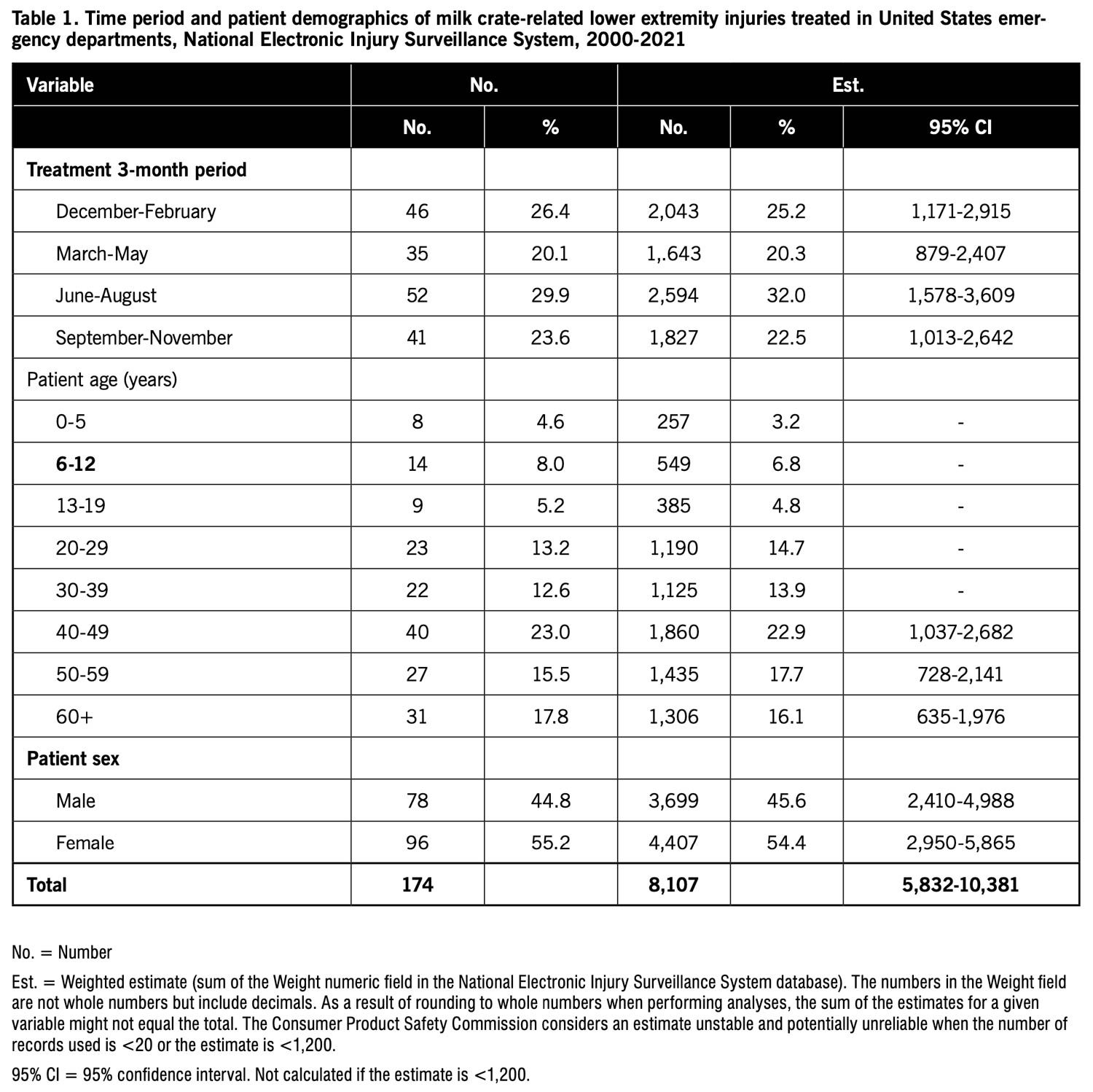
There were 174 milk crate-related lower extremity injuries identified at a sample of US hospital EDs during 2000-2021, resulting in a national estimate of 8,107 (95% CI 5,832-10,381) milk crate-related lower extremity injuries. This represents 27.6% of the 29,322 total milk crate-related injuries affecting any body part. The mean annual estimated number of lower extremity injuries was 379 during 2000-2005, 398 during 2006-2011, 384 during 2012-2016, and 305 during 2017-2021. Table 1 shows milk crate-related lower extremity injuries by 3-month period and patient demographics. The highest proportion of injuries was reported during June-August. Patients age 20 years and older accounted for 143 (82.2%) of the injuries and 6,915 (85.3%) of the estimated injuries. A higher proportion of the patients were female.
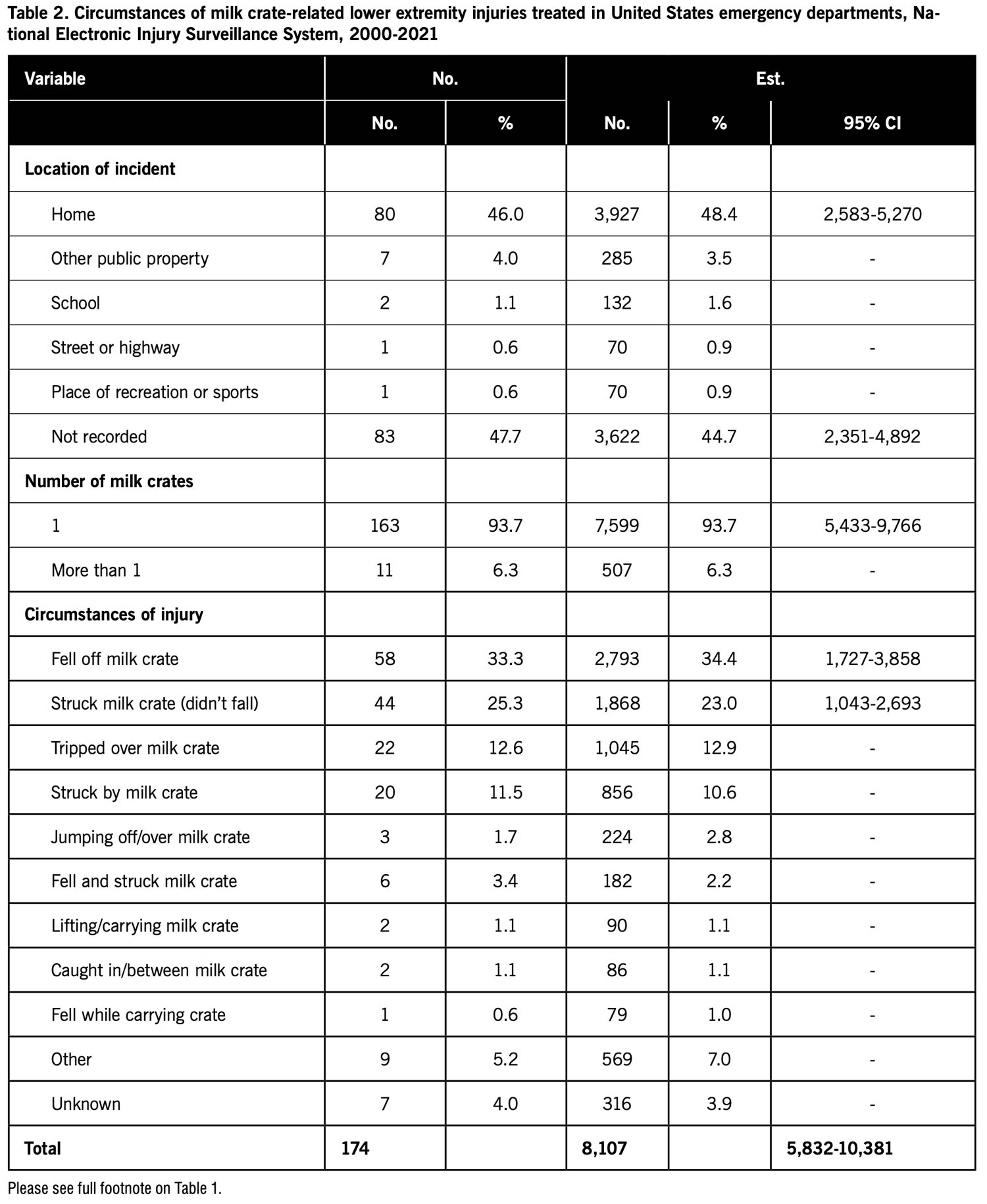
When the circumstances of milk crate-related lower extremity injuries were examined (Table 2), most of the injuries with a known incident location occurred at home. The majority of injuries involved a single milk crate. In the highest proportion of injuries, the patient fell off the milk crate followed by struck milk crate (did not fall) and tripped over milk crate. Of the 2,793 estimated injuries where the patient fell off the milk crate, the patient was standing on the milk crate in 1,400 (50.1%) of the estimated injuries, sitting on the milk crate in 71 (2.5%), climbing on or off the milk crate in 31 (1.1%), and what the patient was doing was not documented in 1,291 (46.2%).
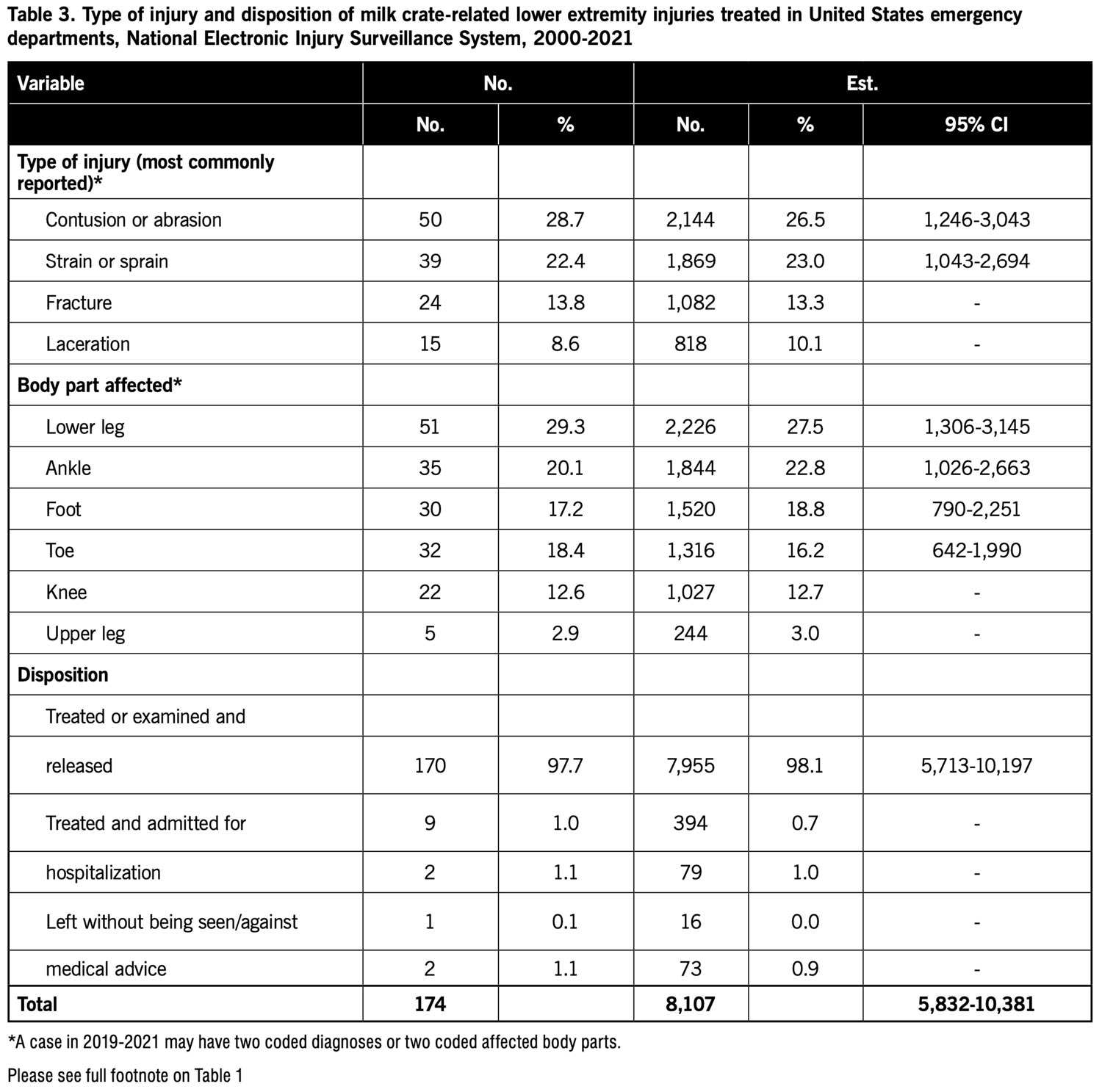
Table 3 presents milk crate-related lower extremity injuries by type of injury (diagnosis) and patient disposition. The most common type of injury was contusion or abrasion followed by strain or sprain, fracture, and laceration. The lower leg was the most frequently affected body part followed by the ankle. The majority of patients were treated or examined in the ED and released.
 Of the 40 total milk crate-related injuries identified in 2021, 9 specifically mentioned the Milk Crate Challenge and 3 described a scenario consistent with the Milk Crate Challenge, resulting in 12 identifiable Milk Crate Challenge-related injuries (30.0% of total milk crate-related injuries for the year). 7 (58.3%) of the injuries were treated in August, 3 (25.0%) in September, 1 (8.3%) in October, and 1 (8.3%) in November. The mean patient age was 27 years (range 7-50 years); 6 (50.0%) of the patients were age 7-19 years and 6 (50.0%) were age 20-50 years. Eleven (91.7%) of the patients were male and 1 (8.3%) was female. 4 (33.3%) of the patients had a fracture, 3 (25.0%) internal organ injury, 2 (16.7%) contusion or abrasion, 2 (16.7%) strain or sprain, and 1 (8.3%) each concussion, laceration, and other/not stated injury. The affected body part was 6 (50.0%) head and neck, 5 (41.7%) upper extremity, 2 (16.7%) lower extremity, and 1 (8.3%) trunk. Ten (83.3%) of the patients were treated or examined and released from the ED, 1 (8.3%) treated and admitted for hospitalization, and 1 (8.3%) left without being seen or against medical advice.
Discussion
This study examined an estimated 8,107 milk crate-related lower extremity injuries treated at US hospital EDs over a 22-year period. There is little published information on such injuries. The majority of patients were adults, particularly age 40-59 years, who accounted for 40% of the estimated lower extremity injuries. This age group may have been more likely to engage in activities that resulted in milk crate-related lower extremity injuries or more likely to have sought treatment for such an injury at a hospital ED.
In over 30% of the estimated lower extremity injuries, the patient fell off the milk crate. Furthermore, of these injuries sustained when the patient fell off the milk crate and the action of the patient was known, the majority of patients were standing on the milk crate when they fell. However, the majority of lower extremity injuries occurred in other circumstances, with the next most common circumstances being the patient struck the milk crate (did not fall) and the patient tripped over the milk crate. This suggests that while prevention activities should emphasize that people should not stand on milk crates, the public should be warned that most milk crate-related lower extremity injuries may occur in other ways.

The most frequent diagnoses were contusion or abrasion followed by strain or sprain, fracture, and laceration. Most of these injuries might be considered to be relatively minor and not require hospitalization. This study did find that 98% of the patients were treated or examined and released from the ED.
Twelve (30%) of the total milk crate-related injuries reported in 2021 were related to the Milk Crate Challenge. This suggests that the NEISS database may serve as a useful source of data on injuries related to certain social media challenges. Although the majority of Milk Crate Challenge-related injuries were treated in August 2021, when the social media trend first started, injuries continued to be treated in the 3 following months. The patient age ranged from 7 years to 50 years with half being children and half adults. The majority of patients were male. A variety of injuries were reported with the most common being fracture and internal organ injury. The most commonly affected body part was the head and neck followed by the upper extremity. The majority of patients were treated or examined and released from the ED.
This study is subject to limitations. Cases were initially identified by searching for all records that included the letter groups “mil” and “crat” in the Narrative field. Milk crate-related lower extremity injuries where these letter groups were not documented in the Narrative field would not have been included in this study. In addition, the selection of records to be included in the study, identification of the number of milk crates involved in an injury, and assignment of an injury to a particular circumstance was performed by a single person and used the Narrative field, which contains a limited amount of information. Errors in the selection and classification of records may have resulted in records being included or excluded erroneously or misclassified. Furthermore, the NEISS database only includes injuries treated at an ED. Studies that include information on injuries not evaluated at hospital EDs would provide a more complete view of milk crate-related lower extremity injuries.
In conclusion, the highest proportion of milk crate-related lower extremity injuries involved the patient falling off a milk crate followed by striking a milk crate (did not fall) and tripping over a milk crate. The most common type of injury was contusion or abrasion followed by strain or sprain, fracture, and laceration. The lower leg was the most frequently affected body part followed by the ankle. The majority of patients were treated or examined in the ED and released.
Mathias B. Forrester, BS, is an independent researcher in Austin, Texas. Now retired, he previously performed public health research for various university and government programs for 34 years.
- Delbert C. How to conquer the viral milk crate challenge. Popular Mechanics. August 24, 2021. Available at https://www.popularmechanics.com/science/a37384750/conquer-milk-crate-challenge-with-science/. Accessed January 31, 2023.
- Meares J. A tall order for the humble milk crate amuses its inventor. The Sydney Morning Herald. August 3, 2014. Available at https://www.smh.com.au/entertainment/art-and-design/a-tall-order-for-the-humble-milk-crate-amuses-its-inventor-20140803-zzxn7.html. Accessed January 31, 2023.
- Smith E. Why milk crates are the perfect container. Dairycrates.com. Available at https://dairycrates.com/milk-crate-history/. Accessed January 31, 2023.
- Rox M. 20 awesome uses for milk crates. Wise Bread. February 4, 2013. Available at https://www.wisebread.com/20-awesome-uses-for-milk-crates. Accessed January 31, 2023.
- Rennex M. Junk explained: What is the milk crate challenge and why are so many doctors against it? Junkee. August 27, 2021. Available at https://junkee.com/milk-crate-challenge-explainer/306622. Accessed January 31, 2023.
- Yang M. Milk crate challenge has doctors warning it’s ‘worse than falling from a ladder.’ The Guardian. August 25, 2021. Available at https://www.theguardian.com/technology/2021/aug/25/milk-crate-challenge-tiktok-doctors-warnings. Accessed January 31, 2023.
- United States Consumer Product Safety Commission. National Electronic Injury Surveillance System (NEISS). Available at https://www.cpsc.gov/Research–Statistics/NEISS-Injury-Data/Explanation-Of-NEISS-Estimates-Obtained-Through-The-CPSC-Website. Accessed January 31, 2023.
- United States Consumer Product Safety Commission. NEISS Coding Manual. January 2021. Available at https://www.cpsc.gov/s3fs-public/January-2021-NT-CPSC-only-NEISS-Coding-Manual.pdf?xa_nMM1kB4SGpuSMOwf0NHkkkIqNcn8F. Accessed January 31, 2023.