







 By Richard Blake, DPM, MS
Biomechanics are foundational to podiatry, physiotherapy, and the study of orthotics and prosthetics. Here we provide an excerpt from the author’s recently released Book 1 of the 4-part series, Practical Biomechanics for the Podiatrist.
…Rule of 3
One of the general rules I use in practice is the Rule of 3. This is a rule that most overuse injuries are caused by at least 3 factors colliding together to overstress an area (a “perfect storm’’ sort of speak). If you go back to the basic fact that a single abnormal motion can produce a myriad of injuries, ask yourself why the injuries vary from patient to patient. For example, why would abnormal pronation produce knee pain in one patient, neuroma pain in another, and posterior tibial tendon pain in another? And, why would abnormal supination cause peroneal tendonitis in one patient, a fibular stress fracture in another, and sacroiliac joint inflammation in another? And, why would limb length discrepancy cause iliotibial band syndrome in one patient, low back pain in another patient, and hip arthralgias in another? I try to discover the answer to these questions by applying the Rule of 3. It typically takes 3 things to cause a problem especially because we tend to pick on the weakest link in the chain.
I love the example of a runner with wide feet and bunions and overpronation. Because of the bunions, they were in shoes longer than the actual shape of their feet. Therefore, the shoe does not bend where it should at the ball of the foot. It was also wintertime and most activities were indoors, leading to a transient Vitamin D deficiency. During this time, while running on the treadmill for the first time, pain developed under the big toe joint. The initial diagnosis was bunion pain from pronation, but the pain lingered. X-rays were taken on the second visit noting a tibial sesamoid fracture and appropriate treatment of removable boot for 3 months was started. During the following visits, as the cause(s) was investigated, 5 (not 3) causes were eventually found, treated and discussed with the patient, as correction of the causes could hopefully prevent this from happening again and again. These 5 causes and their treatments were therefore part of a successful rehabilitation program. The causes (with treatment in parentheses) were:
-
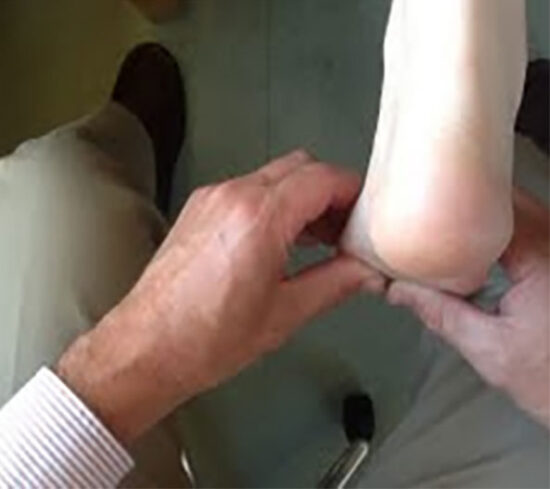
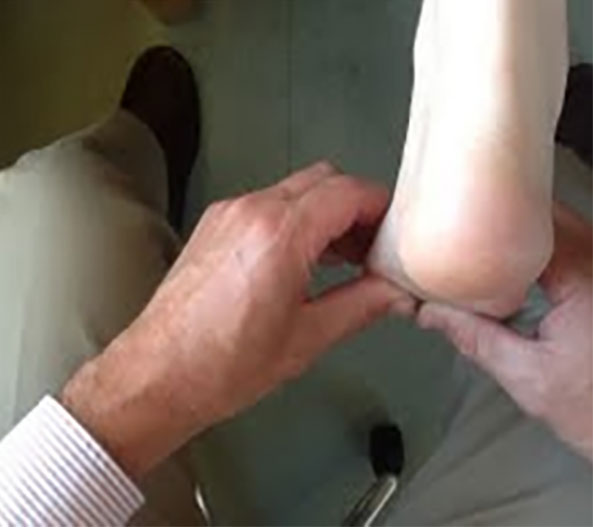
First metatarsal position being evaluated by stabilizing the 2nd metatarsal head and moving the first metatarsal head up and down to get position and range of motion.
Excessive pronation leading to an overload of big toe joint (orthotic devices used along with dancer’s padding and cluffy wedges)
- Vitamin D deficiency with initial blood level 17 (32-80 normal range attained with 2000 units vitamin D daily over the next 6 months)
- Improper metatarsal bending point, leading to the excessive metatarsal rigidity since the too long shoe did not bend where the patient’s foot should bend, leading to too much stress on the sesamoids (proper shoe selection with better forefoot width and normal length sizing)
- Inexperience with a treadmill can make patients run faster than normal (excessive braking can cause a jerk to the foot from the treadmill) or slower than normal (excessive pronation torque to foot as the belt tries to speed you up which was the case here and the patient was educated on this)
- Plantarflexed first metatarsal is a structural deformity that puts the first metatarsal head below the plane of the other metatarsals. Fifty percent of the time this deformity will cause excessive rearfoot supination for compensation, but this patient actually pronated due to poor shoe stability and generalized loose ligaments and loose midfoot on the exam. The foot pronation driving the foot to overload the medial side, along with the plantigrade position of the first metatarsal head, lead to the sesamoid overload and injury. (This was corrected with an orthotic device and the patient used dancer’s pads from Dr. Jill’s [drjillsfootpads.com] and Hapad [hapad.com] companies for a while).
This example is to show how looking for causes, starting simply with the Rule of 3, can help the injury rehabilitation and reverse the cause for the future. The goal is to help all the weak areas and keep the patient going and going like the old Energizer Bunny!! For me, the Rule of 3 differentiates podiatrists from all other professions. And, it is the mechanics of an injury and its treatment that also makes podiatry work. The example above shows how 5 mechanical issues involving the foot structure, treadmill mechanics, shoe gear issues, bone health, and general overpronation, all contributed to a broken sesamoid bone. In our fast and furious world of medicine, you may not have time to put this all together. Yet, I find in situations where injuries need 5-7 visits from you, and then more from a physical therapist, you can have time to put these things together to help your patient heal and avoid further problems. It takes a certain mechanical focus to achieve that.

Presence of a plantar flexed first ray makes the sesamoid more plantarly prominent.
Practical Biomechanics Question #25: The Rule of 3 focuses on causes of injury to speed up rehabilitation and prevent injury recurrence. What are 3 common causes of plantar fasciitis?
Practical Biomechanics Question #26: Using the rule of 3, what are 3 common structural causes of 2nd metatarsal pain from overload?
Richard Blake, DPM, MS, is adjunct faculty at the California School of Podiatric Medicine. He has practiced podiatry at the Sports and Orthopedic Institute of St. Francis Memorial Hospital in San Francisco, CA. Dr. Blake is Past President of the American Academy of Podiatric Sport Medicine. His book, Practical Biomechanics for the Podiatrist, Book 1, is available from Amazon.com and Barnesandnoble.com.