







 By Windy Cole, DPM, CWSP
Exudate management is a common clinical concern when treating chronic wounds. Excessive wound leakage can be harmful to peri-wound skin1 and can require more frequent dressing changes. These dressing changes can damage tissue, be painful to the patient, and utilize nursing time, thereby increasing nursing costs. A dressing that is absorbent and requires minimal dressing changes could improve wound healing, while reducing patient discomfort and nursing costs.2 It is therefore essential that wound dressings used in the management of chronic wounds have effective antimicrobial properties and optimally manage exudate.
Silver alginate dressings are a class of advanced antimicrobial wound dressing that has been developed for the management of moderately to heavily exudating chronic wounds. Most silver alginate dressings are comprised of a hydrofiber that helps maintain optimal moisture balance, ionic silver, which has a broad spectrum of antimicrobial activity, and may contain other enhancing agents which further increase the antimicrobial activity of the silver.3-6 In vitro studies have demonstrated that silver alginate dressings have antimicrobial activity against a wide variety of wound microbes commonly associated with wound colonization and infection including antibiotic resistant species.
Case Study
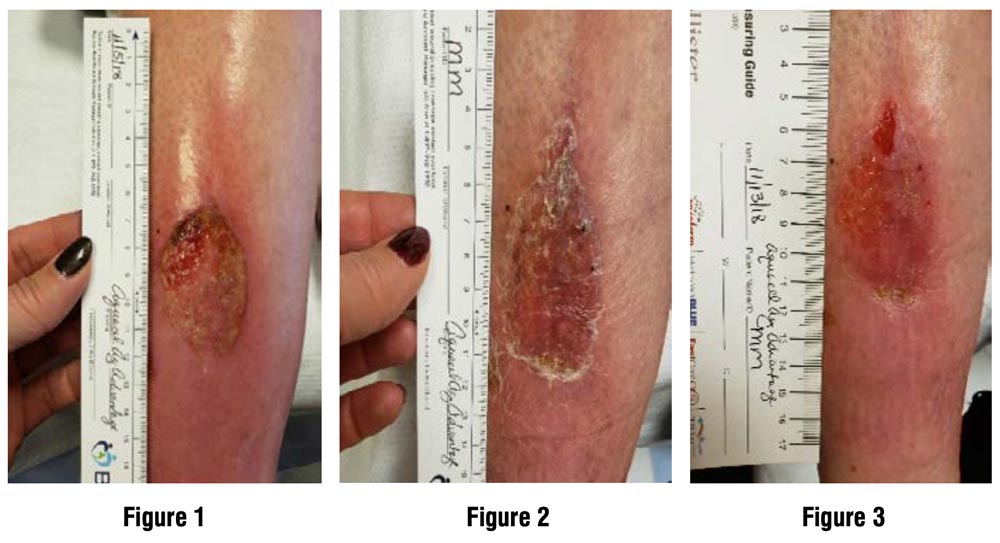
A 65-year-old female with a 6-week history of ulcer of the lower leg presented at my outpatient wound care center. She had previously been self-treating the wound with over-the-counter antibiotic ointment. Her medical history included breast cancer, hyperlipidaemia, and hypertension. Her ankle brachial pressure index was 1.08. The wound measured 5.3×2.7×0.1cm and was producing a moderate volume of malodorous serosanguinous exudate. The wound had a mix of devitalized tissues present on the wound bed, with distinct wound edges and intact peri-wound skin (Figure 1). Patient rated her pain a 5 out of 10. The drainage and malodour were having a negative effect on her quality of life. Patient was treated with a silver alginate under a multilayer compression dressing.
After one week, the wound size had reduced to 3.8×1.2×0.0cm. Granulation tissue was visible on the wound base and a great deal of the wound was now covered with epithelial tissue (Figure 2). There was less serous discharge and no malodour. Patient rated pain at 2 out of 10 and did not experience any pain at dressing changes. The wound edges and peri-wound skin was healthy and intact without maceration. Silver alginate was reapplied under compression bandage.
Upon evaluation on week 2 it was noted the wound was completely covered with epithelial tissue (Figure 3).
Indications for Silver Alginate Dressings
- Wounds where there is an infection or an increased risk of infection
- Wounds that may require a barrier to microbial penetration of the dressing as this may reduce infection risk
- Diabetic foot ulcers, leg ulcers (venous stasis ulcers, arterial ulcers and leg ulcers of mixed aetiology), and pressure ulcers (partial and full thickness)
- Surgical wounds
- Traumatic wounds
- Oncology wounds with exudate, such as fungoids-cutaneous tumors, fungating carcinoma, cutaneous metastasis, Kaposi’s sarcoma and angiosarcoma
- Wounds where the presence of microorganisms is a suspected cause of (or a factor in) chronicity/non-progression
- Partial thickness burns and donor sites
Windy Cole, DPM, CWSP, is an adjunct professor and Director of Wound Care Research at Kent State University College of Podiatric Medicine. Dr Cole also serves as the National Director of Professional Development and Clinical Education for Woundtech. She is board certified by the American Board of Foot and Ankle Surgery and the American Board of Wound Management. She is a wound care advocate on the forefront of wound research and was the 2020 World Union of Wound Healing Silver Medal Award recipient for her work in Technology-driven Research. And she is a member of the LER Editorial Advisory Board.
Suggested Further Readings
Barbu A, Neamtu B, Zăhan M, Iancu GM, Bacila C, Mireșan V. Current trends in advanced alginate-based wound dressings for chronic wounds. J Person Med. 2021;11(9):890. doi.org/10.3390/jpm11090890.
Recent advances in biopolymer-based materials for wound healing highlight the performance of specific types of alginates. This paper explores the roles of alginates in advanced wound-dressing forms with a particular emphasis on hydrogels, nanofibers networks, 3D-scaffolds or sponges entrapping fibroblasts, keratinocytes, or drugs to be released on the wound-bed. The latest research reports are presented and supported with in vitro and in vivo studies from the current literature.
Varela P, Marlinghaus L, Sartori S, Viebahn R, Salber J, Ciardelli G. Response of human macrophages to clinically applied wound dressings loaded with silver. Front Bioeng Biotechnol. 2020;8:124. doi: 10.3389/fbioe.2020.00124.
This publication explores the effect of the silver impregnated wound dressings on the immunomodulation of macrophages, the main immune cell population participating in the wound repair process. In this work, 3 different clinically applied antimicrobial, silver-impregnated wound dressings were investigated. Antimicrobial susceptibility tests, cell viability evaluation, and experiments to determine macrophage polarization were performed to evaluate both safety and efficacy.
- Cameron J. Exudate and care of the peri-wound skin. Nurs Stand. 2004;19(7):62, 64, 66 passim
- Armstrong SH, Ruckley CV. Use of a fibrous dressing in exuding leg ulcers. J Wound Care. 1997;6(7):322-4.
- Newman GR, Walker M, Hobot JA, Bowler PG. Visualisation of bacterial sequestration and bactericidal activity within hydrating Hydrofiber wound dressings. Biomaterials. 2006;27(7):1129-39.
- Bowler PG, Parsons D. Combatting wound biofilm and recalcitrance with a novel anti-biofilm Hydrofiber® wound dressing. Wound Medicine. 2016;14:6-11.
- Said J, Walker M, Parsons D, Stapleton P, Beezer AE, Gaisford S. An in vitro test of the efficacy of an anti-biofilm wound dressing. Int J Pharm. 2014;474(1- 2):177-81.
- Welsby S. The Spectrum Activity of AQUACEL Ag+ with Strengthening Fibre Ribbon using an In Vitro Corrected Zone of Inhibition Assay. 2015. Report No.: WHRI4359.