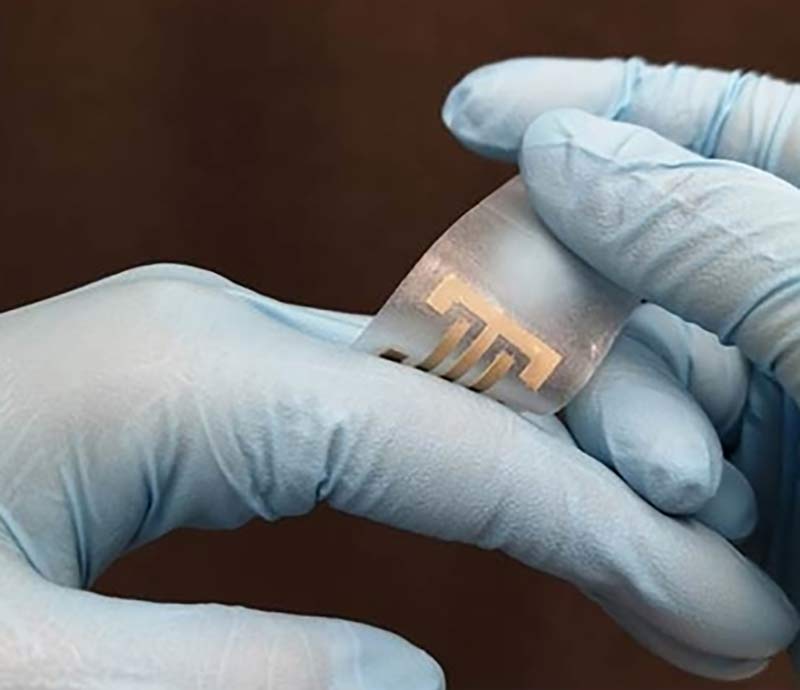
 Electrical field (EF) stimulation has been shown to accelerate wound healing with limited side effects. However, the wearable EF stimulation devices that have been devised to date use bulky, inflexible electrodes, resulting in conformational incompatibility with the wound. Fabricating these electrodes also requires dedicated technologies.
Now, a collaborative team from the Terasaki Institute for Biomedical Innovation (TIBI) has developed a ‘smart’ flexible electric patch (ePatch) that addresses the challenges posed by existing EF stimulation wound-healing devices and offers many advantageous features, in addition to being easy to make and cost effective.
The team chose silver nanowires as electrodes as they provide antibacterial properties and also deliver high conductivity under strain. They embedded the electrodes in alginate, a gelatinous substance that maintains good moisture levels and biocompatibility and is presently used in absorbent surgical dressings. By chemically modifying the alginate and adding calcium, they produced a material that would increase electrode stability and function. Further adjustment of the silver nanowire/modified alginate ratio enabled them to obtain a flexible, precisely printable bio-ink, which would produce a patch with customizable conformity to various wound shapes and sizes. In addition, the calcium induced cell proliferation and migration to the wound site, which in turn would promote blood vessel formation.
Mechanvical tests demonstrated that the ePatch exhibited improved electrode stability and conductivity, and strain tests results showed good tolerance, on a level needed for normal skin deformation. Further, tests conducted on cells cultured on the ePatch showed that ePatches pulsed with EF stimulation exhibited significantly faster cellular proliferation, migration, aggregation, and alignment, as well as an increased secretion of growth factors—all factors that contribute to faster wound healing. The results of studies on rats with open wounds showed that significantly accelerated wound healing results were obtained with the ePatch and there was also a more directional healing process, resulting in minimal scarring, deposition of normal skin layers, and hair growth following wound closure. Other experiments confirmed the antibacterial properties of the silver nanowire electrodes, independent of the amount of EF stimulation applied. Still other experiments found that the silicone component of the ePatch provided an effective, non-stick surface for cells, which helps minimize skin damage and excessive scarring.