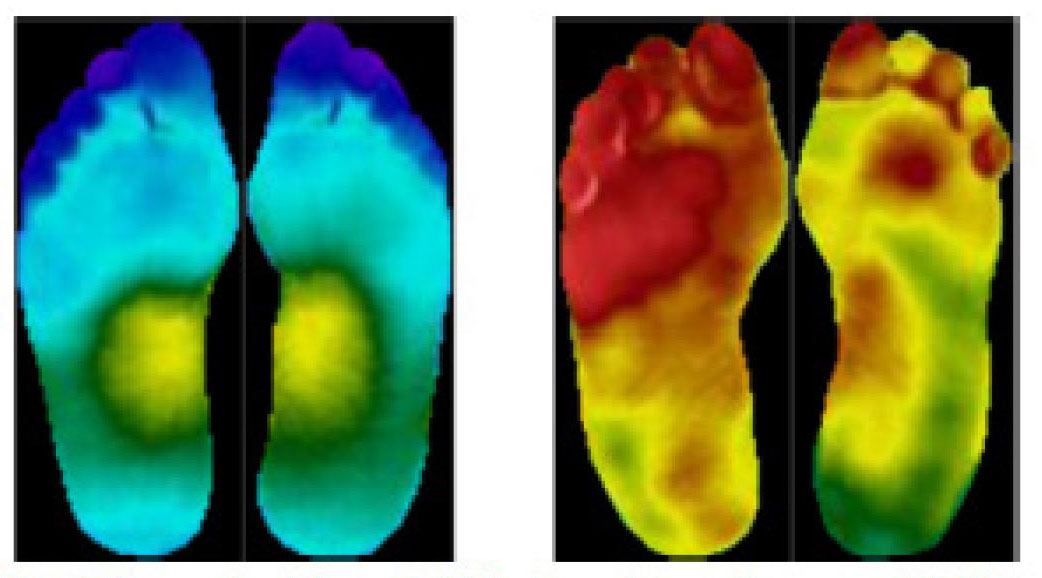
Figure. Symmetrical thermal distribution observed In a non-diabetic subject (left) and absent In a diabetic subject (right) Image reprinted from Muralidhara S, Lucieri A, Dengel A, Ahmed S. Holistic multi-class classification & grading of diabetic foot ulcerations from plantar thermal images using deep learning. Health Inf Sci Syst. 2022;10(1):21. doi: 10.1007/s13755-022-00194-8. Use is per Creative Commons Attribution 4.0 International License.
Prevalence of diabetic foot ulcers (DFUs) in patients with diabetes mellitus (DM) is growing, and the use of thermography has sparked interest in this non-invasive diagnostic method for early DFU risk assessment and management.
The systematic review, conducted by an international research team, sought to explore the use of thermography to predict DFU risk in patients with DM. The research question was: “What is the ability of thermography to predict DFU risk in patients with DM?’
A systematic search of publications using MEDLINE, CINAHL, and Cochrane databases was conducted in April 2023, and relevant articles were reviewed. Data was extracted and a narrative synthesis was undertaken. The evidence-based librarianship (EBL) checklist assessed the methodological quality of the studies included and the team reviewed these articles against the primary and secondary outcomes of this review. The primary objective was to investigate the predictive capability of thermography in anticipating DFU risk among patients with DM. The secondary objective was to determine the usability and feasibility of thermography measurement.
Eight studies were conducted from 1994 to 2021 with an emphasis on the predictability of thermography in predicting DFU risk. All 8 studies focused on temperature variations associated with DFU development. Six of the included studies compared the effectiveness of DFU occurrence in diabetic patients and non-DFU use. The overall results showed that employing thermography in DFU prevention might allow for early detection and intervention, offering a non-invasive and effective means to reduce the risk of DFU development and its associated complications in patients with DM.
In particular, the authors noted that among those with DFUs neuropathy is prevalent, leading to a loss of sensation in temperature and pain, hindering injury detection overall.
In conclusion, this systematic review highlights the role of thermography in DFU risk assessment and sets a clear path for future endeavors in this field. Integrating thermography into diabetes care could represent a crucial step in reducing the burden of DFUs and further advancing patient care in this population.
Source: Thakku Sivakumar D, Murray B, Moore Z, Patton D, O’Connor T, Avsar P. Can thermography predict diabetic foot ulcer risk in patients with diabetes mellitus? A systematic review. J Tissue Viability. 2024 Jun 29:S0965-206X(24)00093-7. doi: 10.1016/j.jtv.2024.06.018.