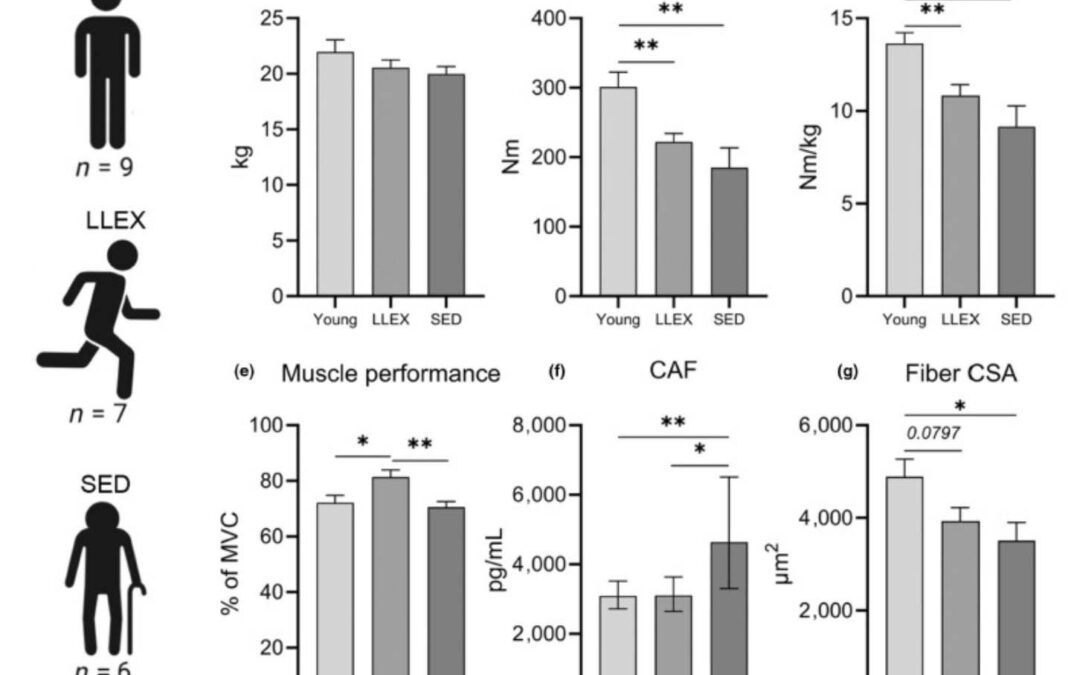








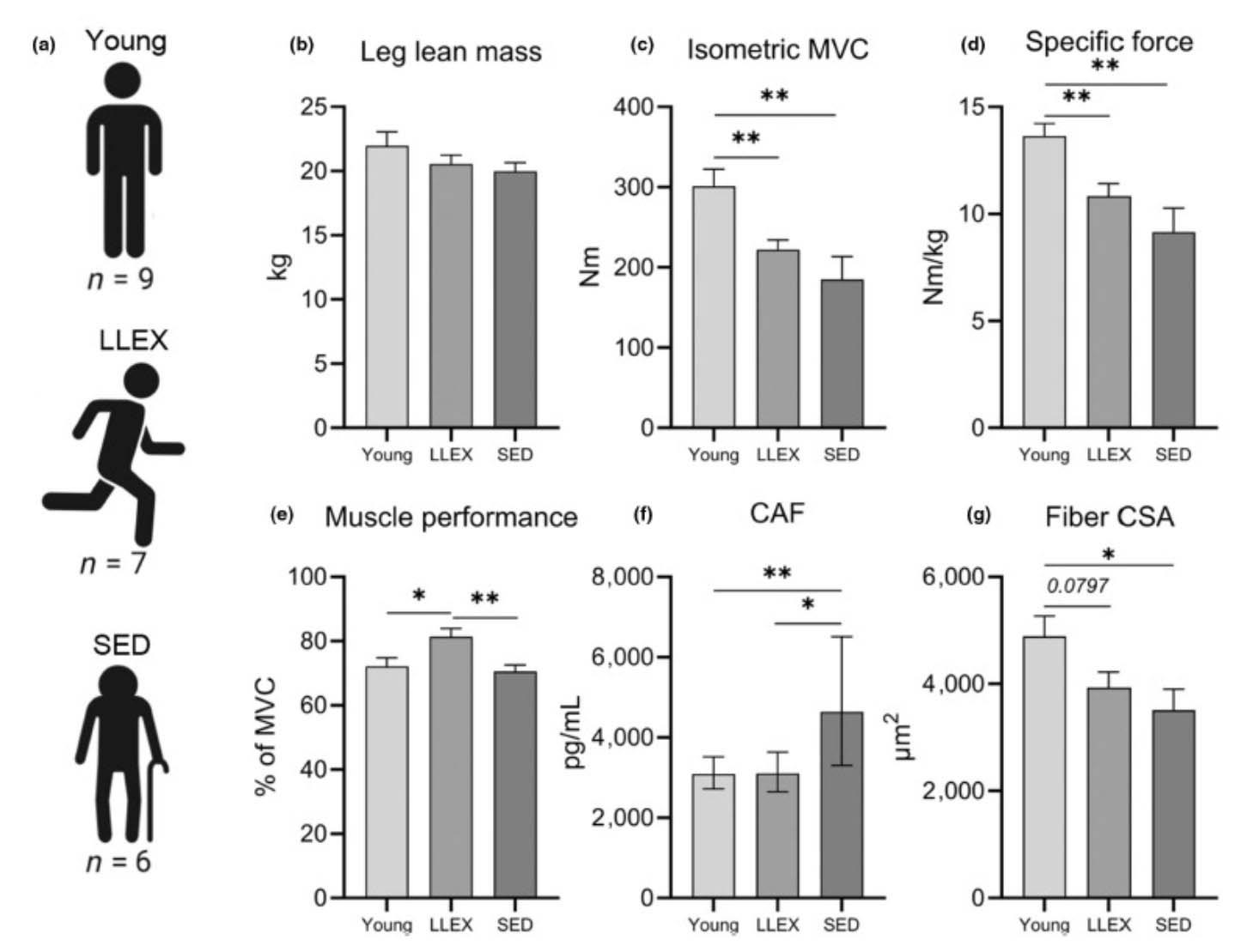
Figure. Sedentary aging is associated with reduced muscle performance and neuromuscular disturbance in vivo. (a) In vivo characterization of male participants. (b) Leg lean mass, measured by DEXA. (c) Isometric unilateral knee extension MVC, measured in a dynamometer. (d) Specific force, calculated as MVC per leg lean mass. (e) Muscle performance, measured as force exerted during repeated maximal knee extension concentric contractions, expressed relative to MVC. (f) CAF, measured in plasma by ELISA. Statistical analysis was conducted on log transformed values. (g) Muscle fiber cross sectional area measured using immunohistochemical analyses of muscle biopsy cross-sections. All data are means ± SEM except CAF which is shown as geometric means with 95% CI. N: LLEX: 7, SED: 6, Young: 9. Statistics: Data were analyzed by unpaired two-tailed t-tests, with significance indicated by *P < 0.05, ** P < 0.01, *** P < 0.001. CAF, C-terminal Agrin Fragment; DEXA, dual-energy X-ray absorptiometry; LLEX, life-long exercisers; MVC, maximal voluntary contraction; SED, old sedentary.
Exercise preserves neuromuscular function in aging through unknown mechanisms. Skeletal muscle fibroblasts (FIB) and stem cells (MuSC) are abundant in skeletal muscle and reside close to neuromuscular junctions, but their relative roles in motor neuron maintenance remain undescribed. Using direct cocultures of embryonic rat motor neurons with either human MuSC or FIB, RNA sequencing revealed profound differential regulation of the motor neuron transcriptome, with FIB generally favoring neuron growth and cell migration and MuSC favoring production of ribosomes and translational machinery. Conditioned medium from FIB was superior to MuSC in preserving motor neurons and increasing their maturity. Lastly, these authors established the importance of donor age and exercise status and found an age-related distortion of motor neuron and muscle cell interaction that was fully mitigated by lifelong physical activity.
In conclusion, the research team show that human muscle FIB and MuSC synergistically stimulate the growth and viability of motor neurons, which is further amplified by regular exercise.
Source: Soendenbroe C, Schjerling P, Bechshøft CJL, et al. Muscle fibroblasts and stem cells stimulate motor neurons in an age and exercise-dependent manner. Aging Cell. 2024;18:e14413. doi: 10.1111/acel.14413. Use is per the CC BY International license.