 By Angela Margaret Evans, AM*
“The climate emergency is a multidisciplinary, multisectoral crisis that transcends professional and organizational barriers. Health professionals can help bring sharp focus to the urgent reforms required from individuals, organizations, and governments”.1
I share the view that sustainability in practice begins with embedding climate change in university curriculums.2 The [British] National Health Service (NHS) has ambitious targets to reach net zero over the next 2 decades. Clinicians will require knowledge and support to achieve this goal, as part of the NHS responsibility for achieving climate targets.3,4
Climate action needs promotion in public health to include the large emission areas (eg, transport, energy, food, agriculture, and housing) to reduce air pollution, increase physical activity, and improve diets.5,6
A fresh focus on ‘big picture health,’3 must balance/lessen the management of illness. Medical ‘prescribing’ can prioritize ‘green health,’ to encourage time in the natural world as therapeutic, as occurs in Canada,7 Scotland,8 and China.9
Green Podiatry – Pillars for Practice
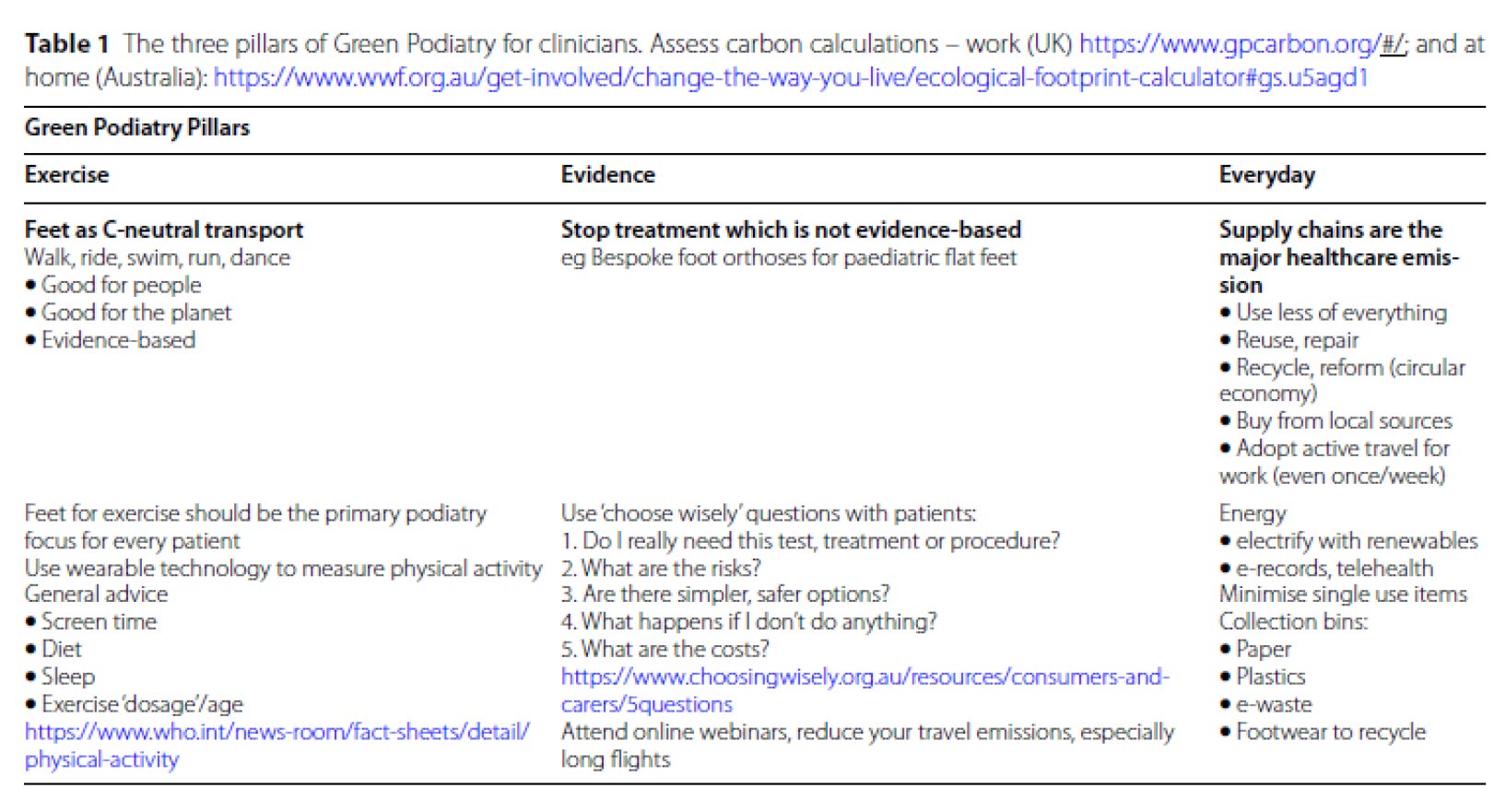
Green Podiatry is founded on: 1) exercise, 2) evidence, and 3) everyday actions4 (Table 1). Calculation of your carbon footprint [visit footprintnetwork.org], at work and at home, is illuminating, and provides a baseline for targeting change, eg,
– walk to the shops rather than drive
– use public transport
– walk/cycle to work (even once/week) and encourage patients similarly.
Such simple changes are good for health, good for our planet, and raise awareness of both.10
1. Exercise
Podiatrists need to focus on foot health for carbon-neutral transport. Physical activity is easily measured with wearable technology (phones, watches, Fitbits) and ‘dosed’, eg adults: 300 min moderate-vigorous physical activity/week, and more if sedentary.5,10 This is essential primary healthcare for podiatrists to champion, and a great antidote for noncommunicable diseases (eg, diabetes, arthritis, obesity, depression, cancer, heart disease). Exercise may allay ‘eco-anxiety’ in children, with cycling fostering children’s well-being and independent transport.11
A ‘green shoe list’ [https://angelaevanspodiatrists.com.au/wp-content/uploads/2022/08/green-shoes-2022.pdf, accessed January 15, 2023] acknowledges that exercise involves feet and footwear. Podiatry needs transparency from footwear manufacturers to avert ‘green-washing’ for commercial gain.6 Aware manufacturers increasingly use natural materials, including raffia palm and banana skin fibers.12 Footwear can be repaired and recycled (access local footwear recycling7), and dedicated companies offer ‘take back’ programs8 and even shoes for lease.9
The Green Foot Orthoses Project (GFOP) is a new initiative,10 and foot orthoses use must be supported by diagnosis and evidence. Repairing orthoses further extends product life.
2. Evidence
We can encourage ‘health’, over ‘healthcare,’ In the lower limb, knee arthroscopy13 and customized foot orthoses for pediatric flat feet14 are interventions no longer evidence-based, and clinicians should stop using them. Healthcare needs to focus on evidence-based care, and dispense with unnecessary treatments, imaging, and tests.14,16 We can engage patients in ‘Wiser Healthcare’ to avert overdiagnosis17 and excessive healthcare.11 Podiatrists are in prime position to promote healthy feet for physical activity which aids health,18 is evidence-based,10 and provides carbon-neutral transport.5
3. Everyday
The first commentary outlined changes for podiatrists to lessen greenhouse gas emissions.19 Fossil fuels comprise 98% of plastics, and approximately 40% of plastics are single-use.21 Healthcare is a large user, especially hospitals,22 where use of personal protection equipment and single-use items creates enormous waste. Pegna and McNally20 have suggested a pause:
“We are constantly told that for ‘infection control reasons’ we must wear and use single-use items. But where is the evidence for this? Is there evidence that single-use items are always safer than reusable ones? Is there evidence that disposable drapes are better than washable for infection prevention?”
The NHS and Climate and Health Alliance support the Global Green and Healthy Hospital network to reduce environmental impacts of workplaces.14 Supply chains cause most emissions (approximately 70%), and the Royal College of Podiatry and Australian Podiatry Association could partner with suppliers, footwear manufacturers, waste hubs (eg, Treadlightly15), to access ‘green’ supplies, and circular economy waste cycles.
Conclusion
Ultimately, we each share the responsibility to work and live as ‘green’ as we can. What we do as podiatrists–reduce waste, reduce unnecessary treatment, promote and live ‘green podiatry’–and as citizens–buy local, buy less, choose renewable energy, vote thoughtfully, divest fossil fuel investments, manage waste–is important for every aspect of health.
Two suggestions for podiatrists are to: 1) adopt the 3 pillars of Green Podiatry, viz., exercise, evidence, and everyday practices; 2) promote feet as carbon-neutral transport, and physical activity as evidence based and health enhancing. Podiatry has a great opportunity for positive legacy.
Angela Eveans, AM, is adjunct associate professor in the Discipline of Podiatry, School of Allied Health, Human Services and Sport at La Trobe University in Adelaide, Australia.

This article has been excerpted from “Incorporating ‘Green Podiatry’ into your clinic, and into your life” Foot Ankle Res. 2022;15(1). https://jfootankleres.biomedcentral.com/articles/10.1186/s13047-022-00591-y. Editing has occurred, including the deletion and renumbering of references for brevity. Use is per CC BY 4.0 International License.
- Dobson J, Cook S, Frumkin H, Haines A, Abbasi K. Accelerating climate action: the role of health professionals. BMJ. 2021;375:n2425.
- Brand G, Collins J, Bedi G, Bonnamy J, Barbour L, Ilangakoon C, et al. “I teach it because it is the biggest threat to health”: Integrating sustainable healthcare into health professions education. Med Teach. 2020:1–9.
- Tennison I, Roschnik S, Ashby B, Boyd R, Hamilton I, Oreszczyn T, et al. Health care’s response to climate change: a carbon footprint assessment of the NHS in England. Lancet Planet Heal. 2021;5:e84–92.
- Watts N, Amann M, Arnell N, Ayeb-Karlsson S, Beagley J, Belesova K, et al. The 2020 report of The Lancet Countdown on health and climate change: responding to converging crises. Lancet. 2020;397:129–70.
- Brand C, Götschi T, Dons E, Gerike R, Anaya-Boig E, Avila-Palencia I, et al. The climate change mitigation impacts of active travel: Evidence from a longitudinal panel study in seven European cities. Global Environ Change. 2021;67:102224.
- Marshman J, Blay-Palmer A, Landman K. Anthropocene Crisis: Climate Change, Pollinators, and Food Security. Environ. 2019;6:22.
- Pitt TM, Aucoin J, HubkaRao T, Goopy S, Cabaj J, Hagel B, et al. The Relationship of Urban Form on Children and Adolescent Health Outcomes: A Scoping Review of Canadian Evidence. Int J Environ Res Pu. 2021;18:4180.
- McDougall CW, Hanley N, Quilliam RS, Bartie PJ, Robertson T, Griffiths M, et al. Neighbourhood blue space and mental health: A nationwide ecological study of antidepressant medication prescribed to older adults. Landscape Urban Plan. 2021;214:104132.
- Zhang J, Cui J, Astell-Burt T, Shi W, Peng J, Lei L, et al. Weekly green space visit duration is positively associated with favorable health outcomes in people with hypertension: Evidence from Shenzhen, China. Environ Res. 2022;212:113228.
- Bull FC, Al-Ansari SS, Biddle S, Borodulin K, Buman MP, Cardon G, et al. World Health Organization 2020 guidelines on physical activity and sedentary behaviour. Brit J Sport Med. 2020;54:1451–62.
- Wild K, Woodward A. The bicycle as ‘constructive hope’: Children, climate and active transport. J Paediatr Child H. 2021;57:1785–8.
- Unal F, Avinc O, Yavas A. Sustainable approaches in textiles and fashion, fibres, raw materials and product development. 2022. p. 157–93.
- Siemieniuk RAC, Harris IA, Agoritsas T, Poolman RW, Brignardello-Petersen R, de Velde SV, et al. Arthroscopic surgery for degenerative knee arthritis and meniscal tears: a clinical practice guideline. BMJ. 2017;357:j1982.
- Evans AM, Rome K, Carroll M, Hawke F. Foot orthoses for treating paediatric flat feet. Cochrane Db Syst Rev. 2022;2022:CD006311.
- Fleck LM. Choosing Wisely. Camb Q Healthc Ethics Cq Int J Healthc Ethics Committees. 2016;25:366–76.
- Levinson W, Kallewaard M, Bhatia RS, et al. “Choosing Wisely”: a growing international campaign. BMJ Qual Saf. 2014;24:167–74.
- Barratt A, McGain F. Overdiagnosis is increasing the carbon footprint of healthcare. BMJ. 2021;375:n2407.
- Grunseit A, Richards J, Merom D. Running on a high: parkrun and personal well-being. BMC Public Health. 2017;18:59.
- Evans AM. Sustainable healthcare – Time for ‘Green Podiatry.’ J Foot Ankle Res. 2021;14:45.
- Pegna V, McNally SA. Are single use items the biggest scam of the century? Bulletin Royal Coll Surg Engl. 2021;103:233–5.