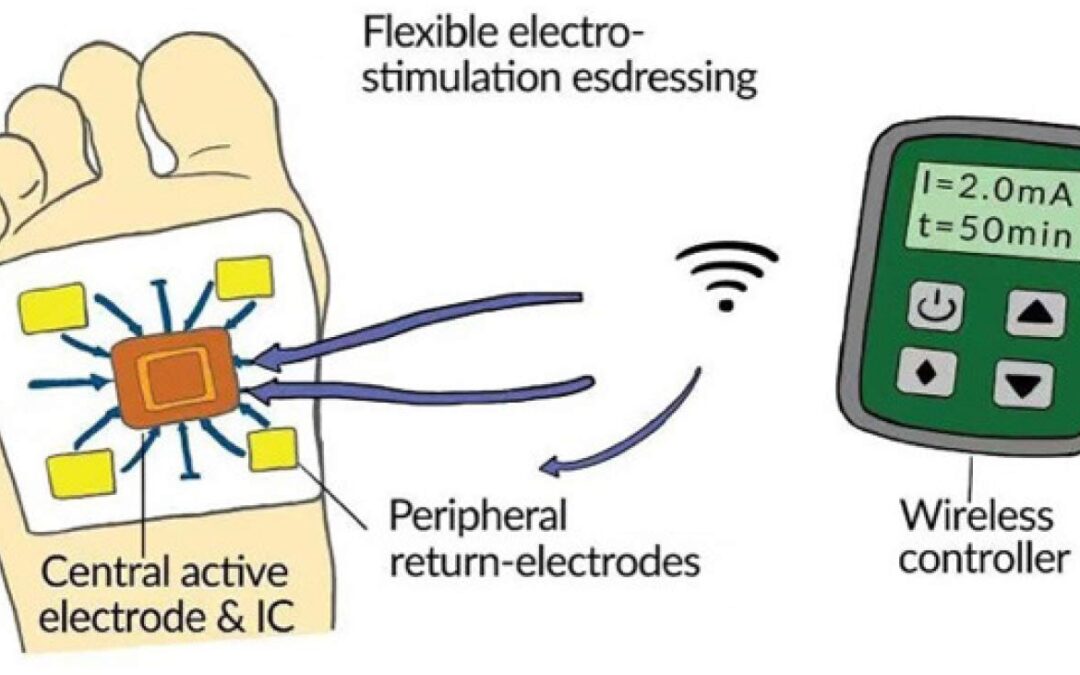









Fig. 1. A remotely controllable advanced dressing comprising a central section and a peripheral section. The central section houses an active electrode and an on-board control unit capable of receiving external commands to deliver programmable electrical stimulation. The peripheral section contains 4 reference electrodes that, together with the active electrode, complete the current loop and generate a uniformly distributed directional electric cue across the wound bed.
Diabetic foot ulcer (DFU) is one of the most severe complications of diabetes; its healing is typically protracted and marked by a high rate of recurrence. In recent years, electrical-stimulation (ES) therapy has emerged as a novel adjunct to conventional approaches such as debridement, negative-pressure wound therapy, and moist dressings. By applying an exogenous electric field that mimics the skin’s endogenous wound currents, ES provides directional cues for cells and signaling molecules involved in repair, guiding them toward the wound bed. The external field reconstructs the bioelectric landscape, inducing oriented migration and proliferation of keratinocytes, fibroblasts, and endothelial cells, while up-regulating factors such as HIF-1α and VEGF to relieve local ischemia and promote neovascularization. Cathodal currents can also dampen the inflammatory cascade and facilitate the shift of macrophages from the M1 to the pro-healing M2 phenotype. The advent of nanogenerators, conductive hydrogels, and wireless “smart” bandages is gradually freeing ES from hard-wired leads, paving the way for home-based, closed-loop wound care.
Source: Liu Y, Liu X, Lu J, Jiang Y, Wu J. Electrical stimulation: a novel adjunct therapy for diabetic foot ulcers. Front Clin Diabetes Healthc. 2026 7;6:1682871. doi: 10.3389/fcdhc.2025.1682871.