






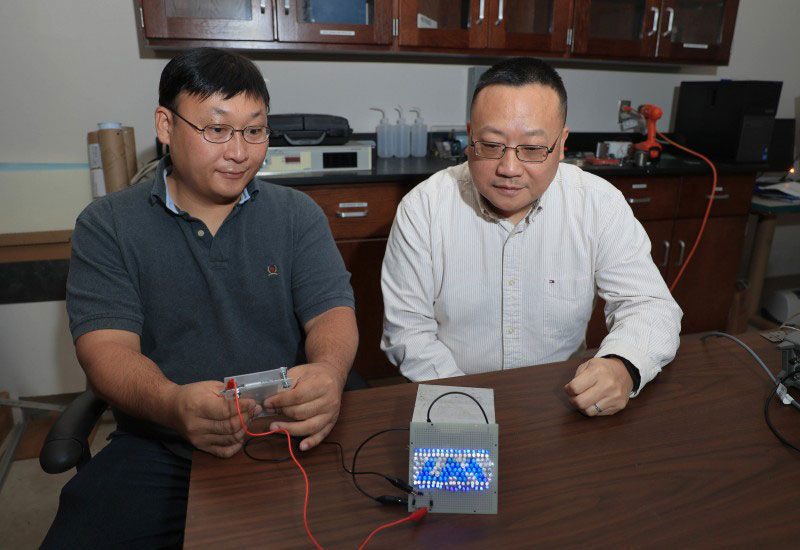
Moonhyung Jang, PhD, left, operates TENG generator to light an LED display as Wang looks on in the Adaptive Structures Laboratory. Image courtesy of Michael Mercier with UAH.
Researchers at The University of Alabama in Huntsville (UAH) have designed a wearable biosensor that offers a new way to measure human muscle activation to potentially prevent injuries and enhance athletic performance. The breakthrough design is built around a new type of triboelectric nanogenerator (TENG), a device that converts mechanical or thermal energy into electricity for use in wearable electronics, that will cost less to manufacture than traditional nanotechnology. UAH’s new sensor uses adhesive materials to harvest power by transferring an electric charge between 2 objects when they contact or slide against 1 another.
This biosensor design consists of Scotch tape and a metalized polyester sheet. “When it is pressed and released, we are able to detect human motions involving the elbow, knee, finger, eye, and jaw,” said Gang Wang, PhD, an associate professor in the College of Engineering. “The design is an advance because it is self-powering, light weight, low cost, and disposable.” Further, the UAH biosensor only involves commercial off-the-shelf materials and a simple fabrication scheme compared to those used in TENG-based sensors, and an external power source to function is not required.
The size of conventional devices also tends to be quite large when compared to the UAH device, and human skin must serve as another triboelectric layer, meaning the sensing performance could degrade with perspiration or other changes in skin condition. UAH’s device using ‘tacky’ materials simplifies the design and provides a more comfortable user experience and can detect motion involving both gross and fine motor movements. Skin contraction and relaxation during body motion activate the contact and separation between the polypropylene and acrylic adhesive layers. Demonstrations have been conducted to detect various body motions, including elbow flexion, forearm protonation/supination, knee flexion/extension, and more.