








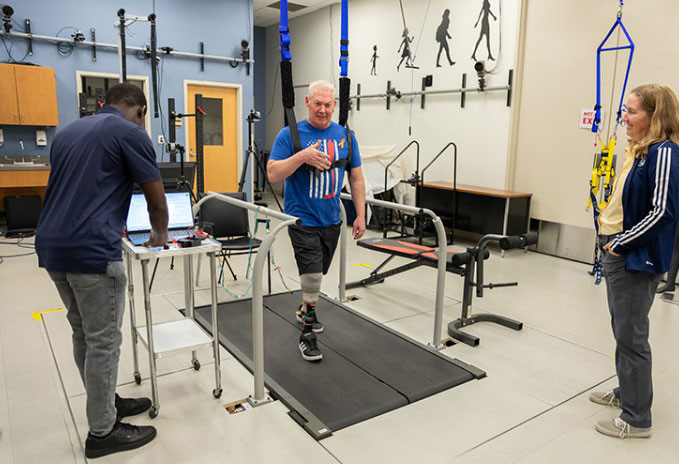
John Horne (center) walks with a fabric-based sensor in his prosthetic in UD’s Neuromuscular Biomechanics Laboratory while George W. Laird Professor of Mechanical Engineering Jill Higginson (right) and biomedical engineering doctoral student Theophilus Annan test whether the sensor can monitor lead in individuals with limb loss.
John Horne lost his right leg to bone cancer when he was a freshman in high school. This personal experience spawned his career and passion for advocating for those with limb loss. The president of Independence Prosthetics-Orthotics on the University of Delaware’s (UD) Science, Technology, and Advanced Research (STAR) Campus has seen prostheses improve significantly since his limb loss and since he was an undergraduate student at UD, interning at Nemours Children’s Health, where he poured prosthetic molds.
Now, Horne is part of pioneering research led by George W. Laird Professor of Mechanical Engineering Jill Higginson, PhD, in the Neuromuscular Biomechanics Laboratory along with co-investigators Elisa Arch, PhD, associate professor of kinesiology and applied physiology, and Meg Sions, DPT, PhD, associate professor of physical therapy, in the College of Health Sciences. The study aims to test the potential of fabric-based sensors in monitoring load in individuals with limb loss.
“By monitoring limb loads in individuals with lower limb amputation, we can determine whether they’re loading symmetrically or overloading over time to ensure they’re using their limb optimally,” Higginson said. “Wearable technology like these sensors can help us monitor loads and gauge performance in the real world.”
These innovative sensors were developed by Erik Thostenson, PhD, professor of mechanical engineering in the College of Engineering; and Sagar Doshi, PhD, an associate scientist in UD’s Center for Composite Materials; and Higginson.
Horne first experienced force-sensing devices in an orthopedic boot for people with Achilles tendon rupture as part of a senior design project in Higginson’s lab several years ago and identified an unmet need in the limb loss community. “The difference between the socket and the foot in a prosthetic pylon is an area that functionally we haven’t taken advantage of until now,” he said.
Horne demonstrated that the ongoing study requires placing the small sensors in the pylon of his prosthesis. He then walked on a treadmill with force plates in the motion capture lab to gauge whether the treadmill data mirrored the sensor data.
“The conversation, clinically with patients, has always been tough to translate what the patient is feeling,” Horne said. “A device like this gives us hardcore data so clinicians can directly understand what’s happening and make changes,” said Horne. It could also help patients who lack access to healthcare. “The device could generate data from patients in rural areas who may be having prosthetic issues, and we can adjust without them being on-site,” he said.
“Right now, the only time we know if something is wrong with a person’s prosthetic is when they’re in pain,” said Hanna Armstrong, an honors student who graduated from UD in May with her bachelor’s degree in biomedical engineering and has worked in Higginson’s lab since high school . “These pressure sensors stand to change what rehabilitation looks like for people with limb loss.” So far, it’s working, she said.