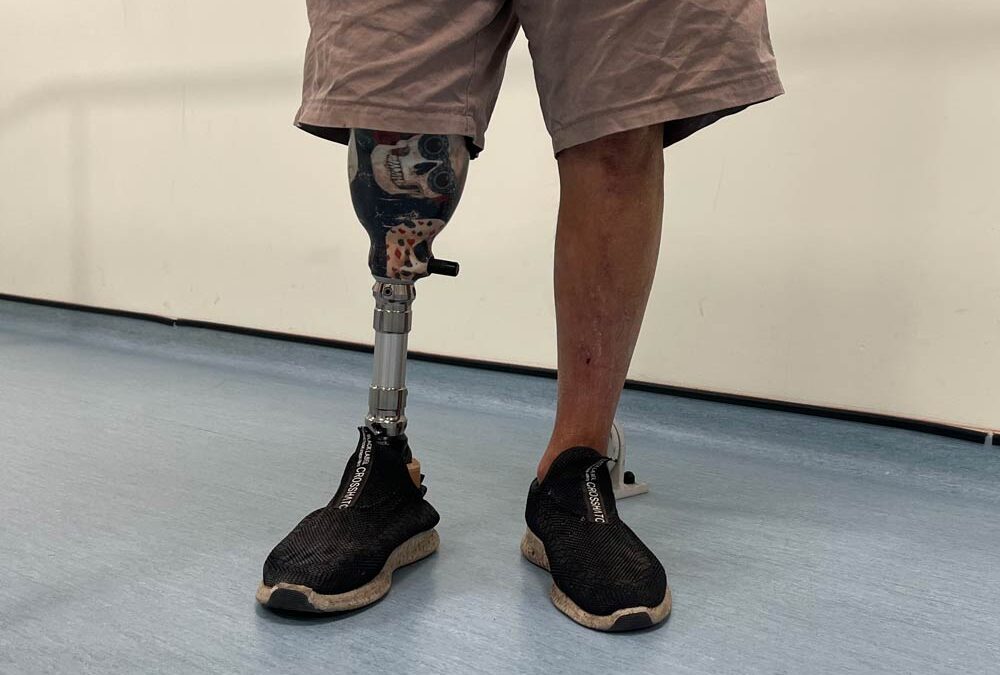








 Researchers have developed a new, data-driven way of fitting prosthetic legs, which could lead to better fitting prostheses, in less time and at a lower cost. The technology has been developed by Radii Devices and the University of Southampton, UK. The study shows that transtibial prosthetic limbs designed using the new approach were as comfortable, on average, as those created by skilled prosthetists, and with more consistent results. Crucially, the new method generates a basic design instantly. The team behind the software hopes that data-driven ‘socket’ designs will reduce the time, number of iterations, and number of appointments it takes to arrive at a prosthetic limb with which the patient is comfortable.
Radii Devices, a spin-out company from the university, has developed software that draws on data from hundreds of previous prosthetic socket designs to generate recommendations for the most comfortable socket shape using a 3D scan of the patient’s residual limb. In doing so, they’ve been able to identify trends between different patient characteristics, such as the shape and size of the residual limb, and successful socket shapes, said Joshua Steer, PhD, founder and CEO of Radii Devices. “We can then scan a patient’s residual limb and generate a personalized design recommendation based on features that have been successful for similar patients in the past.”
Seventeen patients were given a trial socket designed by a prosthetist and 1 designed using the new method and were asked to compare the comfort of the sockets. The study found there was no difference in the comfort scores on average, and less variation in comfort in the data-driven socket designs. Several participants preferred the fit of the data-driven socket design and had it turned into their definitive prosthesis.
The design recommendations aren’t intended to be used on their own in clinical practice. Instead, the researchers envision prosthetists working with the technology to further enhance the patient experience. Now, the software interface is being developed with clinicians to provide them the most effective way to incorporate data-driven socket designs into their practice.