







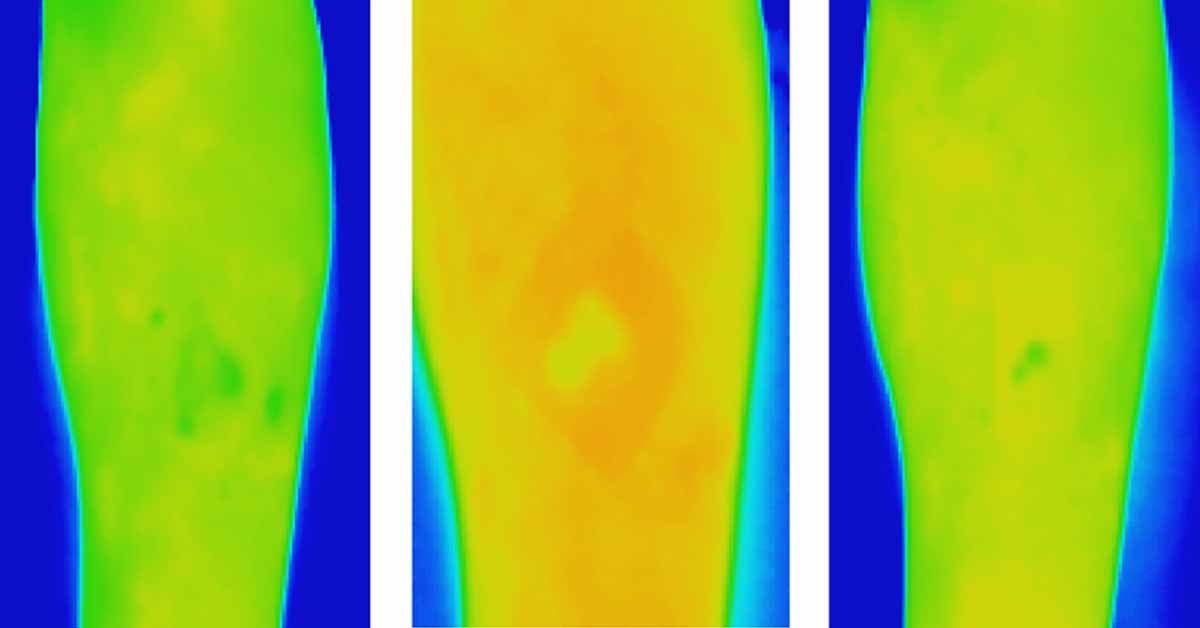
Thermal images of a venous leg ulcer showing healthy healing progress over 3 weeks. Image courtesy of RMIT University.
A thermal-imaging tool to screen for chronic wounds, such as venous leg ulcers (VLUs), could enable nurses to identify these hard-to-heal sores during the first assessment at a person’s home. This new method by researchers at Royal Melbourne Institute of Technology (RMIT), Australia, and Bolton Clarke Research Institute (Bolton Clarke) is an artificial intelligence–powered system to predict how leg ulcers will heal based on thermal images from the first assessment.
Their method provides information on spatial heat distribution in a wound and predicts, with 78% accuracy, whether VLUs would heal in 12 weeks without specialized treatment. It is not sensitive to changes in ambient temperature and light, so it is effective for in-home visits to people’s homes and even in tropical environments.
“This means specialized treatment for slow-healing leg ulcers can begin up to 4 weeks earlier than the current gold standard,” said Dinesh Kumar, PhD, from RMIT’s School of Engineering. The current gold-standard approach requires taking tracings of the wound size after 4 weeks, involving physical contact with the wound, which delays identification of slow-healing wounds. Additionally, the non-contact method reduces infection by minimizing physical contact.
The team will also assess whether their method can predict healing of diabetes-related foot ulcers.