







Image courtesy of the research team.
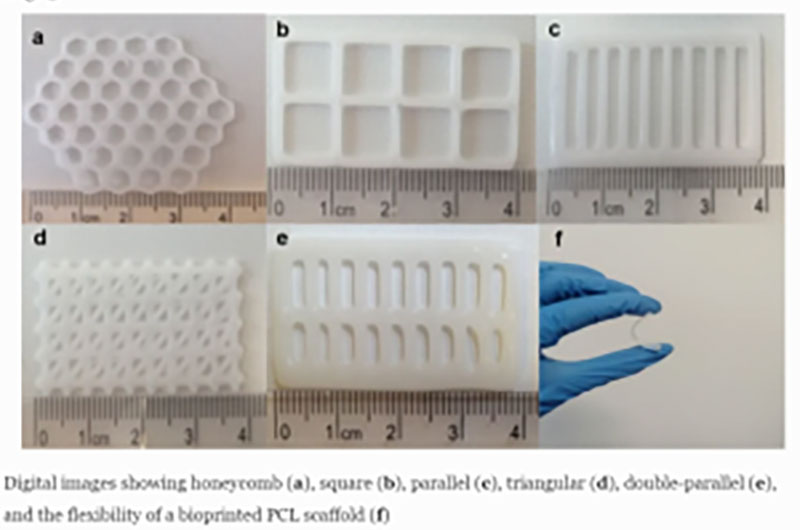
Researchers at Queen’s University Belfast have designed a new bandage treatment, known as a scaffold, to treat diabetic foot ulcers (DFUs), which is cost-effective while improving patient outcomes. Produced by 3D bioprinting, the scaffolds slowly release antibiotics over a 4-week period to effectively treat the wound. This new research demonstrates outcomes with significant implications for patient quality of life, as well as decreasing the costs and clinical burden in treating DFUs. Additionally, the scaffolds can easily be modified to the size of the wound.
“These scaffolds are like windows that enable doctors to monitor the healing constantly. This avoids needing to remove them constantly, which can provoke infection and delay the healing process,” said Dimitrios Lamprou, PhD, a professor of biofabrication and advanced manufacturing at Queen’s School of Pharmacy. “The ‘frame’ has an antibiotic that helps to kill the bacteria infection, and the ‘glass’ that can be prepared by collagen/sodium alginate can contain a growth factor to encourage cell growth. The scaffold has 2 molecular layers that both play an important role in healing the wound.”