








 By Mathias B. Forrester, BS
Background: Millions of people in the United States (US) have lawn mowers. Consequently, thousands of people visit US hospital emergency departments (EDs) each year for lawn mower-related injuries. The intent of this study was to characterize lawn mower-related injuries treated at US hospital EDs.
Methods: This study used lawn mower-related lower extremity injuries during 2000-2022 reported to the National Electronic Injury Surveillance System (NEISS), a database of consumer product-related injuries treated at a representative sample of US hospital EDs. Cases reported to the NEISS were used to calculate national injury estimates. The distribution of lawn mower-related lower extremity injuries was determined for patient demographics, injury circumstances, and management.
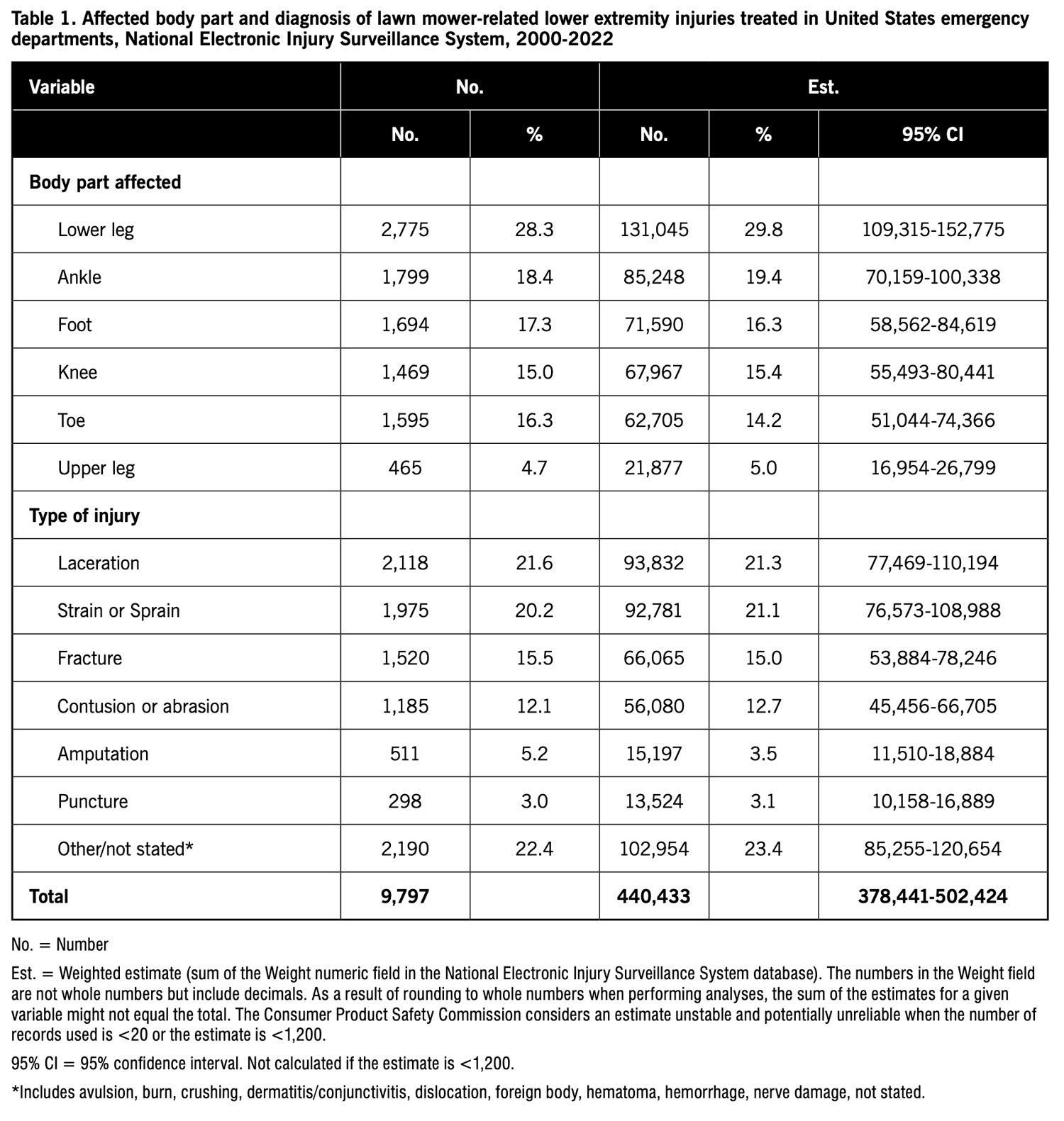
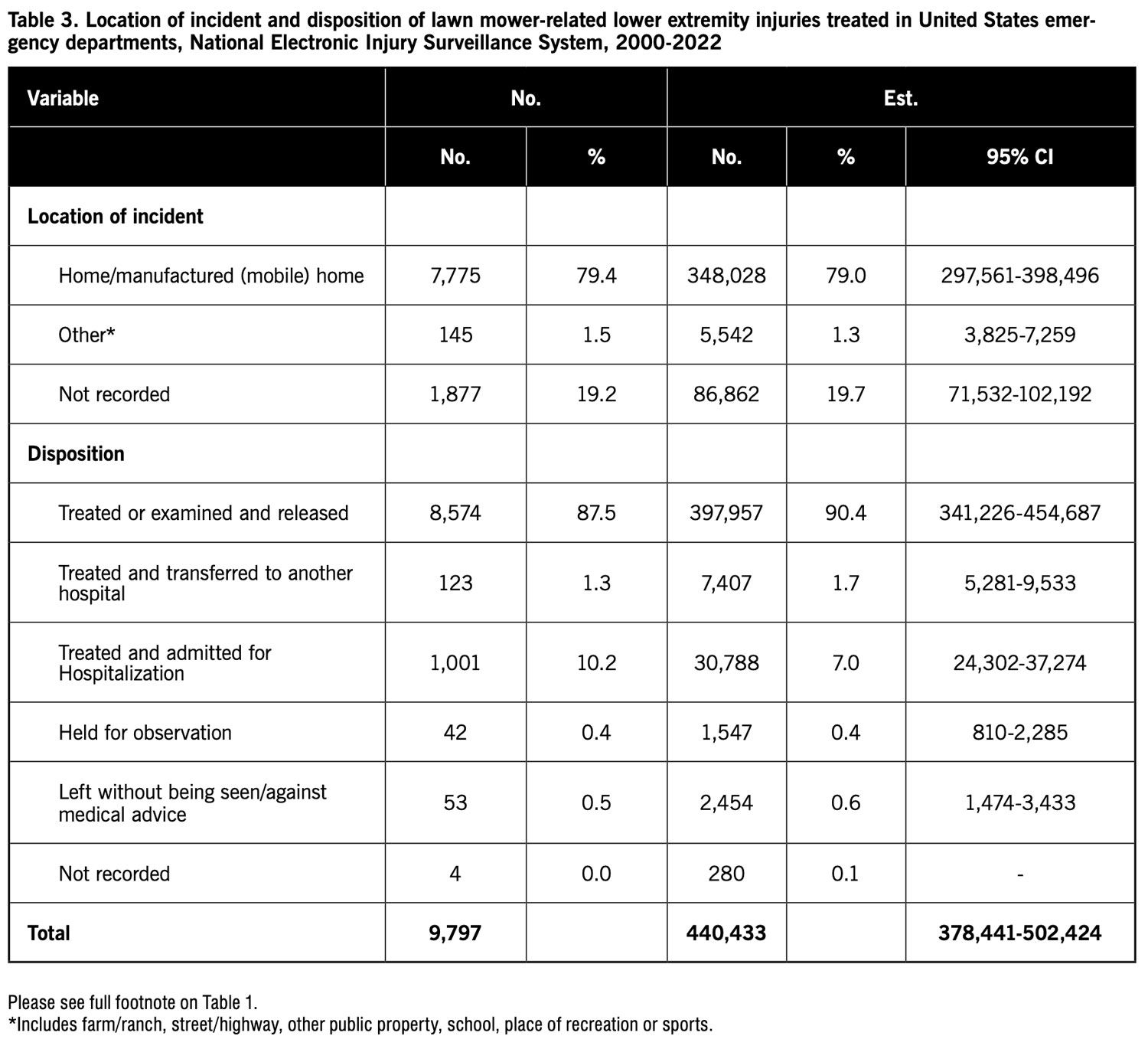
Results: Of an estimated 1,919,146 total lawn mower-related injuries, 440,433 (22.9%) involved the lower extremity. Of these lower extremity injuries, the affected body part was 29.8% lower leg, 19.4% ankle, 16.3% foot, 15.4% knee, 14.2% toe, and 5.0% upper leg. The injuries were 21.3% laceration, 21.1% strain or sprain, 15.0% fracture, 12.7% contusion or abrasion, 3.5% amputation, 3.1% puncture, and 23.4% other/not stated. The patient disposition was 90.4% treated or examined at the ED and released, 1.7% treated and transferred to another hospital, 7.0% treated and admitted for hospitalization, 0.4% held for observation, 0.6% left without being seen/against medical advice, and 0.1% not recorded.
Conclusion: Over one-fifth of all lawn mower-related injuries treated at US hospital EDs involved the lower extremity. The most commonly reported injuries were laceration, strain or sprain, and fracture. The majority of patients were treated or examined at the ED and released.
Lawn mowers are common household machines used in the United States. In 2020, 228.73 million Americans owned lawn and garden equipment.1 There are a variety of types of lawn mowers. Walk mowers are machines that the operator walks behind and pushes. Types of walk mowers include reel or cylinder mowers, which have vertically rotating cylindrical blades at the front of the mower that cut against a fixed blade; rotary mowers, which have a single blade that rotates at very high speed in a horizontal motion; and push mowers, which require the operator to manually push the mower forward. Riding mowers or lawn tractors are machines that the operator rides. Lawn mowers may be manually powered, electric, gas-powered, or battery-powered.2 What most, if not all, lawn mowers have in common are sharp blades, moving parts, and being heavy, particularly riding lawn mowers (See box).3
 Injuries may occur during use of or proximity to lawn mowers. Lawn mower injuries may occur under a variety of circumstances, such as falling off of the mower (while in use or stationary); rolling over or flipping over the mower while in use; moving the machine by lifting, loading, or unloading the mower; striking an object while riding the mower; servicing or repairing the mower; being run over or backed over by a mower; striking or being struck by the mower; being hit by debris from the mower; and contacting a hot part of the mower.4-6
Thousands of lawn mower-related injuries are treated at United States (US) emergency departments each year.4-9 Lawn mower-related injuries include lacerations, strains or sprains, soft tissue injuries, fractures, burns, contusions and abrasions, and amputations.4,5,7-9 Deaths have occurred.5,7,10
Lawn mower-related injuries may occur to all body parts, including the lower extremity.4,5,7-9,11 The intent of this study was to characterize lawn mower-related lower extremity injuries reported to US hospital EDs.
Methods
Data for this descriptive study were downloaded from the National Electronic Injury Surveillance System (NEISS) website athttps://www.cpsc.gov/cgibin/NEISSQuery/home.aspx. The NEISS database has been described in detail in Lower Extremity Review previously.12 In brief, the NEISS collects data on consumer product-related injuries from the EDs of approximately 100 hospitals as a probabilistic sample of the more than 5,000 hospitals with EDs in the US. National estimates are calculated from database records according to the sample weight assigned to each case based on the inverse probability of the hospital being selected for the NEISS sample.13,14 Since data are publicly available and de-identified, the study is exempt from institutional review board approval. Previous studies have used NEISS data to examine lawn mower-related injuries; however, none of these previous studies focused on lower extremity injuries.4-7,9 Another study examined lawn mower-related injuries to the lower extremity but included cases from a single trauma center.11
Cases were lawn mower-related lower extremity injuries reported to the NEISS database during 2000-2022. The publicly available NEISS database contains 3 numeric fields for coding the product involved in the injury (Product_1, Product_2, Product_3). (The Product_3 field was added in 2018 although it does not appear to have been used until 2019.) The NEISS database was searched for all records that included the following 7 codes in any of the 3 product code fields: 1401 – Power lawn mowers (not specified), 1402 – Manual push mowers (unpowered), 1405 – Garden tractors, 1422 – Riding power lawn mowers, 1439 – Lawn mowers (not specified), 1446 – Reel power lawn mowers, 1448 – Rotary power lawn mowers. Only those records where the Body_Part numeric field (a field that documents the injured body part) contained codes for a lower extremity (upper leg, knee, lower leg, ankle, foot, toe) were included in the study. The NEISS database contains another numeric field for documenting whether a second body part was injured (Body_Part_2); however, this field was only added in 2018,14 although this field does not appear to have been used until 2019. For consistency over the entire study period, the Body_Part field alone was examined. (Ninety-eight cases had a lower extremity coded in the Body_Part_2 field but not in the Body_Part field during 2019-2022 and were excluded from the study. In contrast, 4 records that included a lawn mower code in the Product_3 field but not the Product_1 or Product_2 fields were included.)
The variables examined were treatment year, month, and day of week; patient age, sex, and race; type of lawn mower involved, based on the product code; location where the incident occurred; type of injury (diagnosis); affected body part; and disposition. Analyses were performed using Microsoft 365 Access and Excel (Microsoft Corporation, Redmond, Washington, US). For all lawn mower-related lower extremity injuries, the distribution of cases and national injury estimates were determined for the variables. National injury estimates were calculated by summing the values in the Weight numeric field in the publicly available NEISS database, and 95% confidence intervals (CIs) were calculated for the estimates. The CPSC considers an estimate unstable and potentially unreliable when the number of records used is <20 or the estimate is <1,200.13 For those variable subgroups where the estimate was <1,200, 95% CIs were not calculated.
Results
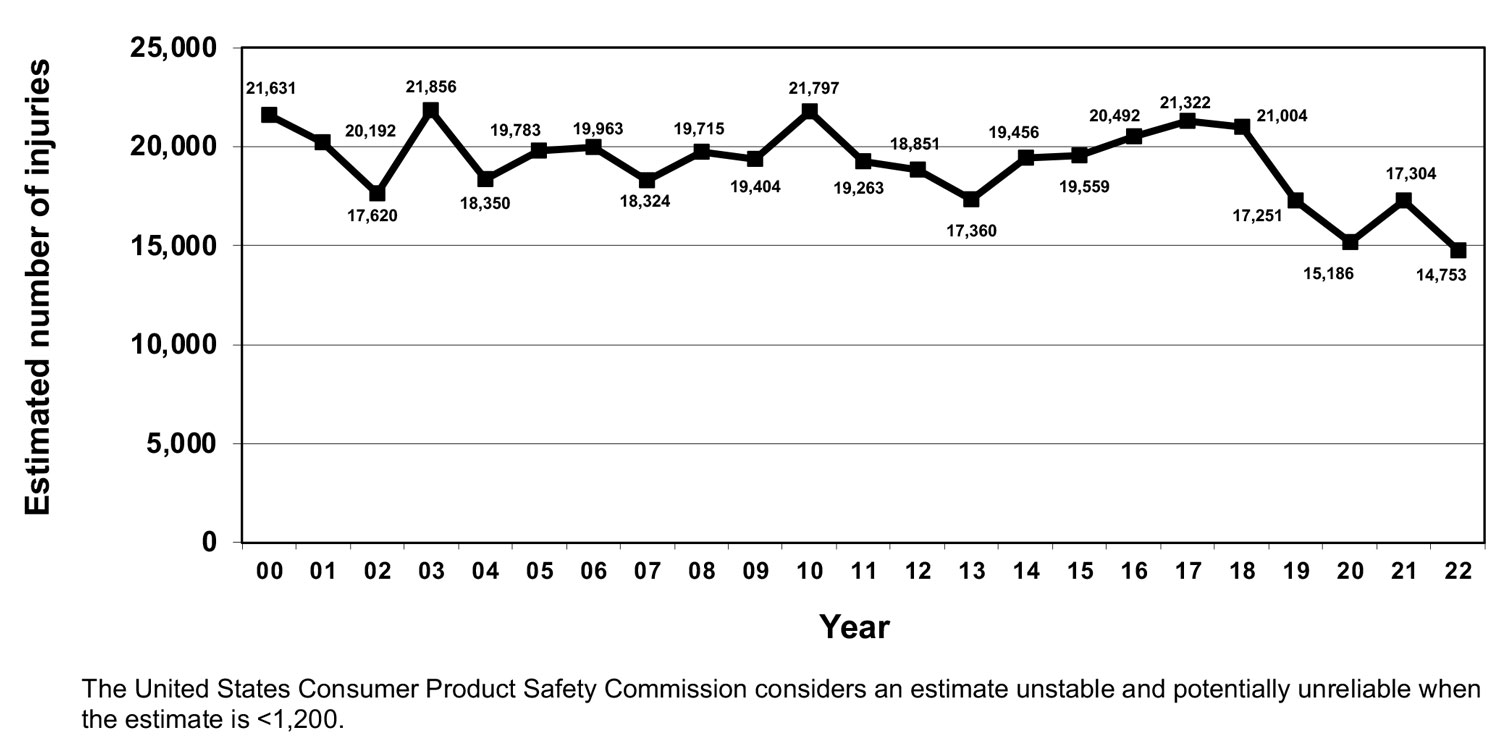
Figure 1: Annual estimated number of lawn mower-related lower extremity injuries reported to the National Electronic Injury Surveillance System, 2000-2022
During 2000-2022, 9,797 lawn mower-related lower extremity injuries were treated at a sample of US hospital EDs, resulting in a national estimate of 440,433 (95% CI 378,441-502,424) lawn mower-related lower extremity injuries. This represents 22.9% of the 1,919,146 total estimated lawn mower-related injuries affecting any body part. Among the estimated lower extremity injuries, the type of lawn mower associated with the injury was 92,133 (20.9%) riding lawn mowers or garden tractors, 76,964 (17.5%) power lawn mowers (not specified), 31,979 (7.3%) rotary power lawn mowers, 10,861 (2.5%) manual push mowers (unpowered), 1,109 (0.3%) reel power lawn mowers, and 227,387 (51.6%) lawn mowers (not specified).
Table 1 shows the distribution of lawn mower-related lower extremity injuries by diagnosis and affected body part. The most common types of injury were laceration, strain or sprain, fracture, and contusion or abrasion. The highest proportion of lower extremity injuries involved the lower leg followed by the ankle and foot.
There was a mean of 19,149 estimated lawn mower-related lower extremity injuries per year. The estimated annual number of lower extremity injuries ranged between 17,360 and 21,856 during 2000-2018 and between 14,753 and 17,304 during 2019-2022 (Figure 1). By 4-month period, the estimated number of lower extremity injuries was 60,652 (13.8%) in January-April; 290,977 (66.1%) in May-August; and 88,803 (20.2%) in September-December; 143,274 (32.5%) estimated lower extremity injuries were treated on Saturday and Sunday and 297,158 (67.5%) on Monday-Friday.
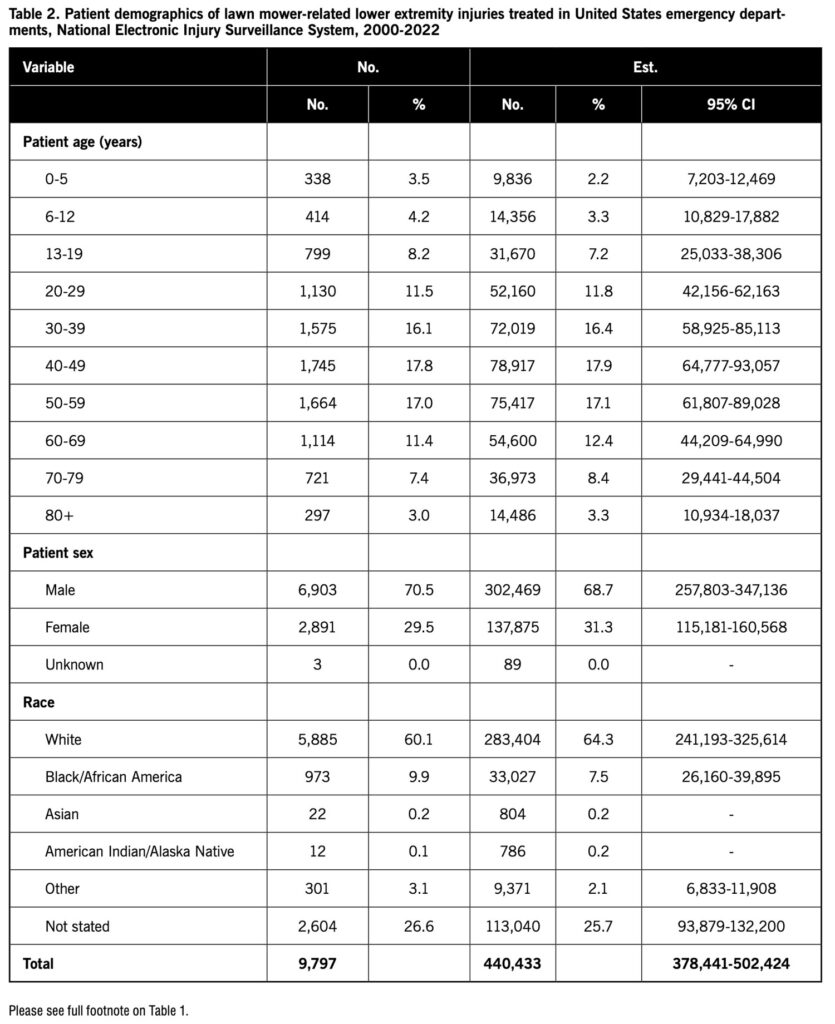
Table 2 presents the patient demographics of lawn mower-related lower extremity injuries. Patients age 30-59 years accounted for 226,353 (51.4%) of the estimated lower extremity injuries. The majority of patients were male, and most patients were White.
Table 3 shows the distribution of injuries by location of the incident and patient disposition. Of those injuries where the location of the incident was known, most occurred at home. The majority of patients were treated or evaluated at the ED and released.
Discussion
 This study examined lawn mower-related lower extremity injuries treated at US hospital EDs. Such information is important because millions of people in the US have lawn mowers, and over the last 23 years, almost 2 million estimated lawn mower-related injuries were treated at US hospital EDs, making this a serious public health concern.8 (See also “Lawn Mower Injuries Costly Public Health Concern” and “Riding Mower Injuries Major Cause of Pediatric Limb Loss”.) This study found that over one-fifth of all lawn mower-related injuries involved the lower extremity.

The most common types of lower extremity injury were laceration, strain or sprain, fracture, and contusion or abrasion, accounting for 70% of all lower extremity injuries. Amputations were relatively uncommon, though a recent study cited riding lawn mower injuries as the leading cause of major limb loss in young children in the US.15 Most of the common types of injuries would not be expected to require extensive medical intervention. This is consistent with the observation that nearly 90% of patients with lawn mower-related lower extremity injuries were treated or examined and released from the ED. However, roughly 10% of patients were admitted or transferred to another hospital for more costly care.While the estimated annual number of lawn mower-related lower extremity injuries remained relatively stable during 2000-2018, the estimated annual number of injuries declined during 2019-2022. In March 2020, due to the COVID-19 pandemic, stay-at-home or lockdown orders were issued, and schools, businesses, and other facilities were closed or restricted, although these restrictions were lifted in subsequent months.16 Declines in various consumer product-related lower extremity injuries treated at US hospital EDs were associated with the start of the COVID-19 pandemic in 2020.17 However, the decline in lawn mower-related lower extremity injuries began in 2019, prior to the COVID-19 pandemic, and continued into 2021 and 2022, when the US had returned to a semblance of pre-COVID-19 conditions. Examination of data from subsequent years will determine whether this decline in lawn mower-related lower extremity injuries continues.
Other temporal patterns were found with lawn mower-related lower extremity injuries. The injuries were seasonal, with almost two-thirds of the injuries occurring during May-August. Weather in the US is warmer, and grass grows most, during those months. Although lawn mower-related lower extremity injuries were treated throughout the week, a higher proportion of the injuries were treated during Saturday and Sunday. This may be due to people most likely being off work on the weekend and thus having more opportunity to mow grass.
There were demographic differences in lawn mower-related lower extremity injuries. Over half of the injuries occurred in patients age 30-59 years, and two-thirds of the injuries occurred in male patients. Individuals in this age group and of this sex might be more likely to use lawn mowers or may be more likely to experience lower extremity injuries resulting in treatment at hospital EDs.
There are a variety of ways to reduce the risk of lawn mower-related injuries.3 A lawn mower should undergo routine service. Prior to mowing, the area to be mowed should be examined for objects such as rocks or sticks, which then should be removed to prevent them from being thrown when the lawn mower runs over them. Proper gear, including closed-toed shoes that are slip resistant and possibly also long pants, safety glasses, and grip gloves, should be worn while mowing. The lawn mower’s fuel and/or battery levels should be checked before starting. An examination should be made for any debris or other objects that may be stuck in the lawn mower and a long-handled item should be used to remove any stuck objects. Safety shields or other features attached to the lawn mower should not be altered or removed. Other safety tips include making sure another person knows the lawn mower is being used, never leaving a lawn mower unattended when in use, educating children about the dangers of lawn mowers, ensuring that all pets are inside when mowing, being careful when mowing on slopes, never mowing backwards because the lawn mower will be moving towards the feet, and not mowing on wet grass.
There are limitations to this study. Lawn mower-related injury cases were initially identified by selecting those records with any of the 7 codes for lawn mowers in the Product_1, Product_2, or Product_3 numeric fields. Records involving lawn mower-related injuries where none of these 7 codes were used would not be included in the analysis. Furthermore, records with any of the 7 codes for lawn mowers in the Product_1, Product_2, or Product_3 numeric fields where lawn mowers were not actually involved in the injuries would be included in the analysis. It should be noted that review of the Narrative text field found only 82 records included in the study that did not mention “mow,” “lawn tractor,” “garden tractor,” “cutting grass,” or “cutting lawn.” Of these 82 records, 71 mentioned a “tractor” but did not specify the type of tractor.
Furthermore, the study only included injuries treated at hospital EDs. Information on injuries treated elsewhere might provide a more complete perspective of lawn mower-related injuries.
In conclusion, over one-fifth of all lawn mower-related injuries treated at US hospital EDs involved the lower extremity. The most commonly reported lower extremity injuries were laceration, strain or sprain, and fracture; amputations were relatively uncommon. The majority of patients were treated or examined and released. Lawn mower-related lower extremity injuries were seasonal, most often occurring in May-August. Persons with these injuries tended to be adults, particularly age 30-59 years, and most were male.
Mathias B. Forrester, BS, is an independent researcher in Austin, Texas. Now retired, he previously performed public health research for various university and government programs for 38 years.
- Statista Research Department. U.S. population: Do you own lawn and garden equipment? Statista.com. February 5, 2024. Available at https://www.statista.com/statistics/275103/us-households-owning-lawn-and-garden-equipment/. Accessed April 1, 2024.
- Trees.com staff. 15 different types of lawn mowers explained. trees.com. December 22, 2022. Available at https://www.trees.com/gardening-and-landscaping/types-of-lawn-mowers. Accessed April 1, 2024.
- Westerlund S, Curls A. Lawn mower safety for your home. Today’s Homeowner. October 26, 2023. Available at https://todayshomeowner.com/lawn-garden/guides/lawn-mower-safety-for-your-home/#:~:text=According%20to%20recent%20data%2C%20nearly,alone%20in%20the%20United%20States. Accessed April 1, 2024.
- Ren KS, Chounthirath T, Yang J, Friedenberg L, Smith GA. Children treated for lawn mower-related injuries in US emergency departments, 1990-2014. Am J Emerg Med. 2017;35(6):893-898.
- Hammig B, Childers E, Jones C. Injuries associated with the use of riding mowers in the United States, 2002-2007. J Safety Res. 2009;40(5):371-375.
- Costilla V, Bishai DM. Lawnmower injuries in the United States: 1996 to 2004. Ann Emerg Med. 2006;47(6):567-573.
- Harris C, Madonick J, Hartka TR. Lawn mower injuries presenting to the emergency department: 2005 to 2015. Am J Emerg Med. 2018;36(9):1565-1569.
- Hottinger DG, Nasr I, Canner JK, Kattail D, Koka R, Schwengel D. Incidence, Distribution, and Cost of Lawn-Mower Injuries in the United States, 2006-2013. Public Health Rep. 2018;133(5):570-577.
- Vollman D, Smith GA. Epidemiology of lawn-mower-related injuries to children in the United States, 1990-2004. Pediatrics. 2006;118(2):e273-e278.
- Colville-Ebeling B, Lynnerup N, Banner J. Fatal lawn mower related projectile injury. Forensic Sci Med Pathol. 2014;10(2):229–33.
- Greenhagen RM, Raspovic KM, Crim BE, Ryan MT, Gruen GG. Lawn mower injuries to the lower extremity. Foot Ankle Spec. 2013;6(2):119-24.
- Forrester MB. Pickleball-related injuries involving the lower extremity treated in emergency departments. Lower Extremity Review. 2021;13(5):24-30.
- United States Consumer Product Safety Commission. National Electronic Injury Surveillance System (NEISS). Available at https://www.cpsc.gov/Research–Statistics/NEISS-Injury-Data/Explanation-Of-NEISS-Estimates-Obtained-Through-The-CPSC-Website. Accessed April 1, 2024.
- United States Consumer Product Safety Commission. NEISS Coding Manual. January 2021. Available at https://www.cpsc.gov/s3fs-public/January-2021-NT-CPSC-only-NEISS-Coding-Manual.pdf?xa_nMM1kB4SGpuSMOwf0NHkkkIqNcn8F. Accessed April 1, 2024.
- Jennissen CA, Krupp TD, Vakkalanka JP, Hoogerwerf PJ. Pediatric lawn mower-related injuries and contributing factors for bystander injuries. Inj Epidemiol. 2023;10(Suppl 1):51.
- Muccari R, Chow D, Murphy J. Coronavirus timeline: Tracking the critical moments of Covid-19. NBC News Dec. 29, 2020. Available at https://www.nbcnews.com/health/health-news/coronavirus-timeline-tracking-critical-moments-covid-19-n1154341. Accessed April 1, 2024.
- Forrester MB. Changes in product-related lower extremity injuries treated at emergency departments during the COVID-19 pandemic. Lower Extremity Review. 2021;13(8):23-25,27,29-31.