








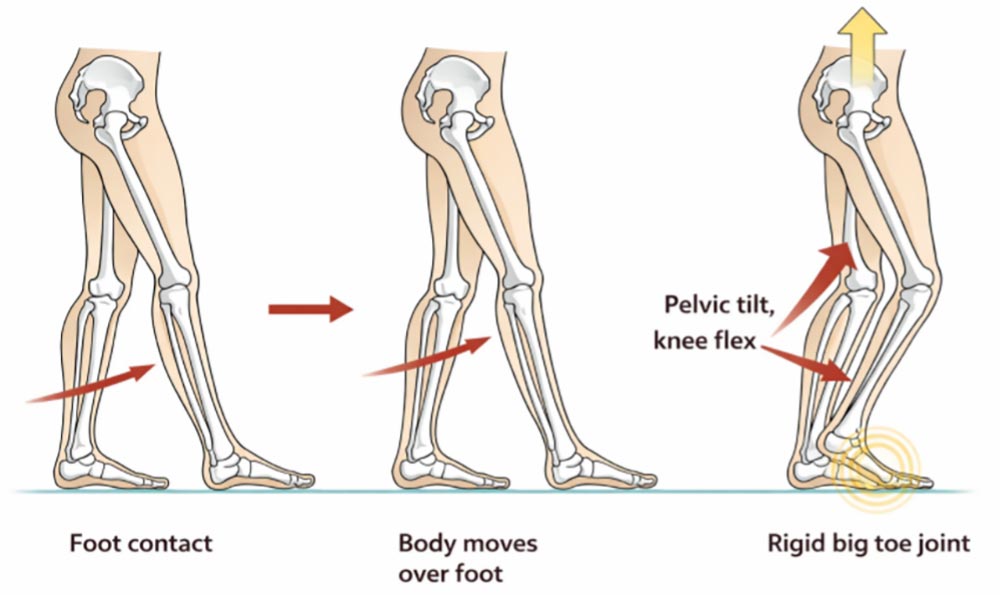
Asymmetry or dysfunction at the ground alters load distribution through the ankle, knee, hip, and spine, creating compensatory stresses that propagate throughout the musculoskeletal system–much like the worn rubber of a tire or a misaligned wheel affecting the entire axle.
By Jay Segel, DPM; Sally Crawford, MS
Dirty Truth #10 is grounded in the old saying, “where the rubber meets the road.” When your foot strikes the ground, the ground hits you back. The foot goes from an unloaded state (swing phase) to a weight-bearing, interactive body, getting pushback during every step you take on that road. The equal and opposite force Newton promised us. This bottom-up view changes everything.
These ground reaction forces deform the 3-dimensional foot against a 2-dimensional floor, triggering a cascade of accommodation up through the joints. For our purposes, let’s define the kinetic chain as a linked system of bones and soft tissues, body parts that interact to provide weight-bearing movement. It starts at the heel and climbs through the primary points of the ankle, knee, and hip, single-sided centric, coming together centrally, at the lower back, continuing ever upward, through to the cranial sutures in the head.
With the exclusion of infection and some nail issues, along with macro-traumatic events from burns to bites to breaks, the majority of foot issues are mechanical in nature, so they only get worse over time, not better. It’s like saying the wear on my tires will get better the more I drive. No, that way of thinking leads to greater deformity, structural damage, and danger. While letting the analogy continue its pictorial work, we can now explain the ground we have covered before. Looking at the body from bottom up rather than top down uncovers the stem of these mechanical issues. The real story begins when the foot strikes the ground.
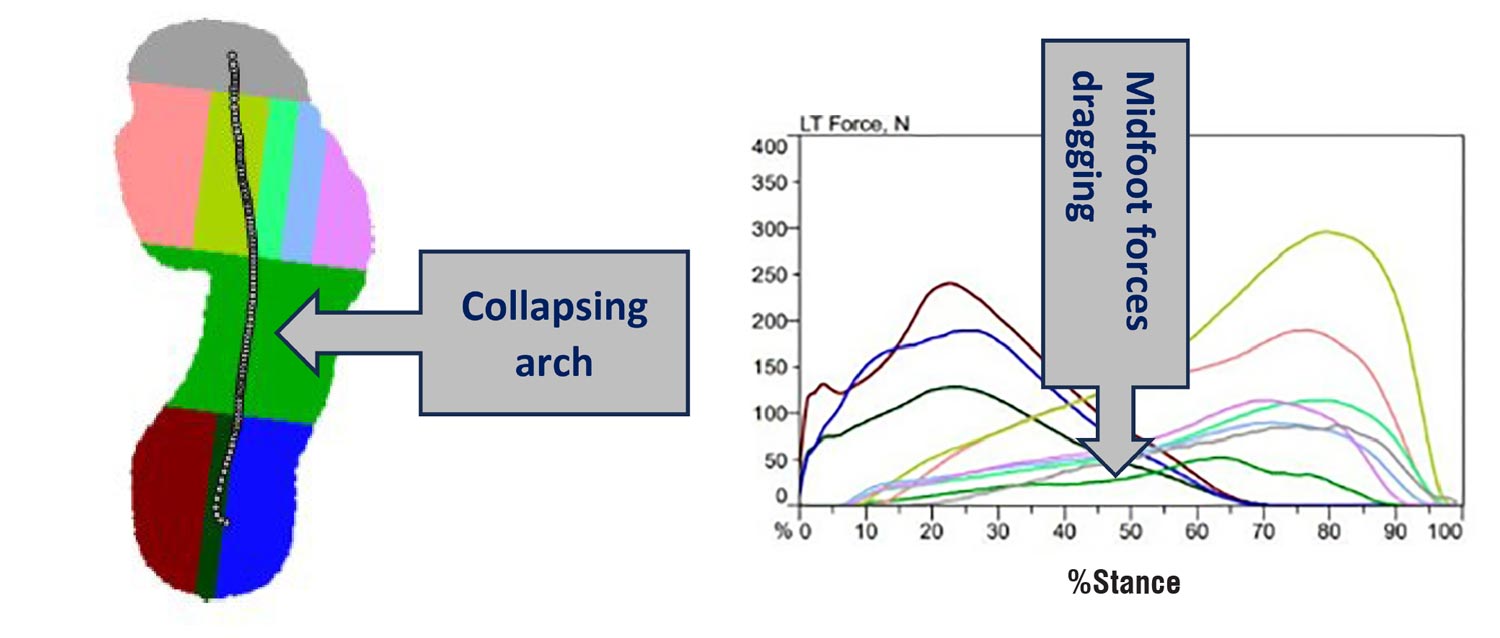
Unilateral arch collapse shifts the center of pressure and prolongs ground reaction forces.
Recalling all the prior “Dirty Truths” presented in this computer-aided gait analysis (CAGA) 101 series, stance is an unavoidable collision–but it is also predictable and measurable with CAGA. The softer the surface, the smaller the ground reactive forces, yet the softer the surface, the less support it provides, with increased friction and tensile forces due to a longer time to achieve stability. This is why the trend in orthotic shell design has shifted away from foam or rigid framework toward an evolved semi-rigid/semi-flex plate type.
It’s all about objectively measuring that improved balance and maintaining motion for the long run. For example, a collapsed arch on one side often leads to knee pain–or even tension headaches–on the opposite side. A collapsing arch disrupts the normal center of pressure (COP) pathway, causing it to shift medially during stance. The force–time curves show prolonged and elevated midfoot loading, with forces “dragging” later into stance rather than resolving efficiently. These sustained forces increase compensatory stress throughout the kinetic chain, helping explain how unilateral foot collapse can drive knee, hip, spinal, and contralateral symptoms. The foot doesn’t just hit the ground–it starts a conversation with the entire body, and every joint up the chain is forced to reply.
With CAGA, we have the tools to help quantitatively illustrate the findings, solutions, and progress. It is a language that is surprisingly easy to misunderstand and even harder to communicate. And that’s exactly where our next Dirty Truth begins.
Related posts:

Lower Extremity Injuries Caused by Falls Treated at Hospital Emergency Departments

Explosion of Analytics Will Fuel Growth of Sports Medicine

Robotic-Assisted Total Knee Arthroplasty is Associated with Improved Quality of Life and Increased Patient Satisfaction ...

Rock Climbing-Related Lower Extremity Injuries Treated at Hospital Emergency Departments

lerEXPO Highlights: 5 Surprising Lessons from the Frontlines of Limb Preservation