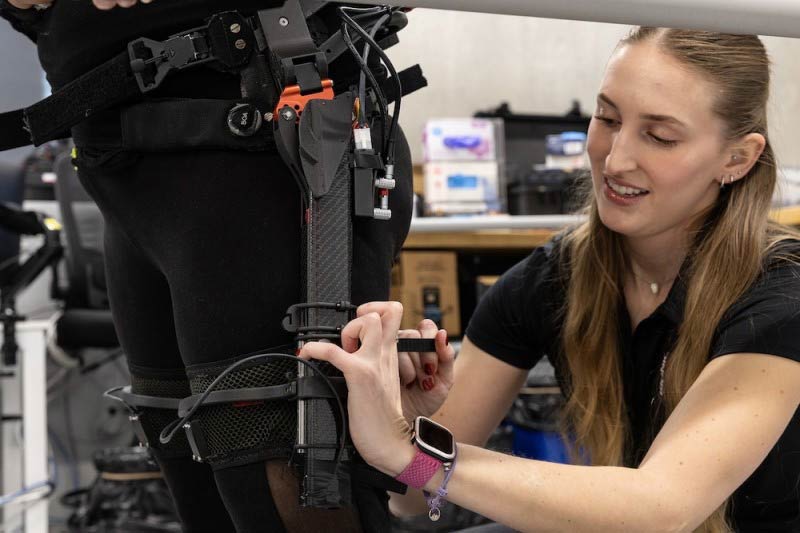
Pruin adjusts the exoskeleton on a study participant. Image courtesy of Dan Hixson, University of Utah.
Researchers led by Tommaso Lenzi, associate professor in the mechanical engineering department at the University of Utah’s John and Marcia Price College of Engineering, are piloting a portable, lightweight hip exoskeleton that can reduce the energy required to walk by nearly 20% in individuals with post-stroke hemiparesis. The 5.5-pound device is worn around the hips and straps to the user’s thighs. Battery-powered motors help move the user’s legs with every step, leading to a more efficient gait. The level of motor assistance on each side is custom-tuned for each user, and an intelligent control system synchronizes with them in real time, providing a boost exactly when the hip needs to lift or push off.
Other types of powered exoskeletons have been explored in earlier attempts at solving this problem. Identifying foot drop and impaired ankle propulsion as key contributors to this problem, these prototypes were built to assist with ankle mobility.
“Patients with ankle weakness often compensate with their hip joints, which requires extra energy,” said Kai Pruyn, a graduate student in Lenzi’s HGN Lab for Bionic Engineering. “Hip exoskeletons can also be extremely lightweight because they are worn closer to the user’s center of mass and have lower torque requirements compared to ankle exoskeletons. We found that the hip assistance effectively compensated for reduced ankle propulsion.”
The study implemented motion-capture techniques to analyze the gait of seven patients with hemiparesis as they walked on an instrumented treadmill, both with and without the exoskeleton. The participants also wore equipment that estimated their caloric expenditure. From that data, the researchers calculated the metabolic cost of walking under both conditions. Using the exoskeleton offloaded nearly 30% of the work from the hip joints, translating into an 18% decrease in the overall metabolic cost of walking. Study participants reported significant improvements in mobility.
Next steps for the research team include ensuring the hip exoskeleton is safe and effective at home and in daily life.