






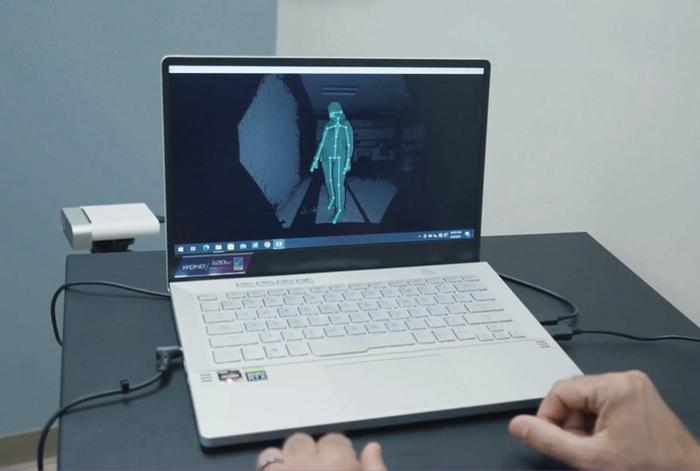
Microsoft’s Azure Kinect depth camera captures 3D data, color images, and body movements for motion tracking. Image courtesy of FAU.
A study from the College of Engineering and Computer Science and the Sensing Institute (I-SENSE) at Florida Atlantic University (FAU), Boca Raton, reveals that foot-mounted wearable sensors and a 3D depth camera can accurately measure how people walk–even in busy clinical environments–offering a powerful and more accessible alternative to traditional gait assessment tools.
To overcome barriers of electronic walkways–their high cost, large footprint, and limited portability–the team conducted the first known study to simultaneously evaluate 3 different sensing technologies: APDM wearable inertial measurement units (IMUs), Microsoft’s Azure Kinect depth camera, and the Zeno™ Walkway–under identical, real-world clinical conditions. The depth-sensing camera captures 3D data, color images, and body movements for use in AI, robotics, and motion tracking.
The study recruited 20 adults age 52–82, who completed both single-task and dual-task walking trials. Each participant’s gait was captured by the 3 systems at the same time. Researchers evaluated 11 different gait markers, including basic metrics like walking speed and step frequency, as well as more detailed indicators such as stride time, support phases, and swing time. These markers were analyzed using statistical methods to compare each device’s measurements with those from the Zeno Walkway.
The study findings revealed that foot-mounted IMUs and the Azure Kinect not only showed near-perfect agreement with the walkway across nearly all gait markers, but also enabled scalable, remote, and cost-effective gait analysis. The Azure Kinect also performed impressively, maintaining strong accuracy even in the complex, real-world clinic setting where multiple people were present in the camera’s field of view.
Importantly, the study is the first to benchmark the Azure Kinect against an electronic walkway for micro-temporal gait markers, filling a gap in the literature and confirming the device’s potential clinical value.