









 By Dr. Dean Hartley (Podiatrist & Adjunct Engineering Fellow–University of Queensland)
Technique is not merely a procedural afterthought—it is the foundation of successful digital orthotic design. A well-executed scan captures the anatomical subtleties of the foot and lower limb in the intended corrected position, ensuring the final device conforms precisely to the patient’s morphology. When done poorly, it introduces distortions that compromise fit, function, and ultimately, patient outcomes. This is where technology meets technique.
TrueDepth scanning, leveraging the front-facing camera of an iPad Pro or iPhone–and iPads equipped with Structure Sensor Pro attachments are rapidly becoming the industry standard for foot orthotic and above the ankle capture. These tools offer clinicians accessible, high-resolution scanning capabilities, but their effectiveness is contingent on effective scanning technique.
Why Scan Quality Matters
A compromised scan, whether due to poor resolution, misalignment, or inadequate anatomical capture, can significantly affect the integrity of the final device resulting in potential manufacturing delays, the need for remakes or suboptimal patient outcomes. While digital cast correction can be performed, it is a compensatory measure and not a good substitute for a precise initial scan. Best practice dictates that well-balanced, anatomically aligned scans are provided to ensure best outcomes3.
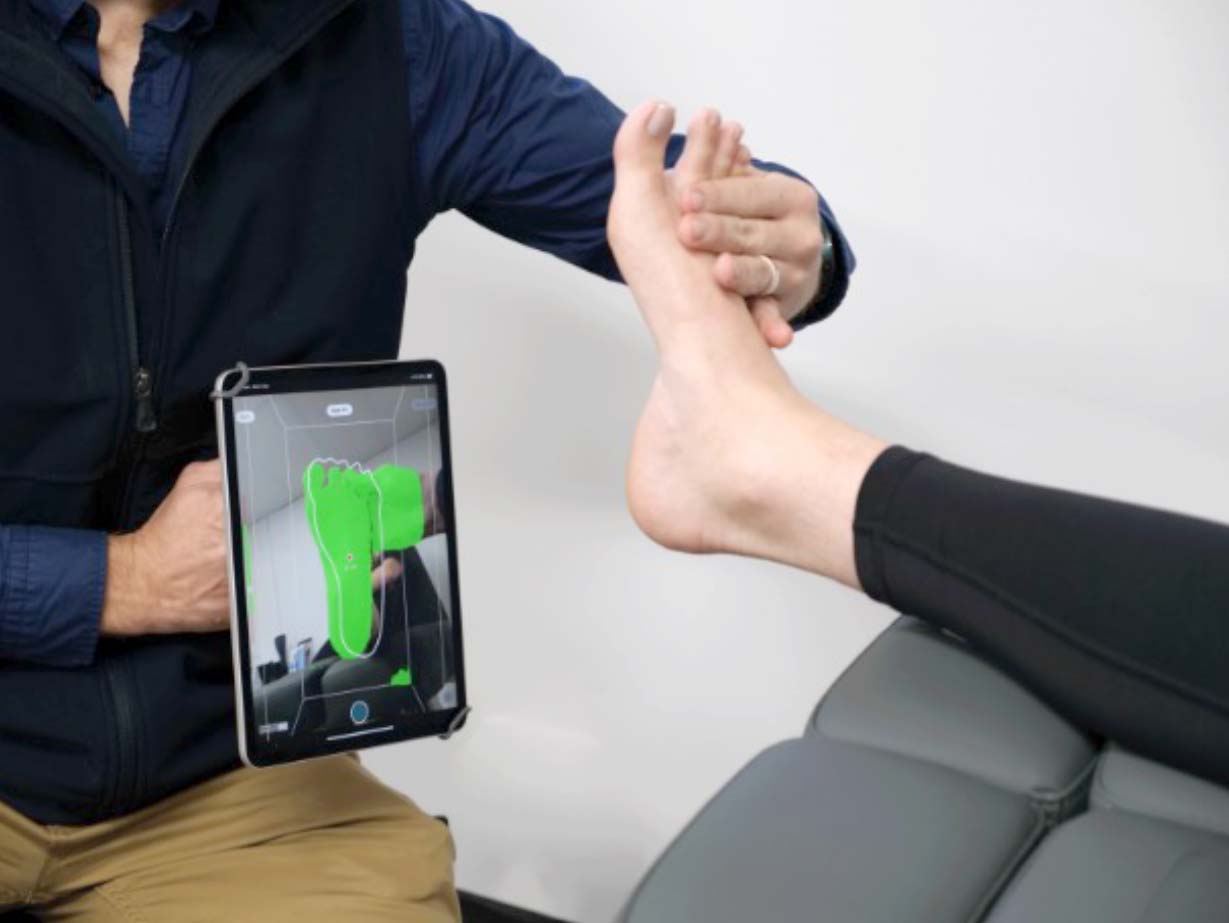
Using an iPad Pro with TrueDepth scanning in a supine suspended NWB position
Tips for Effective 3D Scanning
- Choose the foot position required based on the assessment and diagnosis of the patient.
- Position can vary from STJ neutral to maximally everted/inverted depending on the patient’s needs.
- 3 Point Contact with flatbed scanner/frame is ideal–1st and 5th metatarsal and heel.
- Balance the forefoot to rearfoot relationship within the scan to capture the most accurate foot morphology.
- Be consistent.
- Semi-weightbearing helps negate certain casting errors including forefoot supinates (flexible varus) and plantarflexed forefoot, while capturing soft tissue expansion.
- Labs need to know if scans are full weightbearing (FWB), non-weightbearing (NWB) and semi-weightbearing (SWB).
Weightbearing vs. Non-Weightbearing Scans
The degree of weightbearing during foot scanning has a significant impact on the morphological data captured. SWB scans more accurately reflect the functional alignment of the foot during gait, resulting in orthotic devices that better accommodate dynamic loading patterns and consistently produce more anatomically accurate design files. In contrast, NWB scans, while easier to perform, often produce narrower design files that necessitate post-processing adjustments, thereby increasing both fabrication time and cost3.
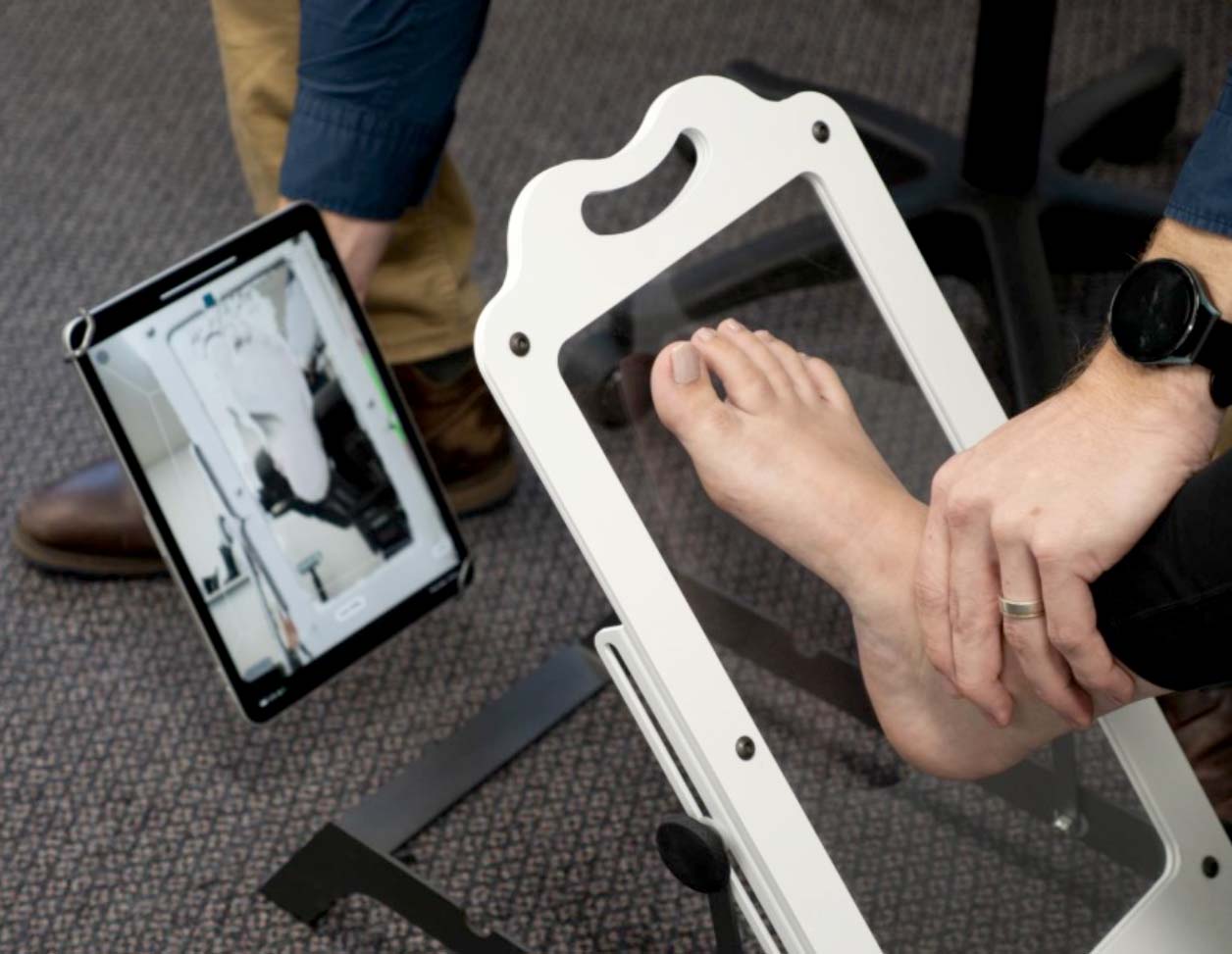
Doctor using a scan plate to capture an SWB scan
Practical Setup Tips for Clinicians
Before You Scan:
- Practice with a colleague before scanning patients.
- Ensure correct setup to avoid fumbling during live appointments.
During Scanning:
- Follow the 90/90 Rule: Position the subtalar and talocrural joints at 90 degrees.
- Elevate the foot to capture the posterior heel.
- Use an adjustable chair: Align the patient’s knee and hip for comfort and accuracy.
- Allow ample space around the patient for device movement.
Tools and Aids to Enhance Scanning
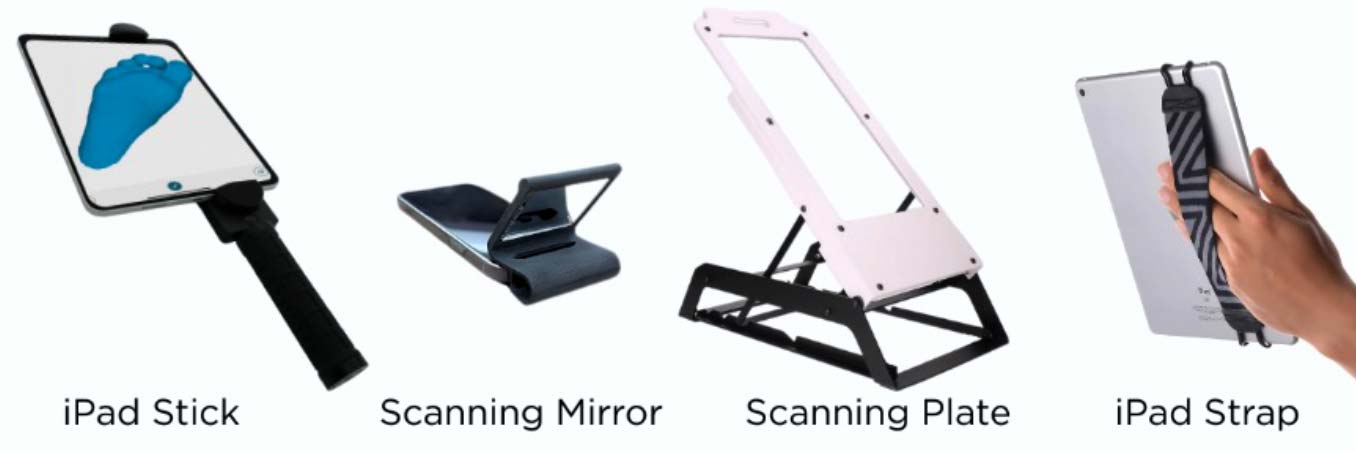
In clinical practice, scanning aids significantly improve the quality and consistency of digital captures. Scan plates are essential for SWB scanning, stabilizing the foot and aligning the forefoot and rearfoot for accurate modeling. We recommend their use for all custom foot orthoses and above-the-ankle scans, as they support reproducible positioning and minimize distortion.
Scan mirrors are especially helpful when using TrueDepth scanning technology and enable the clinician to maintain an upright position of the scanning device, improving visibility and control during the capture process. This is particularly useful when scanning complex anatomical regions or when working in confined clinical spaces.
Hand straps offer ergonomic benefits by improving the mobility and handling of the scanning device, allowing smoother transitions around the limb and reducing clinician fatigue during longer scanning sessions. Together, these aids contribute to a more efficient and precise scanning workflow.
Conclusion: Technique is the New Gold Standard
As 3D scanning becomes the norm for orthotic prescription, the focus must shift from hardware to technique. The research suggests, regardless of the device used, the clinician’s scanning method determines the accuracy of the final orthotic.
By mastering scanning protocols, using the right tools, and understanding the nuances of weight-bearing capture, clinicians can ensure optimal outcomes for their patients—every time3.
Dean Hartley is a Podiatrist and healthcare innovator with over a decade of experience in clinical practice, orthotic manufacturing, and allied health leadership. He co-founded Balance Podiatry, iOrthotics globally, and Healthia Limited, a publicly listed allied health organization. As Director, he leads iOrthotics Australia, The Orthotic Factory (Adelaide), iOrthotics USA and Performance Labs (New Jersey), driving advancement in orthotic manufacturing through 3D printing, digital workflows, and scanning technologies.
Dr. Hartley collaborates with leading universities and industry partners, holds an Adjunct Fellowship at The University of Queensland, and co-established the Healthia R & D Hub, advising on tech-enabled healthcare and private sector research.
- Williams B. Is scanning more effective than casting for custom orthoses? Podiatry Today. May, 2020. Accessed October 16, 2025. https://www.hmpgloballearningnetwork.com/site/podiatry/scanning-more-effective-casting-custom-orthoses
- Payne C. Cost benefit comparison of plaster casts and optical scans of the foot for the manufacture of foot orthoses. Australasian Journal of Podiatric Medicine. 2007;41(2):29-31. https://www.podscan.com.au/images/downloads/Plaster_Cast_Vs_Scaning_Cost_Benefit.pdf
- Chhikara K, Suresh S, Morrison S, Hartley D, et al. Does scanner choice matter for the design of foot orthosis? Sensors (Basel). 2025 Jan 31;25(3):869. doi: 10.3390/s25030869.






Where can I buy the awesome foot scanning plate?