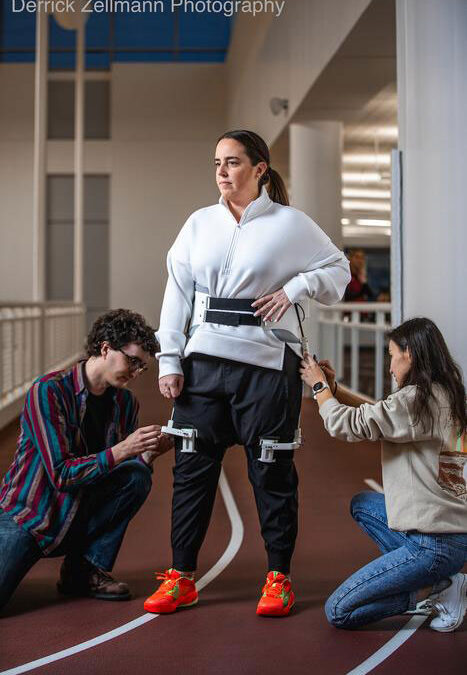








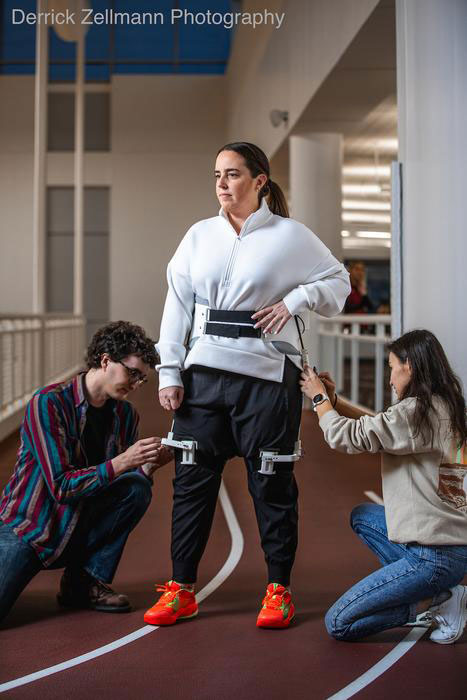
Meghan Huber, PhD, assistant professor of mechanical and industrial engineering, wearing the hip exoskeleton with Mark Price, PhD, and PhD candidate Banu Abdikadirova. Image courtesy of Derrick Zellmann.
Stroke survivors often experience walking asymmetry, where 1 step is shorter than the other. Now, new research from the University of Massachusetts (UMass) Amherst pushes forward the bounds of stroke recovery with a unique, portable robotic hip exoskeleton. Their work reveals that the robotic hip exoskeleton has the potential to effectively train individuals to modify their walking asymmetry, inviting the possibility of new therapies that are more accessible and easier to translate from practice to daily life compared to current rehabilitation methods.
The approach employed by the robotic exoskeleton is inspired by split-belt treadmills. Prior research has shown that repeated training on a split-belt treadmill can reduce walking asymmetry in stroke patients.
Wouter Hoogkamer, PhD, assistant professor of kinesiology, has spent the last decade studying split-belt treadmills. “Split-belt treadmill training is designed to exaggerate a stroke patient’s walking asymmetry by running the belts under each foot at different speeds,” he said. “Over time, the nervous system adapts, such that when the belts are set to the same speed, they walk more symmetrically.”
This proof-of-concept study showed that applying resistive forces about 1 hip joint and assistive forces about the other with their exoskeleton mimicked the effects of split-belt treadmill training in neurologically intact individuals. Now that the research team has proven that the exoskeleton can alter gait asymmetry, they are eager to move their research into overground contexts that are more akin to the real world. The researchers also plan to expand their work by measuring the neural changes caused by walking with the exoskeleton and testing this new method on stroke survivors.