
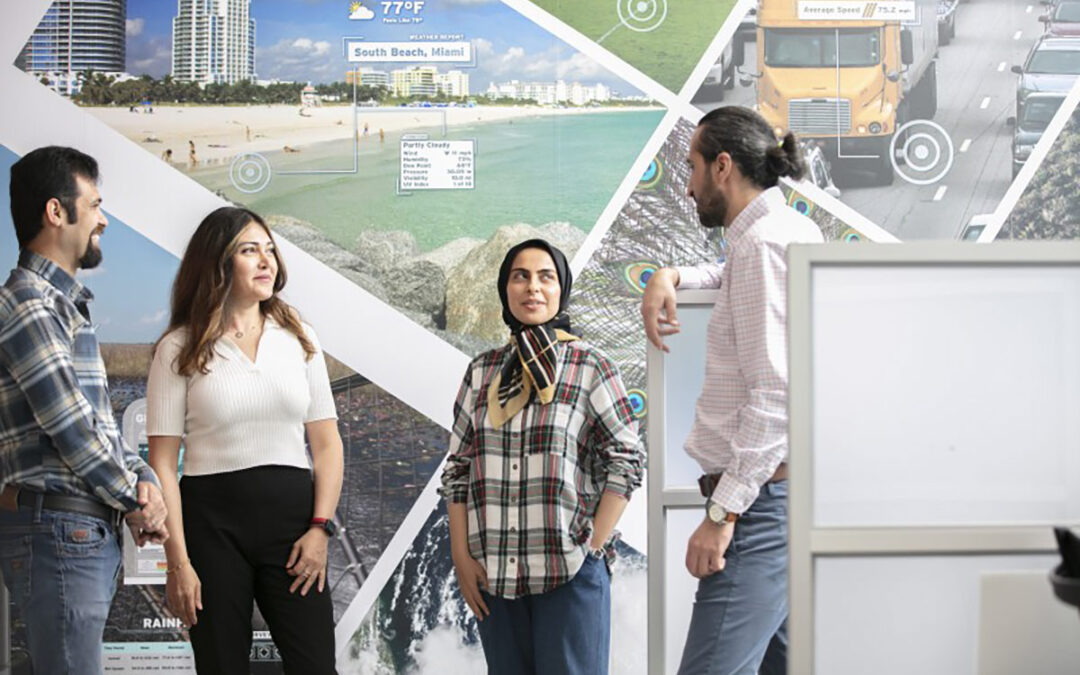








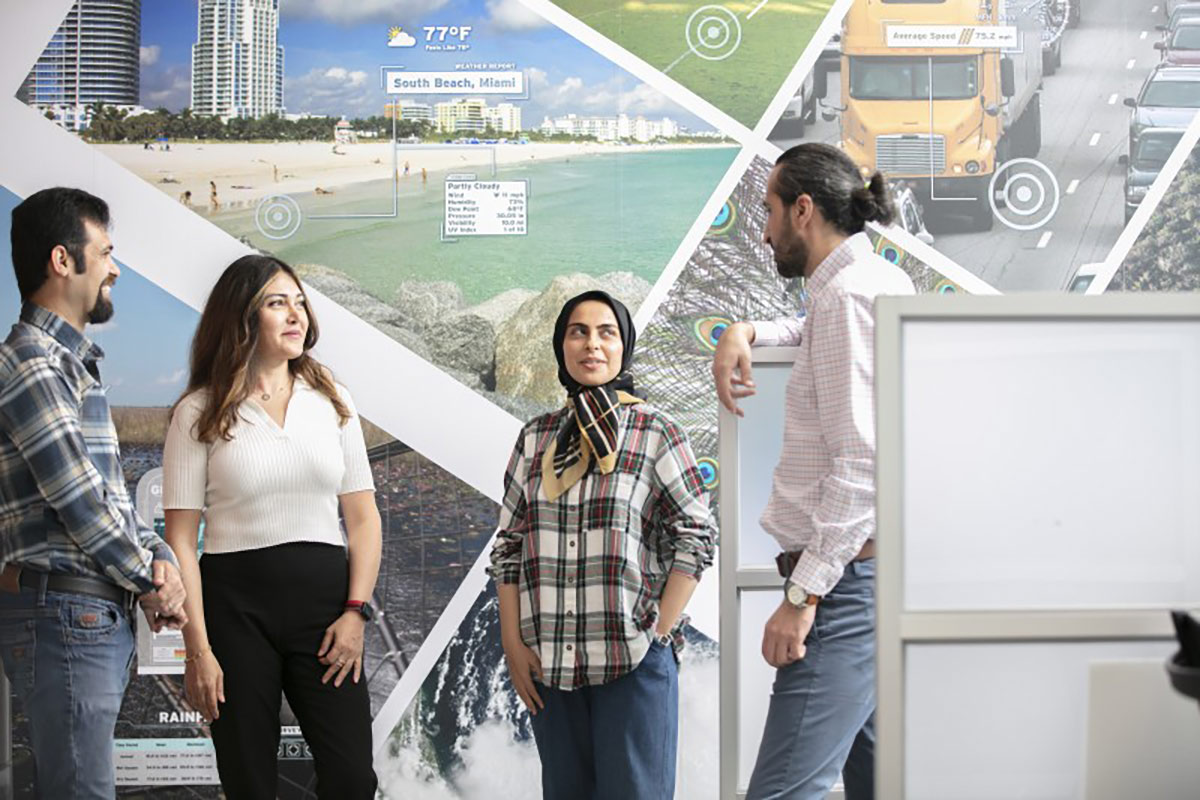
Using wearable sensors and advanced machine learning algorithms, researchers have developed a novel method that could revolutionize balance assessment practices. Image courtesy of Alex Dolce, FAU.
Using wearable sensors and advanced machine learning algorithms, researchers from Florida Atlantic University’s College of Engineering and Computer Science have developed a novel approach that addresses a crucial gap in balance assessment and sets a new benchmark in the application of wearable technology and machine learning in healthcare. The approach is a significant advance in objective balance assessment, especially for remote monitoring in home-based or nursing care settings, potentially transforming balance disorder management.
For the study, researchers used the Modified Clinical Test of Sensory Interaction on Balance (m-CTSIB. Wearable sensors were placed on study participants’ ankle, lumbar, sternum, wrist, and arm. Researchers collected comprehensive motion data from the participants under 4 different sensory conditions of m-CTSIB: balance performance with eyes open and closed on a stable surface; and eyes open and closed on a foam surface. Each test condition lasted about 11 seconds without breaks to simulate continuous balance challenges and streamline the assessment process. Researchers used inertial measurement unit (IMU) sensors coupled with a specialized system to evaluate ground truth m-CTSIB balance scores for their analysis.
The data was then preprocessed and an extensive array of features was extracted for analysis. To estimate the m-CTSIB scores, researchers applied Multiple Linear Regression, Support Vector Regression and XGBOOST algorithms. The wearable sensor data served as the input for their machine-learning models, and the corresponding m-CTSIB scores from Falltrak II, 1 of the leading tools in fall prevention, acted as the ground truth labels for model training and validation. Multiple machine-learning models were then developed to estimate m-CTSIB scores from the wearable sensor data. Researchers also explored the most effective sensor placements to optimize balance analysis.
Results of the study underscore this approach’s high accuracy and strong correlation with ground truth balance scores, suggesting the method is effective and reliable in estimating balance. Data from lumbar and dominant ankle sensors demonstrated the highest performance in balance score estimation, highlighting the importance of strategic sensor placement for capturing relevant balance adjustments and movements.
“Positioned on areas like the lower back and lower limbs, these sensors provide insights into 3D movement dynamics, essential for applications such as fall risk assessment in diverse populations, “said Behnaz Ghoraani, PhD, associate professor, FAU Department of Electrical Engineering and Computer Science, co-director of the FAU Center for SMART Health, and a fellow, FAU Institute for Sensing and Embedded Network Systems Engineering. “Coupled with the evolution of machine learning, these sensor-derived datasets transform into objective, quantifiable balance metrics, using an array of machine learning techniques.”
Results provide important insights into the significance of specific movements, feature selection, and sensor placement in estimating balance. Notably, the XGBOOST model, utilizing the lumbar sensor data, achieved outstanding results in both cross-validation methods and demonstrated a high correlation and a low mean absolute error, indicating consistent performance.
The objectives of this study emerged from recognizing the need for advanced tools to capture the nuanced effects of different sensory inputs on balance.