







 By Mathias B. Forrester, BS
Background: Treadmills are the most popular piece of exercise equipment, with millions of people in the United States (US) using the devices each year. Thousands of people are treated for treadmill-related injuries in the US annually. The objective of this study was to describe treadmill-related lower extremity injuries treated at US hospital emergency departments (EDs).
Methods: Treadmill-related lower extremity injuries during 2000-2022 were identified using the National Electronic Injury Surveillance System (NEISS), a database of consumer product-related injuries treated at a representative sample of US hospital EDs. Cases reported to the NEISS can be used to calculate national injury estimates. The distribution of treadmill-related lower extremity injuries was determined for patient demographics, injury circumstances, and management..
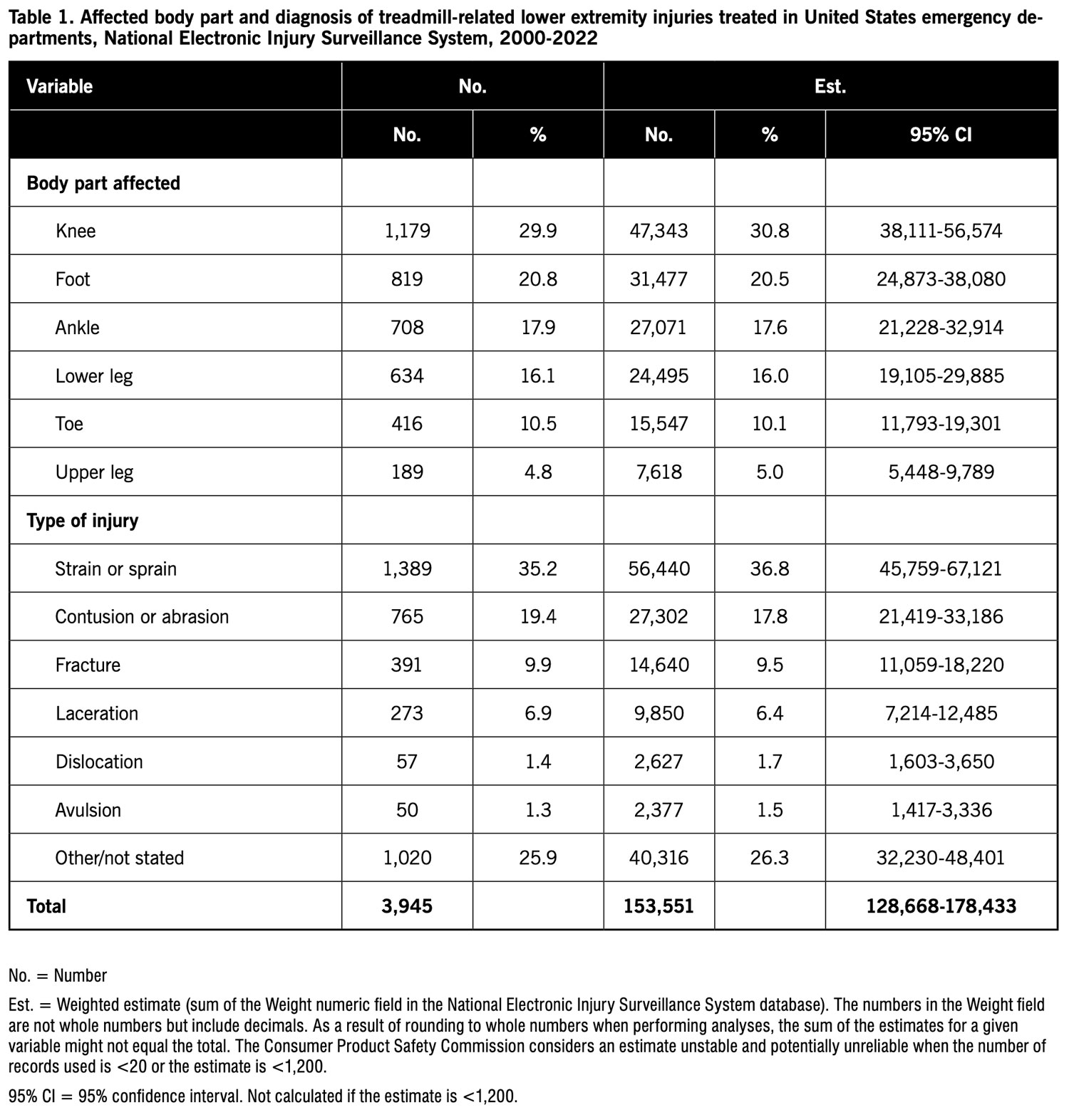
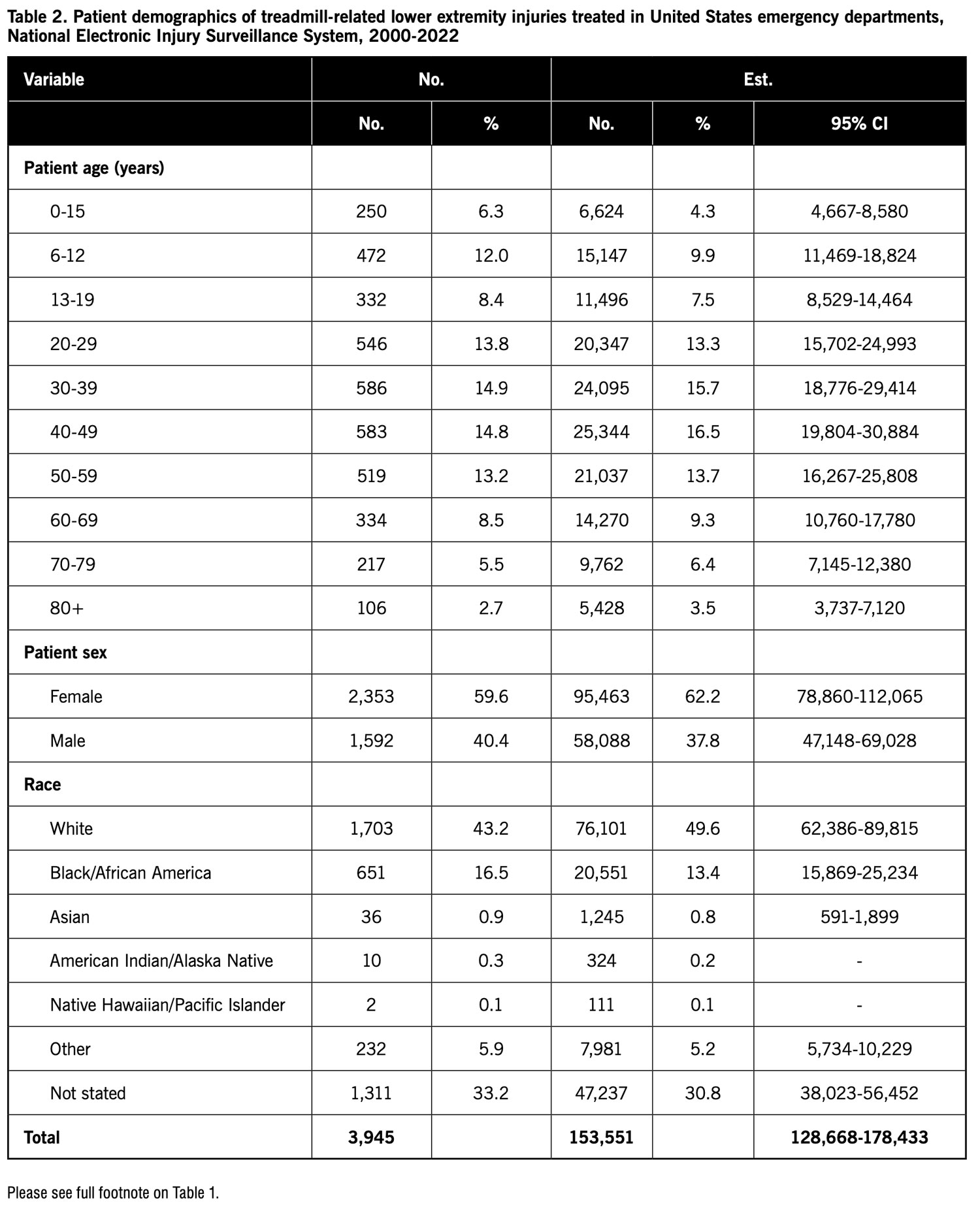
Results: Of an estimated 451,250 total treadmill-related injuries, 153,551 (34.0%) involved the lower extremity. Of these lower extremity injuries, the affected body part was 30.8% knee, 20.5% foot, 17.6% ankle, 16.0% lower leg, 10.1% toe, and 5.0% upper leg. The injuries were 36.8% strain or strain, 17.8% contusion or abrasion, 9.5% fracture, 6.4% laceration, 1.7% dislocation, 1.5% avulsion, and 26.3% other/not stated. The age distribution was 4.3% 0-5 years, 9.9% 6-12 years, 7.5% 13-19 years, 13.3% 20-29 years, 15.7% 30-39 years, 16.5% 40-49 years, 13.7% 50-59 years, 9.3% 60-69 years, 6.4% 70-79 years, and 3.5% 80 years or older; 62.2% of the patients were female and 37.8% male.
Conclusion: One-third of all treadmill-related injuries treated at US hospital EDs involved the lower extremity. The highest proportion of patients with lower extremity injuries were aged 30-49 years, and most patients were female. The most commonly reported injuries were strain or sprain, contusion or abrasion, and fracture, and the most frequently affected parts of the lower extremity were the knee, foot, and ankle.
A treadmill is an exercise machine mainly used for running, walking, or climbing while remaining in one place. The device is a moving platform with a conveyor belt driven by an electric motor or flywheel. The conveyor belt moves backward, forcing the person on the belt to run or walk at a speed matching the belt. Depending on the type of treadmill, the speed, inclination, and other factors may be adjusted. Treadmills may be found in such locations as healthcare facilities (eg, hospitals, rehabilitation centers), fitness facilities, and homes. Treadmills also may be found in the workplace as treadmill desks.1
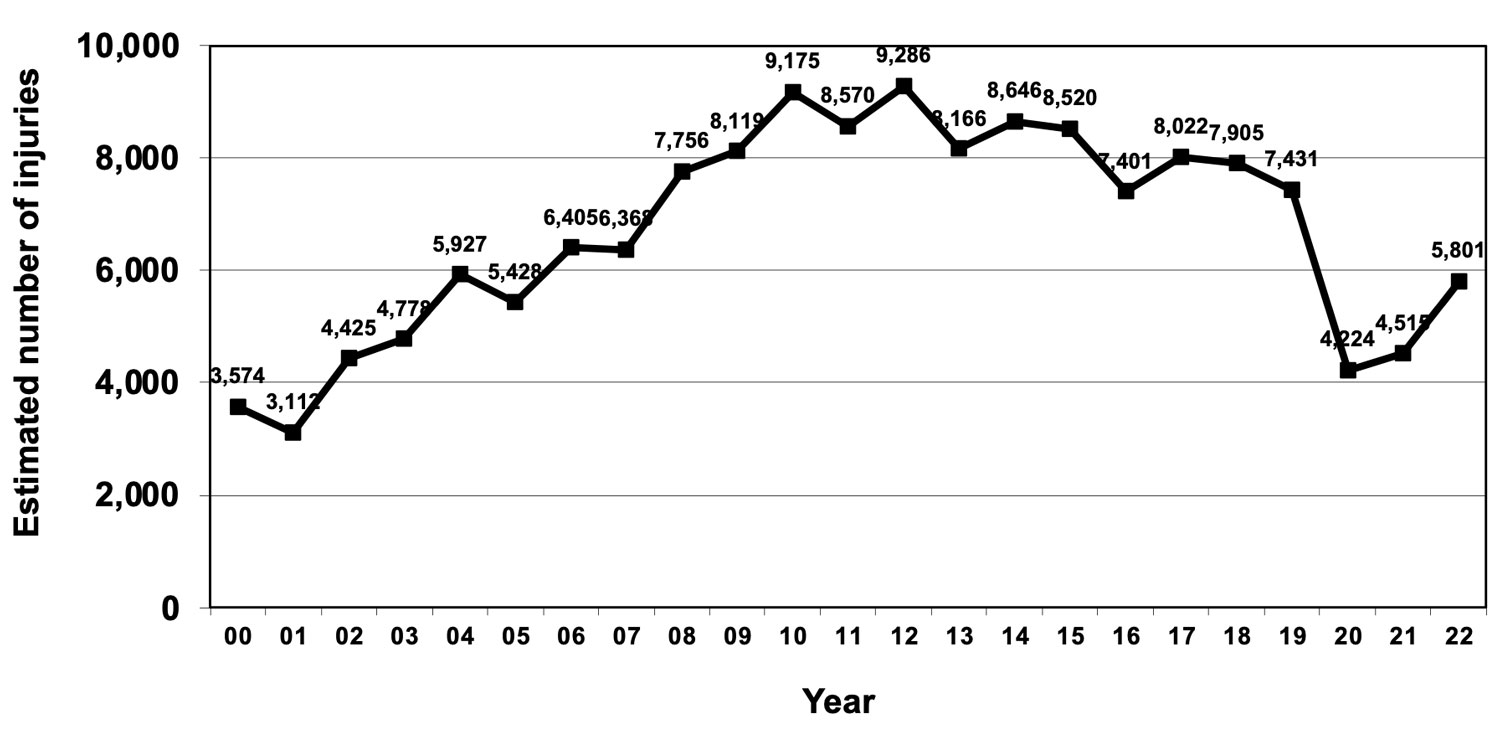
Figure 1: Annual estimated number of treadmill-related lower extremity injuries reported to the National Electronic Injury Surveillance System, 2000-2022
Treadmills are the biggest-selling exercise equipment category.1 One analysis reported approximately 50 million people in the United States (US) aged 6 years or older used treadmills annually.2 According to the International Health, Racquet and Sportsclub Association (IHRSA) 2018 IHRSA Health Club Consumer Report, during the previous 3 years, treadmills were the most popular piece of exercise equipment, with 43% of members using the devices.3
Treadmills account for a large proportion of exercise-related injuries. A study of home mechanical exercise equipment-related injuries treated at hospital emergency departments (EDs) reported that 66% of the injuries involved treadmills.4 Another study found that treadmills accounted for 25% of all home exercise equipment injuries involving children ages 18 years and younger treated at hospital EDs.4
Thousands of people are treated for treadmill-related injuries in US EDs each year.5,6 Treadmill-related injuries include soft tissue injuries (contusions, abrasions, crushing injuries, and hematomas), strains and sprains, lacerations, fractures, friction burns, and blunt trauma.5,7 Deaths have been associated with treadmills.6
Several studies have indicated that over one-third of treadmill-related injuries involved the lower extremity.7,8 The objective of this study was to describe treadmill-related lower extremity injuries reported to US hospital EDs.
Methods
 Data were obtained from the National Electronic Injury Surveillance System (NEISS) website (https://www.cpsc.gov/cgibin/NEISSQuery/home.aspx). The NEISS database has been described in detail in Lower Extremity Review previously.9,10 Briefly, the NEISS is a database of consumer product-related injuries collected from a representative sample of approximately 100 US hospital EDs. National estimates are calculated from database records according to the sample weight assigned to each case based on the inverse probability of the hospital being selected for the NEISS sample.11,12 Data are publicly available and de-identified; thus, the study is exempt from institutional review board approval.
Cases were treadmill-related lower extremity injuries reported to the NEISS database during 2000-2022. The publicly available NEISS database contains three numeric fields for coding the product involved in the injury (Product_1, Product_2, Product_3). Treadmills are usually assigned product code 3277 (exercise equipment). However, this product code is not specific to treadmills but also may be used for other types of exercise equipment. The NEISS database contains a text field (field name Narrative) that provides a brief summary of the circumstances of the injury. The NEISS database was searched for all records that included the letter groups “tre” and “mil” in the Narrative field. The Narrative fields of the resulting records were individually examined, and any records that involved a treadmill-related injury were included in the study. That the injury involved a lower extremity was based on the Body_Part numeric field (a field that documents the injured body part) containing codes for a lower extremity (upper leg, knee, lower leg, ankle, foot, toe). The NEISS database contains another numeric field for documenting whether a second body part was injured (Body_Part_2); however, this field was only added in 2018,12 although this field does not appear to have been used until 2019. For consistency over the entire study period, the Body_Part field alone was examined. (Fifty-four cases had a lower extremity coded in the Body_Part_2 field but not in the Body_Part field during 2019-2022.)
The variables examined were treatment year; patient age, sex, and race; location where the incident occurred; type of injury (diagnosis); affected body part; and disposition. Analyses were performed using Microsoft 365 Access and Excel (Microsoft Corporation, Redmond, Washington, US). For all treadmill-related lower extremity injuries, the distribution of cases and national injury estimates were determined for the variables. National injury estimates were calculated by summing the values in the Weight numeric field in the publicly available NEISS database, and 95% confidence intervals (CIs) were calculated for the estimates. The CPSC considers an estimate unstable and potentially unreliable when the number of records used is <20 or the estimate is <1,200.11 For those variable subgroups where the estimate was <1,200, 95% CIs were not calculated.
Results
During 2000-2022, 3,945 treadmill-related lower extremity injuries were treated at a sample of US hospital EDs, resulting in a national estimate of 153,551 (95% CI 128,668-178,433) treadmill-related lower extremity injuries. This represents 34.0% of the 451,250 total estimated treadmill-related injuries affecting any body part. The knee was the most frequently affected part of the lower extremity, followed by the foot and ankle (Table 1). The most common types of injury were strain or sprain, contusion or abrasion, and fracture (Table 1).
 The annual estimated number of treadmill-related lower extremity injuries increased from 2000 to a peak in 2012 before declining to 2020 before increasing once more (Figure 1). The estimated number of injuries declined from 7,431 in 2019 to 4,224 in 2020, a 43% decrease.
Table 2 shows the patient demographics of treadmill-related lower extremity injuries. The highest proportions of patients were aged 30-39 years and 40-49 years; these two age groups accounted for approximately 30% of the injuries. The majority of patients were female, and most patients were White.
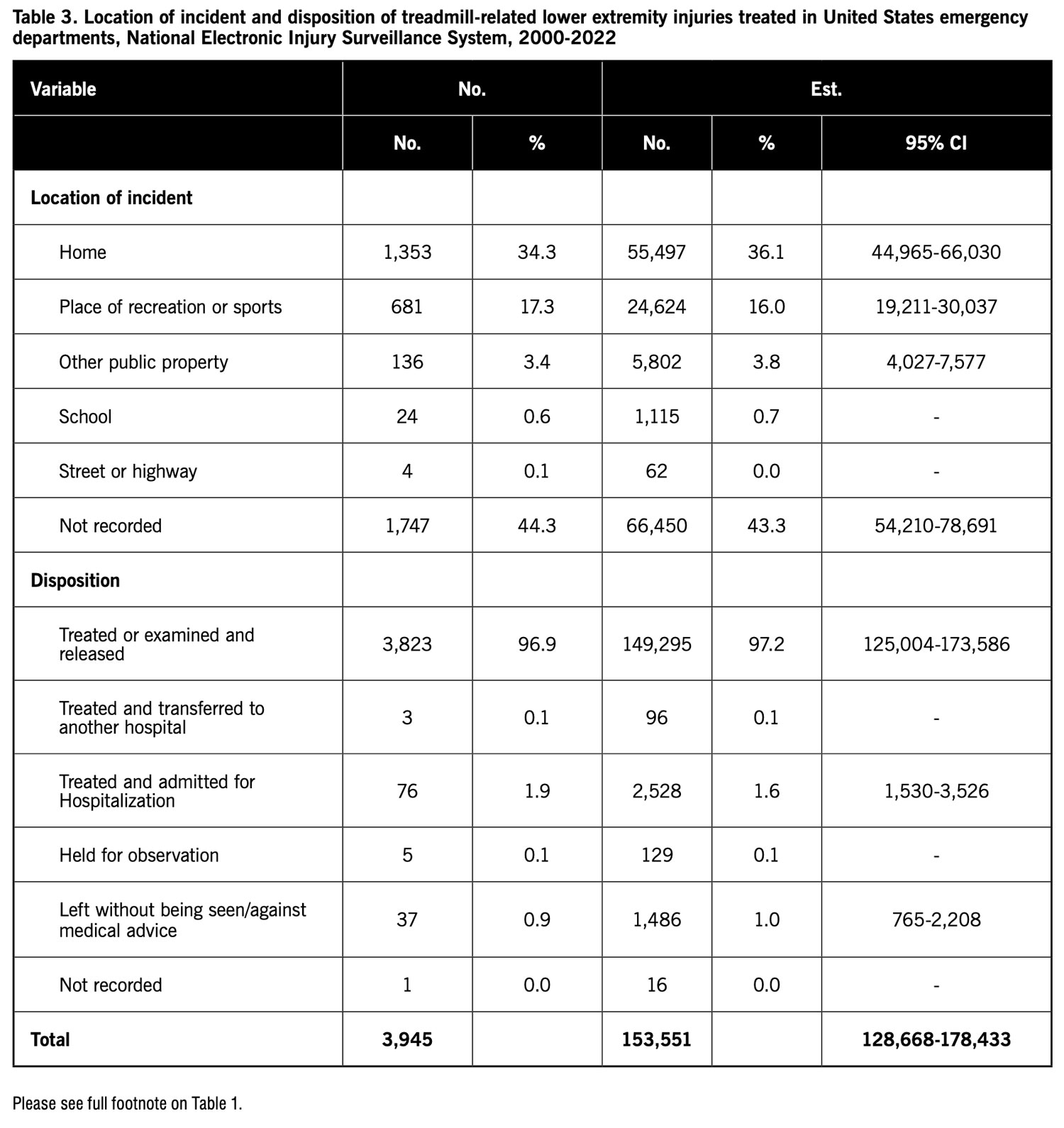
Table 3 provides the distribution of injuries by location of the incident and patient disposition. Of those injuries where the location of the incident was known, the majority occurred at home followed by a place of recreation or sports. Of the 15,003 estimated injuries among patients aged 0-12 years where the location of the incident was known, 13,343 (88.9%) occurred at home and 866 (5.8%) occurred at a place of recreation or sports. Of the 72,098 estimated injuries among patients aged 13 years and older where the location of the incident was known, 42,154 (58.5%) occurred at home and 23,759 (33.0%) occurred at a place of recreation or sports. Most of the patients were treated or evaluated at the ED and released.
Discussion
This study examined treadmill-related lower extremity injuries treated at US hospital EDs. This information is important because treadmills are the most popular piece of exercise equipment, with millions of people in the US using the devices each year. Thousands of people are treated for treadmill-related injuries in the US annually. Several prior studies have indicated that over one-third of treadmill-related injuries involve the lower extremity.7,8 The current study was consistent with this literature in that it found that 34% of total estimated treadmill-related injuries involved the lower extremity.

Thirty percent of the lower extremity injuries involved the knee with the next most frequently injured body parts being the foot and ankle. The most common types of injury were strain or sprain, contusion or abrasion, and fracture. These injuries usually are not expected to require extensive medical intervention. This is consistent with the finding that 97% of the patients with treadmill-related lower extremity injuries were treated or examined and released from the ED.
The annual number of treadmill-related lower extremity injuries increased from 2000 to 2012 then decreased to 2020 before increasing over the next 2 years. The decline in annual injuries after 2012 may reflect a decline in the use of treadmills by the US population, occurrence of treadmill-related injuries, or seeking treatment of these injuries at hospital EDs. Alternately, it may be that the people documenting injuries for NEISS became less likely to mention a treadmill in the record Narrative field.
Of note was the 43% decline in the estimated number of treadmill-related lower extremity injuries between 2019 and 2020. This was the greatest year-on-year percent change in the number of injuries during the study period, the next closest being a 42% increase between 2001 and 2002. Even though the estimated annual number of injuries increased in 2021 and 2022, it was still lower than any year since 2005. The low estimated number of treadmill-related injuries of the lower extremity during 2020-2022 is likely due to the COVID-19 pandemic. A study that examined the effect of the COVID-19 pandemic on sports-related injuries found that injuries sustained while participating in personal fitness activities decreased by 18% in 2020. This decline was attributed to recommendations that minor injuries be treated at home and the general fear of contracting COVID-19 during a hospital visit.13
 Patients aged 30-49 years accounted for the 30% of all treadmill-related injuries of the lower extremity, and most of the patients were female. People aged 30-39 years and females may be more likely to use treadmills or more likely to experience injuries that are treated at hospital EDs.
Of those treadmill-related injuries of the lower extremity with a known location of the incident, most occurred at home with the next most common location being a place of recreation or sports. However, this pattern was influenced by patient age. Of those injuries with a known location of the incident, for patients aged 0-12 years, 89% of the injuries occurred at home and 6% occurred at a place of recreation or sports while, for patients aged 13 years an older, 58% of the injuries occurred at home and 33% occurred at a place of recreation or sports. This might be expected because young children are less likely to be present or permitted to use mechanical exercise equipment at places of recreation or sports. But no matter what the patient age, the majority of injuries occurred at home. This suggests that activities to reduce or prevent treadmill-related injuries should focus on the home.
There are ways to reduce the risk of treadmill-related injuries. It has been recommended that people pay attention while using a treadmill, accelerate and decelerate slowly, and keep young children away from the treadmill.5
There are limitations to this study. Treadmill-related injury cases were initially identified by selecting those records with the letter groups “tre” and “mil” in the Narrative field. If these letter combinations were not used in instances of treadmill-related injuries, then these cases would not have been included in the study. In addition, temporal changes in treadmill-related injuries may reflect changes in the documentation of treadmills in the Narrative field over time. Furthermore, details, such as whether the injury occurred to a person actively using the treadmill or someone, such as a child, having incidental contact with the treadmill, were not examined. The study only included injuries treated at hospital EDs. Information on injuries treated elsewhere might provide a more complete perspective of treadmill-related injuries.
In conclusion, one-third of all treadmill-related injuries treated at US hospital EDs involved the lower extremity. The highest proportion of patients with lower extremity injuries were aged 30-49 years, and most patients were female. The most commonly reported injuries were strain or sprain, contusion or abrasion, and fracture, and the most frequently affected parts of the lower extremity were the knee, foot, and ankle. Most of the patients were treated or evaluated at the ED and released.
Mathias B. Forrester, BS, is an independent researcher in Austin, Texas. Now retired, he previously performed public health research for various university and government programs for 38 years.
- Thomas Publishing Company.. Top treadmill manufacturers and suppliers in the USA. Available at https://www.thomasnet.com/articles/top-suppliers/treadmill-manufacturers-suppliers/. Accessed March 3, 2024.
- Statistica. Number of users of treadmills in the United States for 2006 to 2017 (in millions). Statistica 2023. Available at https://www.statista.com/statistics/191605/users-of-treadmills-in-the-us-since-2006/#:~:text=Users%20of%20treadmills%20in%20the%20U.S.%20from%202006%20to%202017&text=In%202017%2C%20the%20number%20of,amounted%20to%20approximately%2052.97%20million. Accessed March 3, 2024.
- Schmaltz J. Treadmills are the comeback story of 2019. IHRSA.org. May 28, 2019. Available at https://www.ihrsa.org/improve-your-club/treadmills-are-the-comeback-story-of-2019/#. Accessed March 3, 2024.
- Martinez A, Snyder AJ, Smith GA. Home exercise equipment-related injuries among children in the United States. Clin Pediatr (Phila). 2011;50(6):553-558.
- Haupt A. How to keep yourself and your kids safe around your home treadmill. The Washington Post. January 4, 2022. Available at https://www.washingtonpost.com/wellness/2022/01/04/avoid-treadmill-accidents-kids-home/. Accessed March 3, 2024.
- Frankel TC. Peloton fights federal safety recall after its treadmills left one child dead, others injured. The Washington Post. April 17, 2021. Available at https://www.washingtonpost.com/business/2021/04/16/peloton-treadmill-injuries-death-cpsc/. Accessed March 3, 2024.
- Graves JM, Iyer KR, Willis MM, Ebel BE, Rivara FP, Vavilala MS. Emergency department-reported injuries associated with mechanical home exercise equipment in the USA. Inj Prev. 2014;20(4):281-285.
- Eley RM, Hatt D, Baarbe S. A retrospective observational study of presentations to an Australian emergency department for injuries sustained in exercise pursuits over 14 years. Ochsner J. 2020;20(3):261-266.
- Forrester MB. Milk crate-related lower extremity injuries treated at United States emergency departments. Lower Extremity Review. 2023;15(2):43,44,47-49,51,53.
- Forrester MB. Fireworks-related lower extremity injuries treated at United States emergency departments. Lower Extremity Review. 2023;15(5):43,44,46,47,49,51,53.
- United States Consumer Product Safety Commission. National Electronic Injury Surveillance System (NEISS). Available at https://www.cpsc.gov/Research–Statistics/NEISS-Injury-Data/Explanation-Of-NEISS-Estimates-Obtained-Through-The-CPSC-Website. Accessed March 3, 2024.
- United States Consumer Product Safety Commission. NEISS Coding Manual. January 2021. Available at https://www.cpsc.gov/s3fs-public/January-2021-NT-CPSC-only-NEISS-Coding-Manual.pdf?xa_nMM1kB4SGpuSMOwf0NHkkkIqNcn8F. Accessed March 3, 2024.
- Sabbagh RS, Shah NS, Kanhere AP, Hoge CG, Thomson CG, Grawe BM. Effect of the COVID-19 pandemic on sports-related injuries evaluated in US emergency departments. Orthop J Sports Med. 2022;10(2):23259671221075373.