








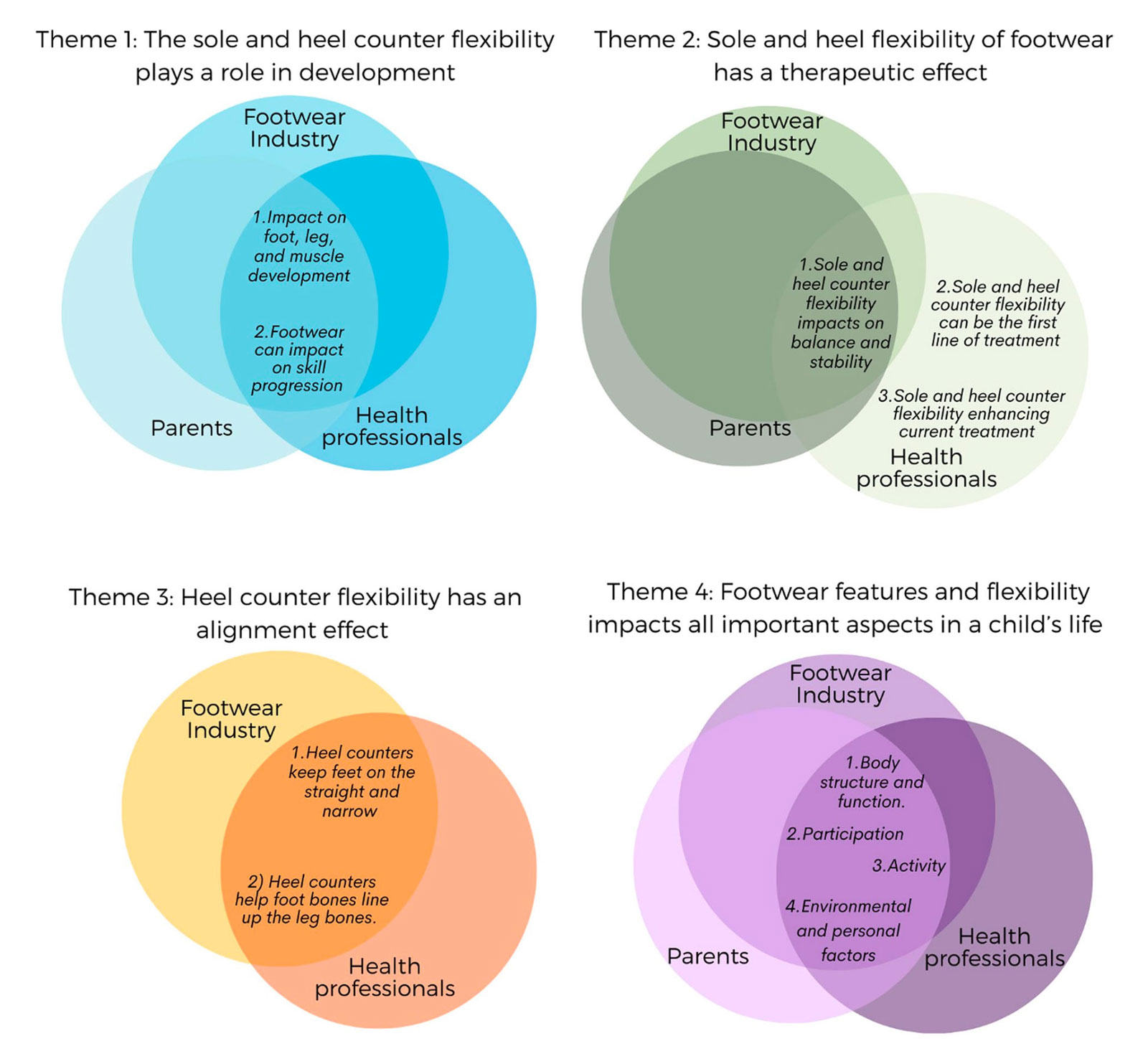
Figure. Four major themes and subordinate themes identified by stakeholder groups
By Cylie M. Williams, Helen A. Banwell, Kade L. Paterson, Katherine Gobbi, Sam Burton, Matthew Hill, Emma Harber, and Stewart C. Morrison
Purchasing footwear for children can be a concern for parents and caregivers, so clear and credible footwear information is important to help them with these decisions. This is particularly pertinent to the first 6 years, where a child’s development and foot growth and change is the greatest.
Footwear research with children under the age of 6, or young children, has focused primarily on design components such as sole flexibility. This is because there is rapid foot change thought to be associated with growth and tissue plasticity in the first 6 years and a theoretical shift to wanting feet to develop in a ‘natural’ way. Yet no evidence supports or refutes this hypothesis, nor whether influencing foot movement is positive or negative. Notably, recommendations for desirable footwear characteristics are not static across childhood as foot demands change. This means recommendations should be tailored and specific. A small but building pool of evidence of the impact of footwear on children’s function means understanding the different beliefs of stakeholders about footwear key features and flexibility is critical for translation into recommendations and to support parents and caregivers in purchasing footwear for their children.
Therefore, the primary aim of this study was to describe how different stakeholders (parents, health professionals and footwear industry representatives) viewed the importance of flexibility of key footwear components. The secondary aim was to understand what other footwear features stakeholders viewed as important for young children.
Methods
This qualitative study was nested within an international modified Delphi online survey. There were 159 participants who consented to complete the first round. Participants responded to open-ended questions about footwear component flexibility and asked if and why flexibility in these areas were important. Participants also described any other important footwear features. Inductive thematic analysis was used to generate themes.
Results
There were 121 responses from 3 stakeholder groups including health professionals (n = 90), parents of young children (n = 26), and footwear industry representatives (n = 5). Overarching themes described by participants included developmental impacts of footwear, therapeutic impact, and how footwear may play a role in function.
Discussion
This study explored the perceptions of flexibility of footwear components and other features determined important by parents, health professionals, and footwear industry representatives. In doing so, the study authors identified differences relevant to stakeholder experience, while determining 4 main themes related to the impact footwear flexibility has on development, desired therapeutic effects, foot and/or leg alignment, and the child’s life (including function and participation, activity, and personal choice effects). These are illustrated in a map of themes, subordinate themes, and the stakeholder groups these themes aligned to (Figure).
Theme 1: Sole and heel counter flexibility plays a role in development
Participants described their beliefs of footwear sole and heel counter flexibility as being strongly linked with various aspects of the child’s development. There were 2 subordinate themes: 1) Impact on foot, leg, and muscle development and 2) Footwear can impact on skill progression.
Theme 2: Sole and heel flexibility of footwear has a therapeutic effect
There were 3 subordinate themes arising from participants relating to the perceived therapeutic effect of footwear features including 1) Sole and heel counter flexibility impacts on balance and stability, 2) Sole and heel counter flexibility can be the first line of treatment, and 3) Sole and heel counter flexibility enhancing current treatment.
Theme 3: Heel counter flexibility has an alignment effect
Health professionals and footwear industry stakeholders—but not parents—described beliefs relating to the heel counter flexibility (or firmness) having an alignment effect. There were 2 subordinate themes, primarily relating to the flexibility of the heel counter in having a proximal, local, or distal impact: 1) Heel counters keep feet straight and 2) Heel counters help foot bones line up the leg bones.
Theme 4: Footwear features and flexibility impacts all important aspects in a child’s life
All participants provided other comments on footwear features relating broadly to footwears’ impact on children’s lives. These comments instinctively aligned with the domains of the International Classification of Functioning, Disability and Health. These being a) Body structure and functions, b) Participation, c) Activity, and d) Environmental and personal factors.
As the first exploration of perceptions around footwear flexibility, participant groups frequently identified common outcomes associated with increased and decreased sole and heel counter stiffness. All stakeholders also expressed the belief that sole firmness needs to meet the developmental requirements of the child, which was noted to change over time and circumstance. It has, however, also highlighted some inconsistencies in perceptions of what footwear flexibility can, or does, impact upon.
Conclusion
There were key differences in how stakeholders viewed footwear and any perceived benefits of footwear components, much of which was not backed with empirical evidence. It was also identified that health professionals are using footwear within treatment recommendations. This work highlights the importance of understanding circumstances in which footwear may have a therapeutic impact or be the first line of treatment for children with complex foot needs. This information is key to developing contemporary footwear recommendations for parents and caregivers.
This article has been excerpted from “Parents, Health Professionals and Footwear Stakeholders’ Beliefs on the Importance of Different Features of Young Children’s Footwear: A Qualitative Study,” from the same authors, which was published in Journal of Foot & Ankle Research. 2022;15:73. https://doi.org/10.1186/s13047-022-00580-1s. Editing has occurred, including the renumbering or removal of tables and figures, and references have been removed for brevity. Use is per CC Attribution 4.0 International License.