







Researchers have developed a decision tree algorithm that they propose can be used to accurately and easily prescribe customized foot orthoses to patients with pes planus.
 By Ji-Yong Jung, Chang-Min Yang, Jung-Ja Kim
Pes planus, one of the most common foot deformities, includes the loss of the medial arch, misalignment of the rearfoot, and abduction of the forefoot, which negatively affects posture and gait. Foot orthosis, which is effective in normalizing the arch and providing stability during walking, is prescribed for the purpose of treatment and correction. Currently, machine learning technology for classifying and diagnosing foot types is being developed, but it has not yet been applied to the prescription of foot orthosis for the treatment and management of pes planus.
The aim of this study is to propose a model that can prescribe a customized foot orthosis to patients with pes planus by learning from and analyzing various clinical data based on a decision tree algorithm called classification and regressing tree (CART).
Methods
CART is a representative algorithm for generating decision trees. This study used clinical data from 1,548 patients diagnosed with pes planus at the Department of Rehabilitation Medicine of Chungnam National University Hospital in Daejeon, Republic of Korea. Pes planus was diagnosed based on the results measured by a professional clinician with a goniometer (universal goniometer and gravity goniometer) and an inclinometer.
Twenty independent variables related to the diagnosis of pes planus in patients were considered. All variables were preprocessed through importance analysis. Through data preprocessing, the study was conducted with a total of 418 data. Then, the following 9 variables affecting the prescription of foot orthosis were selected out of the original 20: age, hip internal rotation (HIR), transmalleolar angle on the left side (TMA-L), inversion angle of the subtalar joint on the left side (IASTJ-L), eversion angle of the subtalar joint on the left side (EASTJ-L), eversion angle of the subtalar joint on the right side (EASTJ-R), forefoot to rearfoot angle on the right side (FFRF-R), resting calcaneal stand position angle on the left side (RCSPA-L), RCSP angle on the right side (RCSPA-R).
Two types of foot orthoses—gait plate (GP) and arch support orthosis with heel cups ASOHC—were used as a dependent variable in this study. A GP is a special type of orthosis that is prescribed to limit in-toeing gait due to increased internal hip rotation and femoral anteversion with pes planus. ASOHC, designed to support the medial longitudinal arch and heel, is recommended to reduce rearfoot pronation, the collapse of the longitudinal arch, and foot instability. Two types of foot orthoses were customized for each patient’s foot. Plaster casting was used to capture the shape of the patient’s foot. Then, based on patient-specific measurements, a GP or ASOHC prescribed by an expert clinician was manufactured.
Results
The CART decision tree method used in this study is among the most effective and practical algorithms for classification and prediction. This method can be applied to foot orthosis prescription due to its ease of classification by making easy-to-understand rules in an if-then format. Hence, the visualized tree-based model can be effectively utilized for decision making by physicians about prescribing foot orthoses.
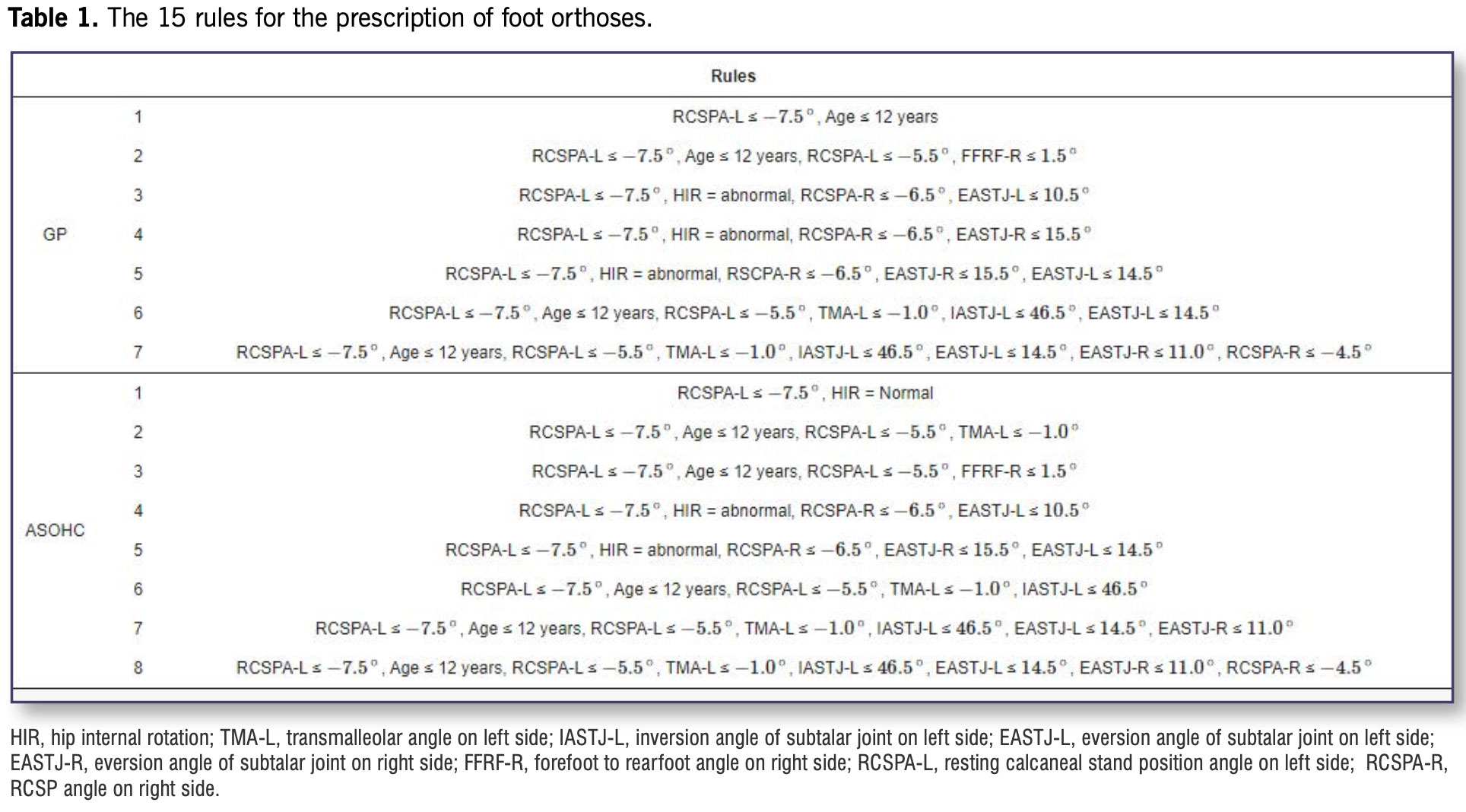
The 15 rules—7 for GP and 8 for ASOHC—for prescribing the 2 types of foot orthoses are shown in Table 1.
The accuracy of the foot orthosis prescription for patients with pes planus, based on the CART algorithm used, is 80.16%. The results of GP prescription showed 89.66% precision, 73.24% sensitivity, and 80.62% f1 score. In the results of ASOHC prescription, the precision, sensitivity, and f1 score were 72.06%, 89.09%, and 79.67%, respectively.
Discussion
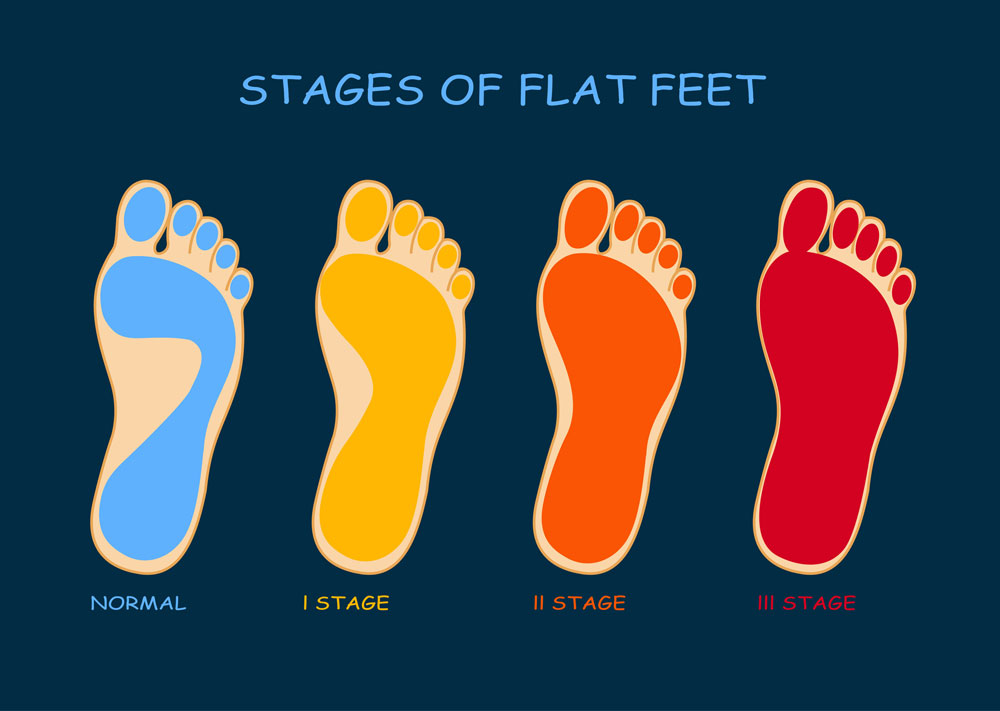
 Pes planus, commonly known as flat foot, is a structural deformity defined as a condition accompanied by a decrease in the medial longitudinal arch height, rearfoot valgus, and lateral deviation of the forefoot. In previous studies, it has been reported that pes planus is often associated with rotational abnormalities of the lower extremities and increased internal rotation of the hip. It is estimated that the prevalence of pes planus is approximately 20% to 37% of the population. This deformation negatively affects the shock absorption from the ground, resulting in foot fatigue, pain, abnormal gait, and postural imbalances. Foot orthosis is most frequently cited as a conservative (non-surgical) intervention for the treatment and management of pes planus. A customized foot orthosis has been prescribed based on the diagnosis results of clinicians to control rearfoot alignment, correct posture, provide comfort, and reduce abnormal movement.
In this study, the authors confirmed the classification accuracy of the CART model for foot orthosis prescription using evaluation metrics. The CART model that was developed prescribes 2 types of foot orthoses in consideration of the various biomechanical characteristics of patients with pes planus: GP and ASOHC. Based on the evaluation results on feature importance, it was confirmed that RCSPA, EASTJ, HIR, TMA, FFRF, and IASTJ were important parameters in prescribing foot orthosis. Age has also been found to be an important factor in prescribing foot orthosis. This result is consistent with previous studies suggesting that excessive joint mobility affecting arch height reduction, rearfoot valgus, and forefoot abduction can manifest differently with age.
Conclusions
Although detailed factors for a patient may affect the accuracy of prescription, the CART model for prescribing a foot orthosis in consideration of the importance and measurement value for biomechanical variables can be utilized to assist expert clinicians. The CART algorithm-based method that was presented in this study resulted in the generation of 15 rules based on the importance of the 9 variables related to foot orthosis prescription identified.
This article has been excerpted from “Decision Tree-Based Foot Orthosis Prescription for Patients with Pes Planus,” which was published in the International Journal of Environmental Research and Public Health. 2022;19(19):12484. doi: 10.3390/ijerph191912484. Editing has occurred, including the renumbering of tables, and references have been removed for brevity. Use is per CC BY.