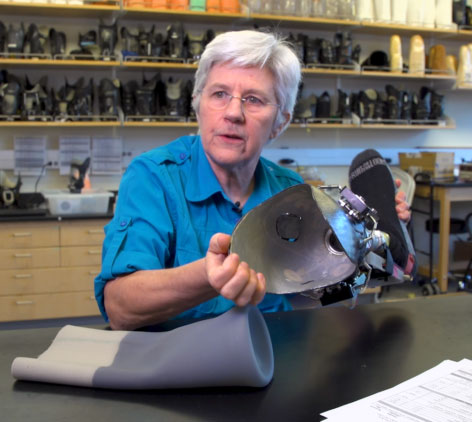
Sanders holds a prototype of the auto-adjusting prosthesis that her team developed. Image courtesy of Kiyomi Taguchi/UW.
University of Washington (UW) Professor Joan Sanders, PhD, and her team are creating a new type of prosthetic leg: one that automatically adjusts its fit throughout the day. Her group, housed within the Department of Bioengineering, designs, builds and tests prostheses for people with transtibial amputations. Their latest prototype alters its fit without the need for adjustments to padding or user action. It detects in real time how well the prosthetic socket and residual limb are fitting and responds by automatically changing the size of the socket. Test results with volunteers are so promising that the researchers hope to eliminate the need to add or remove padding throughout the day.
The prototype resembles a typical transtibial prosthetic limb, but it contains several key features to make auto adjustment possible:
A gel interface material—shaped like a sock that users typically wear over their residual limb—that contains a small amount of iron.
Three ultrathin sensors embedded within the wall of the socket detect the distance to the iron in the gel and send that data to the socket’s microcontroller.
The microcontroller calculates whether adjustments are needed. If so, it transmits instructions to 3 motorized “panels” within the socket wall—2 in the front, 1 in the back. The panels can move in to make the socket smaller, or out to make it bigger.
The adjustments that the panels make, which can also be controlled manually via an app on the user’s smartphone, are usually tiny—less than a millimeter.
Through user trials with volunteers, Sanders’ team is collecting more detailed data on the device’s performance and is working to make the prototype’s motors smaller and lighter.